WhatsApp: +86 18126157548 Email: kerry@alpinemold.com

Views: 0 Author: Site Editor Publish Time: 2026-08-10 Origin: Site


| 1. What Is the Melting Point of PVC? |
| 2. How PVC Melting Point Affects Injection Molding |
| 3. PVC Injection Molding Temperature and Process Settings |
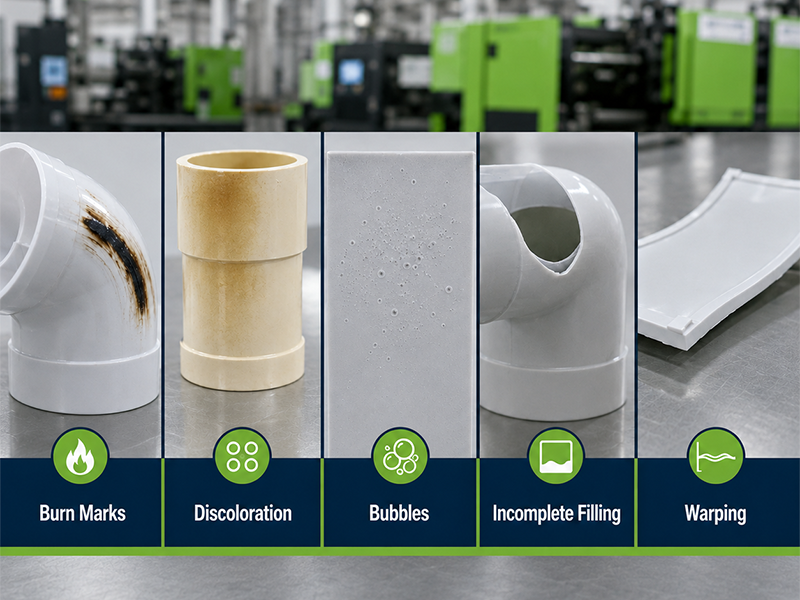
| 4. Common Temperature-Related PVC Molding Defects |
| 5. How to Optimize PVC Injection Molding |
| 6. Conclusion |
| FAQ |
When you injection mold PVC, even a small temperature change can affect material flow, surface appearance, dimensional stability, and production efficiency. Understanding the PVC melting point, PVC injection molding temperature, and safe processing window helps you avoid incomplete filling and thermal degradation. This guide explains how temperature affects PVC molding and how you can establish a more stable injection molding process.
PVC does not have one precise melting point like many crystalline plastics. Instead, it gradually softens and becomes flowable within a processing range. The PVC softening temperature is the point at which the material begins to lose rigidity, while the PVC melting temperature refers to the range where it can flow during injection molding. The PVC degradation temperature is the level at which excessive heat begins to break down the material, potentially causing discoloration, burning, gas formation, and corrosion. Because the melting and degradation ranges are relatively close, controlling the PVC injection molding temperature is especially important.
The correct PVC processing temperature depends on the formulation. Rigid PVC contains little or no plasticizer, so it normally has higher melt viscosity and requires careful control of pressure, shear, and residence time. Flexible PVC contains plasticizers that improve softness and flow, allowing it to be processed under different conditions. Heat stabilizers, fillers, pigments, lubricants, and impact modifiers also affect material flow and thermal stability. Therefore, different PVC grades cannot use exactly the same molding temperature, and the final settings should always follow the resin supplier’s data and actual mold-trial results.
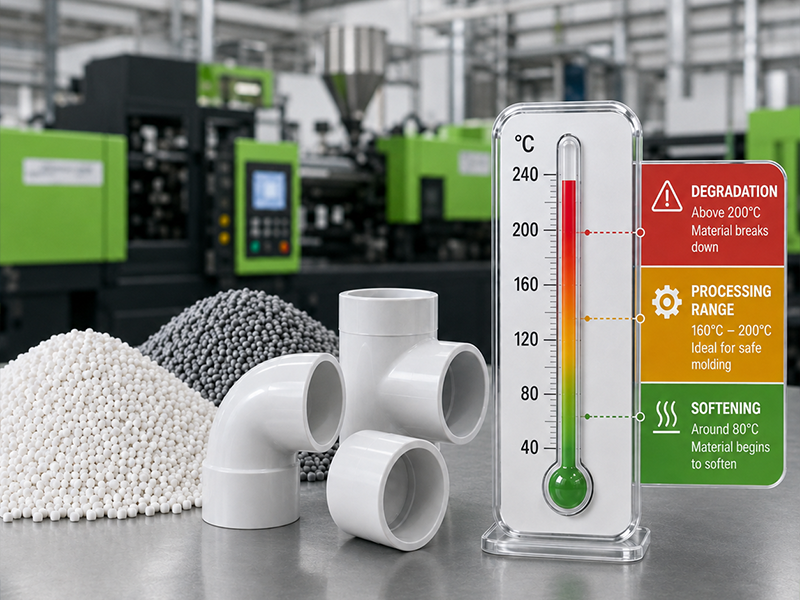
Accurate temperature control helps PVC reach a suitable processing condition before it enters the mold. When the PVC injection molding temperature is too low, the material remains highly viscous and may not fill thin walls, ribs, threads, or long flow paths. You may need excessive injection pressure, yet still produce incomplete parts.
If the temperature is too high, PVC may begin to degrade. This can reduce mechanical performance and cause discoloration, gas, odor, or corrosion. You therefore need to keep the melt inside a stable processing range instead of simply using the highest possible temperature to improve flow.
As the PVC melt temperature increases, melt viscosity generally decreases, making the material easier to inject. This can help you reduce filling pressure and reproduce small details or textured surfaces more accurately.
However, raising the barrel temperature is not always the correct solution to poor flow. A narrow runner, undersized gate, excessive flow length, or abrupt wall-thickness transition can still restrict the material. If you compensate with very high injection speed or pressure, the extra shear heat may locally overheat the PVC.
You should therefore balance temperature, injection speed, pressure, runner design, and gate size rather than adjusting these parameters separately.
The PVC processing temperature also affects the overall molding cycle. If the material is too cold, it may require higher pressure and a longer filling stage. Early solidification can also prevent effective packing, leading to unstable dimensions or incomplete parts.
When the melt is excessively hot, more heat must be removed before the part can be ejected. This may extend cooling time and reduce production efficiency. A stable temperature window allows the cavity to fill smoothly without adding unnecessary heat to the mold, helping you maintain a consistent cycle time.
PVC must flow evenly across the cavity surface to reproduce textures, logos, edges, and other details. When the melt temperature is too low or unstable, you may see flow lines, poor gloss, visible weld lines, dull surfaces, or incomplete texture replication.
Excessive heat can create a different set of problems, including yellowing, brown or black marks, bubbles, and surface streaks. Proper PVC molding temperature control helps you achieve consistent color, smoother surfaces, and more uniform part quality from one cycle to the next.
The temperature at which PVC enters the mold affects how it cools and solidifies. If the melt is too hot, the part may cool unevenly, especially when the wall thickness or cooling-channel layout is unbalanced. This can increase shrinkage differences and lead to warpage or dimensional variation.
If the melt is too cold, the cavity surface may freeze before packing is complete. You may then see internal stress, poor dimensional accuracy, or weak areas around weld lines.
To maintain stable dimensions, you need to balance the PVC melt temperature with mold temperature, holding pressure, cooling time, gate location, and product wall thickness.
PVC is more sensitive to prolonged heat than many common injection-molding plastics. Even when the barrel setting appears acceptable, the material can overheat because of high screw speed, excessive back pressure, restricted gates, or long residence time.
Once degradation begins, the PVC may produce discoloration, gas, burnt material, or corrosive by-products. You should therefore avoid unnecessary production stops with PVC remaining inside the barrel and closely monitor changes in color, smell, pressure, and surface quality.
Cause:
When PVC is overheated or cooled unevenly, different areas of the part may shrink at different rates. This can lead to warpage, twisting, or dimensions outside tolerance. Uneven wall thickness and an unbalanced cooling system can increase the problem.
How to correct it:
You should stabilize the melt and mold temperatures, review the cooling-channel layout, and optimize holding pressure and cooling time. Product structure should also be checked for sudden changes in wall thickness.
Cause:
When the melt temperature is too high, PVC viscosity may fall and the material may flow into small gaps along the parting line, inserts, or shut-off surfaces. Excessive pressure or poor mold fitting can make flash more severe.
How to correct it:
You should confirm whether the temperature and injection pressure are higher than necessary, then inspect the mold parting line, shut-offs, clamping force, and insert positioning.
Cause:
If the PVC melt is too cold when two flow fronts meet, they may not fuse properly. This can leave a visible line and reduce strength around holes, inserts, or multiple-gate filling areas.
How to correct it:
You can improve the melt and mold temperatures within the material’s safe processing range, adjust the injection-speed profile, and review the gate location. Better venting near the weld-line area may also help the flow fronts join more effectively.The correct PVC processing temperature should allow the material to fill and pack the cavity without overheating. To achieve stable production, you need to consider the material grade, actual melt temperature, residence time, injection speed, pressure, mold venting, cooling system, and part structure together.
There is no single PVC injection molding temperature that works for every product. Before setting the machine, you should confirm whether the material is rigid or flexible, check its hardness and formulation, and review the supplier’s processing data. The values below are useful starting references, but the final settings must be adjusted according to part thickness, flow length, gate size, mold structure, and actual molding results.
PVC Type | Typical Barrel Temperature | Actual Melt Temperature | Mold Temperature |
Rigid PVC | 285–360°F / 141–182°C | 380–395°F / 193–202°C | 80–130°F / 27–54°C |
Flexible PVC, Shore A 50–60 | 255–310°F / 124–154°C | 325–335°F / 163–168°C | 50–110°F / 10–43°C |
Flexible PVC, Shore A 60–70 | 265–315°F / 129–157°C | 335–345°F / 168–174°C | 50–110°F / 10–43°C |
Flexible PVC, Shore A 70–80 | 280–320°F / 138–160°C | 345–355°F / 174–179°C | 50–110°F / 10–43°C |
Flexible PVC, Shore A 80–90 | 300–350°F / 149–177°C | 355–365°F / 179–185°C | 50–110°F / 10–43°C |
To optimize PVC injection molding, you should focus on three areas: selecting the correct temperature range, controlling shear and residence time, and improving mold venting and cooling. These factors work together to reduce degradation, stabilize filling, and improve the quality of PVC molded parts.
You should first confirm the exact PVC grade, hardness, and material supplier’s processing data. Rigid PVC and flexible PVC cannot use the same PVC injection molding temperature, because their plasticizer content, melt viscosity, and thermal stability are different.
Start from the middle or lower section of the recommended temperature range, then adjust it gradually according to filling pressure, part color, surface finish, and actual melt temperature. Avoid increasing the barrel temperature too quickly. A higher temperature may improve flow temporarily, but it can also cause yellowing, gas generation, burning, or PVC degradation.
The actual PVC melt temperature is affected not only by barrel heaters but also by screw speed, back pressure, injection speed, runner size, and gate restriction. Excessive shear can overheat the PVC even when the machine temperature setting appears normal.
You should keep screw speed and back pressure only as high as necessary for stable plasticization. PVC should also remain inside the heated barrel for as little time as possible. A machine with an excessively large shot capacity or a long production stop can increase residence time and raise the risk of material degradation.
Good mold design helps PVC fill the cavity with lower pressure and less shear. You should provide effective venting near the end of the flow path, weld lines, ribs, and other areas where air may become trapped. Poor venting may cause short shots, burn marks, and unstable surface quality.
Balanced cooling is also important. If the mold temperature is too low, the PVC may freeze before filling is complete. If cooling is uneven, the part may warp or show dimensional variation. Uniform cooling channels, suitable gate design, and stable mold temperature help you establish a reliable PVC injection molding process window.
Successful PVC injection molding depends on more than choosing a suitable temperature. Material grade, melt temperature, shear heat, residence time, mold venting, gate design, and cooling must work together to achieve stable filling, consistent dimensions, and reliable surface quality.
Since 2002, Alpine Mold has provided integrated services from DFM analysis and injection mold manufacturing to mold trials and mass production. Key processes, including CNC machining, EDM, mold fitting, assembly, testing, and quality inspection, are completed in-house, helping us maintain better control over mold accuracy, lead time, and production stability.
Send us your STEP, IGS, or X-T files, together with the PVC grade, surface requirements, and estimated production volume, for project evaluation and quotation.
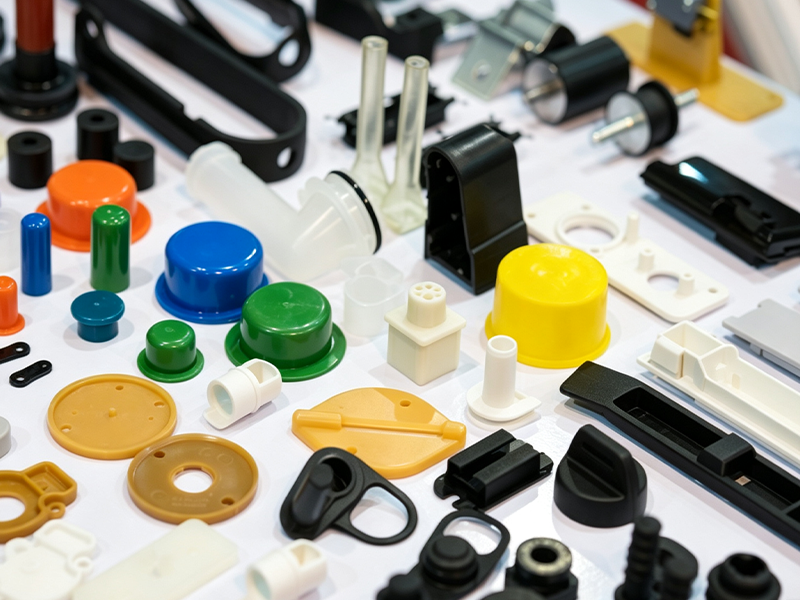
Yes. Both rigid and flexible PVC can be injection molded into products such as fittings, electrical components, handles, seals, housings, and medical parts. However, you need to select an injection molding grade because not every PVC compound is formulated for this process.
PVC generally absorbs less moisture than hygroscopic plastics such as nylon or polycarbonate. However, drying may still be necessary when the material has been stored in a humid environment, contains moisture-sensitive additives, or shows surface streaks during molding. You should follow the drying instructions provided by the PVC supplier and avoid excessive drying temperatures.
Recycled PVC can be injection molded when its source, formulation, contamination level, and previous thermal history are properly controlled. However, repeated processing may affect color, flow behavior, mechanical performance, and thermal stability. Before mass production, you should test the recycled-material ratio and confirm that the finished parts still meet their functional requirements.
Hot runner systems can be used for some PVC projects, but they require careful design because PVC is sensitive to prolonged heating. Long flow channels, dead corners, and uneven heater control can increase the risk of material degradation. For many PVC parts, a well-designed cold runner system may offer simpler temperature control and easier maintenance.
PVC can be used in some overmolding applications, but adhesion depends on the substrate material, PVC formulation, surface condition, and product design. Chemical bonding is not guaranteed between every material combination, so mechanical interlocks, holes, grooves, and undercuts may be needed to improve attachment. Material compatibility should be verified through testing before mold production.


