WhatsApp: +86 18126157548 Email: kerry@alpinemold.com

Views: 0 Author: 陈 Publish Time: 2026-06-09 Origin: Site


Warpage in injection molding is a common defect that affects part appearance, dimensional accuracy, and assembly performance. It is often caused by uneven cooling, improper part design, material shrinkage, or poor process control. This article explains the main causes of injection molding warpage and how to prevent it effectively.
What is warpage in injection molding? It refers to the unwanted bending, twisting, or deformation of a plastic part after it is molded and cooled. A part may look normal when it leaves the mold, but later shows uneven surfaces, lifted edges, or poor assembly fit due to internal stress or uneven shrinkage.
Warpage in injection molding is not only an appearance problem. It can affect dimensional accuracy, product function, and final assembly performance. For parts such as electronic housings, automotive components, medical device shells, or precision plastic fittings, even a small deformation may lead to quality rejection.
The warpage defect in injection molding usually happens when different areas of the part shrink at different rates. This means the causes of warpage in injection molding are often related to part design, material selection, mold cooling, gate location, and processing conditions. To solve this problem effectively, it is important to understand where the deformation comes from before adjusting the mold or molding parameters.
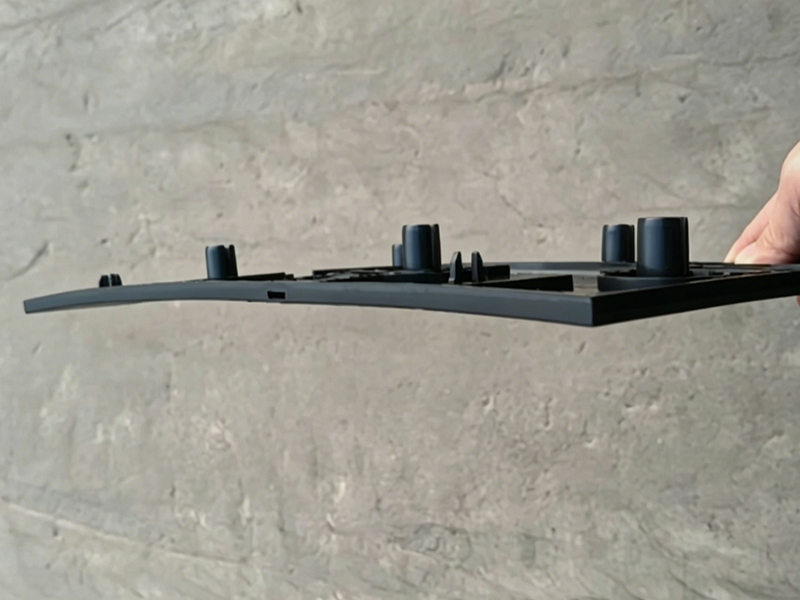
The root cause of warpage in injection molding is usually uneven shrinkage. During cooling, plastic parts naturally shrink. If one area of the part shrinks more than another area, internal stress will be created. After the part is ejected from the mold, this stress may be released and cause bending, twisting, or deformation.
This is why the warpage defect in injection molding is often found in large flat parts, thin-wall housings, long strip-shaped parts, and products with uneven wall thickness. The part may look acceptable during mold opening, but deformation can become more obvious after cooling at room temperature.
Most shrinkage happens while the part is cooling inside the mold, and a small amount of shrinkage may continue after ejection as the part temperature and moisture condition become stable. Therefore, controlling shrinkage balance is the first step in reducing warpage in injection molding.
Part design is one of the most common causes of warpage in injection molding. If the wall thickness is not uniform, thick areas cool more slowly while thin areas cool faster. This difference creates uneven shrinkage and makes the part easier to warp.
For most injection molded parts, keeping wall thickness uniform is more important than simply making the part thicker. A very thick area may look stronger, but it can cause longer cooling time, sink marks, internal stress, and warpage. For example, many common plastic parts are designed with wall thickness around 1.5–3.0 mm, depending on material and product function. Sudden changes from thin to thick sections should be avoided, or they should be connected with smooth transitions.
Large flat surfaces also need special attention. Without proper ribs, curves, or structural support, flat areas can easily bend after cooling. However, ribs should not be too thick. In many designs, rib thickness is usually controlled at about 40%–60% of the main wall thickness to reduce sink marks and shrinkage imbalance.
Mold design directly affects whether the plastic part can cool and shrink evenly. Poor cooling layout is a major reason for warpage in injection molding. If one side of the part is close to cooling channels while another side has poor cooling, the temperature difference can create uneven shrinkage.
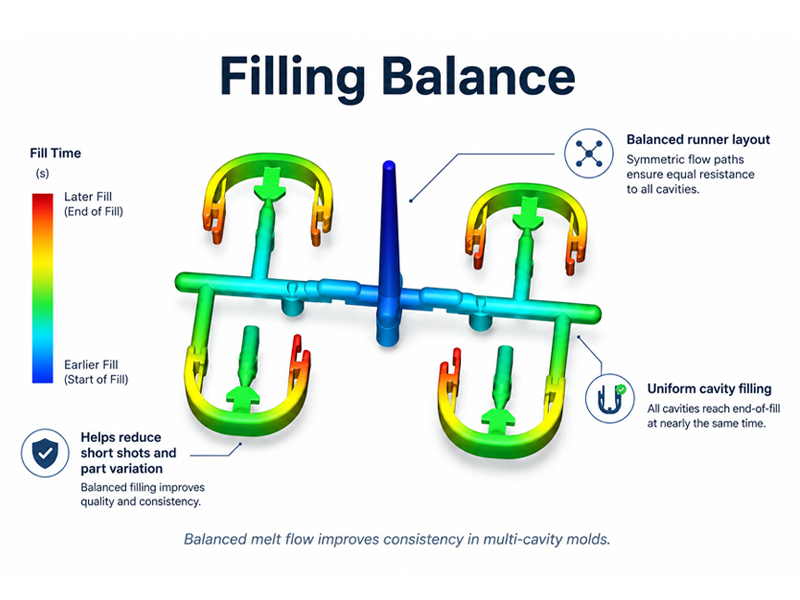
Gate location is also important. If the gate is placed in an unsuitable position, the melt flow may be unbalanced, causing different pressure and shrinkage in different areas. For long or large parts, unbalanced filling can easily lead to twisting or edge lifting.
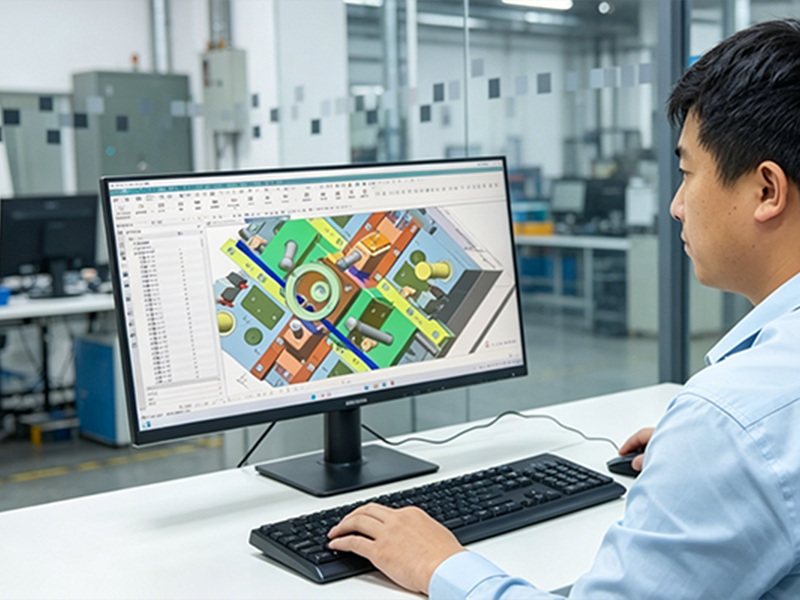
A good mold design should consider cooling balance, gate position, runner layout, venting, and ejection stability at the same time. In some complex products, Moldflow analysis can help predict filling balance, cooling differences, shrinkage tendency, and possible warpage risks before mold manufacturing begins.
Even if the part design and mold design are reasonable, poor process settings can still cause a warpage defect in injection molding. Melt temperature, mold temperature, holding pressure, holding time, cooling time, and injection speed all affect shrinkage and internal stress.
For example, if the cooling time is too short, the part may be ejected before it is fully solidified. At this moment, the part is still soft and can easily deform under ejection force or its own internal stress. If the holding pressure is too low, the part may shrink too much. If the holding pressure is too high or too long, it may create excessive internal stress in some areas.
Mold temperature control is also critical. A large temperature difference between the cavity side and core side can make one surface shrink differently from the other. This is why stable mold temperature and enough cooling time are important for reducing injection molding warpage during mass production.
Material selection also plays an important role in warpage in injection molding. Different plastics have different shrinkage rates. In general, amorphous materials such as ABS and PC usually have lower and more stable shrinkage, while semi-crystalline materials such as PP, PA, POM, and PBT often have higher shrinkage and are more sensitive to cooling conditions.
For example, PC/ABS may have a typical shrinkage range of about 0.3%–0.7%, while PA6 can reach about 1.0%–2.2% depending on flow direction and material grade. POM can be around 2.0%–2.2%, which means dimensional control and warpage prevention become more challenging for high-shrinkage materials.
Glass-filled materials need special attention. Adding glass fiber can reduce overall shrinkage, but it may also create different shrinkage in the flow direction and transverse direction. For example, PA6 with 30% glass fiber may shrink about 0.3% in the flow direction and about 1.0% in the transverse direction. This directional shrinkage can cause bending or twisting if the gate location and flow direction are not well controlled.
Preventing warpage in injection molding should start before mold manufacturing. Once the mold is finished, correcting warpage often becomes more difficult and more expensive. The best approach is to control deformation risks during the early design stage, especially from product structure and mold design. A well-balanced design can reduce uneven shrinkage, internal stress, and dimensional instability during mass production.
Area | Key Point | How It Helps Prevent Warpage |
Wall thickness | Keep thickness uniform | Reduces uneven cooling and shrinkage |
Ribs | Use proper rib thickness | Improves stiffness without causing sink marks |
Corners and transitions | Add radii and smooth transitions | Reduces stress concentration |
Cooling system | Balance cavity and core temperature | Prevents one side from shrinking faster |
Gate location | Ensure balanced filling | Reduces uneven pressure and shrinkage |
Ejection system | Use stable and even ejection | Avoids deformation during demolding |
Good part design is the first step to prevent warpage in injection molding. The most important rule is to keep wall thickness as uniform as possible. When one area is much thicker than another, the thick section cools more slowly and shrinks differently, which can easily lead to deformation. For many plastic parts, a wall thickness range of about 1.5–3.0 mm is commonly used, depending on the material, function, and strength requirements.
Large flat surfaces should also be designed carefully. Completely flat and wide areas are more likely to bend after cooling. Adding proper ribs, curves, or reinforcing structures can improve stiffness and reduce warpage. However, ribs should not be too thick. In many cases, rib thickness is usually designed at about 40%–60% of the main wall thickness to reduce sink marks and shrinkage imbalance.
Sharp corners and sudden thickness changes should be avoided. Smooth transitions, proper radii, and reasonable draft angles can help the melt flow more evenly and reduce stress concentration. For parts with high dimensional requirements, it is better to review the structure through DFM analysis before mold making. This helps identify possible warpage risks early and avoid costly mold modifications later.
Mold design also plays a key role in preventing warpage in injection molding. Even if the part design is reasonable, poor mold cooling or unbalanced filling can still cause deformation. The cooling system should be designed to keep the cavity and core temperatures as balanced as possible. If one side of the part cools faster than the other, uneven shrinkage may occur and cause bending or twisting.
Gate location is another important factor. A poor gate position may cause unbalanced flow, uneven pressure distribution, and different shrinkage in different areas of the part. For long parts, large parts, or complex structural parts, the gate should be placed where the melt can fill the cavity smoothly and maintain better pressure balance.
Ejection design should also be considered. If the part is pushed out unevenly or ejected before it is fully cooled, deformation may happen during demolding. Proper ejector pin layout, sufficient ejection area, and stable demolding action can help protect the part shape.
For complex products, Moldflow analysis is highly recommended before mold manufacturing. It can help predict filling balance, cooling efficiency, shrinkage tendency, and possible warpage areas. By optimizing the mold design before cutting steel, manufacturers can reduce trial times, lower modification costs, and improve production stability.
When a warpage defect in injection molding appears during trial or mass production, the first step is to identify the deformation pattern before changing process parameters. Warpage may come from cooling imbalance, uneven packing, internal stress, ejection force, or material shrinkage. Therefore, each adjustment should be tested step by step instead of changing temperature, pressure, and cooling time at the same time.
Before fixing warpage in injection molding, engineers should first check where and how the part deforms. For example, if a flat cover bends toward one side, it may indicate that the opposite side cools more slowly and shrinks more. If only one corner lifts up, the problem may be related to uneven filling, poor packing pressure, or local cooling difference.
This step helps the team understand the real causes of warpage in injection molding instead of treating all deformation problems the same way. A clear deformation record, such as photos, dimension reports, and cooling condition checks, can make later adjustments more accurate.
Cooling is one of the most important factors when fixing warpage in injection molding during production. If the part is ejected too early, it may still be soft and unstable. After ejection, internal stress continues to release, causing bending or twisting.
In many injection molding cycles, cooling time can account for more than 50% of the total cycle time. For large flat parts, thick-wall areas, or high-shrinkage materials, increasing cooling time by a few seconds may improve dimensional stability. However, cooling time should not be extended blindly, because it directly affects production efficiency.
Mold temperature balance is also critical. If the cavity side and core side have a large temperature difference, one side of the part may shrink faster than the other. For example, when one side of a plastic housing is about 10–15°C hotter than the opposite side, visible bending may occur after cooling. In this case, checking cooling water flow, blocked cooling channels, and actual mold surface temperature is more useful than only adjusting holding pressure.
Holding pressure is used to compensate for plastic shrinkage after filling. If the holding pressure is too low, the part may shrink too much in some areas. If the holding pressure is too high or held for too long, excessive internal stress may remain inside the part, which can also lead to a warpage defect in injection molding.
A practical method is to adjust holding pressure gradually, such as 5%–10% each time, and compare part weight, dimensions, and deformation. If the part weight no longer increases after a certain holding time, longer holding time may not improve the result and may only add stress.
Injection speed and filling balance also matter. For long parts, frames, covers, and parts with ribs, unbalanced filling can cause uneven pressure distribution and different shrinkage rates. For glass-filled materials, flow direction is especially important because fiber orientation can create different shrinkage in different directions, increasing the risk of warpage in injection molding.
Sometimes the part is not seriously warped inside the mold, but becomes deformed during ejection. This often happens when ejector pins are not balanced, demolding resistance is too high, or the part is ejected before it has enough strength.
To reduce this problem, engineers should check ejector pin layout, draft angle, core sticking, and local demolding resistance. For parts with deep ribs, bosses, or textured surfaces, ejection force may be higher than expected. If the force is concentrated in one area, the part can bend or deform during demolding.
For some large or slightly deformed parts, a cooling fixture can be used after ejection to help control the final shape. For example, a long plastic frame can be placed into a shaping fixture immediately after demolding until the temperature becomes stable. However, fixtures should only be a supporting solution. If the product depends heavily on fixtures, the root cause may still come from part design, mold cooling, or gate layout.
In short, fixing warpage in injection molding during production requires a systematic method. Start from the deformation direction, then check cooling, mold temperature, holding pressure, filling balance, and ejection stability. If process adjustment cannot solve the problem, the mold or part design may need to be reviewed again.
Warpage in injection molding is not only a molding defect, but also a sign that part design, mold design, material selection, or process control may need to be improved. To reduce warpage, the key is to find the real cause before production and control every detail from the early design stage.
At Alpine Mold, we help customers reduce the risk of warpage in injection molding through DFM analysis, Moldflow analysis, professional mold design, precision CNC and EDM machining, mold trial, and stable injection molding production. Our engineering team can review your product structure, optimize the mold solution, and support your project from design to mass production.
If you are developing a plastic part and want to avoid warpage defects, feel free to send us your 3D drawing. We will help evaluate the mold structure and provide a suitable quotation for your project.
Yes. Large plastic parts are usually more sensitive to warpage because they have longer flow paths, larger cooling areas, and higher dimensional stability requirements. Large flat covers, automotive panels, appliance housings, and long structural parts are more likely to show bending or edge lifting after cooling. For these parts, mold cooling balance and product structure design are especially important.
Yes. Some parts may look acceptable right after molding, but deformation can appear later as the part continues to cool, release internal stress, or absorb moisture from the environment. This is why dimensional inspection should not only be done immediately after molding. For precision parts, it is better to check the part again after it has stabilized for a certain period.
Not always. Longer cooling time can help the part become more stable before ejection, but it cannot solve all warpage problems. If the root problem comes from poor cooling balance, bad gate location, uneven wall thickness, or material shrinkage difference, simply increasing cooling time may only improve the problem slightly. The real solution should focus on balanced shrinkage and stable process control.
This can happen when production conditions are different from mold trial conditions. For example, mold temperature, cooling water flow, material drying, machine stability, cycle time, and packing pressure may change during mass production. A small change may not affect one or two samples, but it can cause visible warpage in injection molding after continuous production.
Some warped parts can be corrected with fixtures, heat setting, or secondary shaping, but this is usually not the best long-term solution. Post-molding correction adds extra cost and may not guarantee stable dimensions. If the warpage defect in injection molding affects assembly or function, it is better to find the root cause and improve the mold, product design, or molding process.


