WhatsApp: +86 18126157548 Email: kerry@alpinemold.com

Views: 0 Author: Site Editor Publish Time: 2026-07-24 Origin: Site


| 2. How Does Large Part Injection Molding Work? |
| 3. Materials Used for Large Injection Molded Parts |
| 4. Industries and Applications |
| 5. Conclusion |
| FAQ |
Manufacturing oversized plastic components involves more than simply using a larger mold. Warpage, sink marks, incomplete filling, long cycle times, high tooling costs, and insufficient machine tonnage can all affect product quality and production efficiency. Large Part Injection Molding provides a reliable solution for producing large, strong, and consistent plastic parts at scale. This article explains the molding process, machine and mold requirements, material selection, cost factors, and how to choose the right manufacturing partner for your project.
Large Part Injection Molding is a manufacturing process used to produce oversized, heavy, or high-volume plastic components with large molds and high-capacity injection molding machines. Compared with standard injection molding, the injection molding of large plastic parts requires greater clamping force, higher shot capacity, larger platen space, and more precise control of filling, cooling, shrinkage, and deformation. It is also commonly referred to as large part plastic injection molding, large plastic injection molding, or large tonnage injection molding.
Large Part Injection Molding uses the same basic principle as standard injection molding, but it requires larger molds, higher shot capacity, stronger clamping force, and more stable process control. When you are injection molding large parts, the manufacturer must carefully manage material flow, cooling, shrinkage, ejection, and dimensional stability.
The injection molding of large plastic parts usually follows these main steps:
Step | Process | Main Purpose |
1 | Project evaluation | Review your 3D drawing, material, part size, weight, tolerance, and production volume. |
2 | Mold manufacturing | Produce the large injection mold through CNC, EDM, grinding, fitting, and assembly. |
3 | Material preparation | Dry and prepare the plastic resin to maintain stable flow and product quality. |
4 | Plastic injection | Inject molten plastic into the mold using a large tonnage injection molding machine. |
5 | Holding and cooling | Apply holding pressure and cool the part to control shrinkage, sink marks, and warpage. |
6 | Mold opening and ejection | Open the mold and remove the part using ejector systems or robotic equipment. |
7 | Inspection | Check dimensions, appearance, flatness, weight, and assembly performance. |
When injection molding large parts, each step must be carefully controlled because long flow distances and large cooling areas increase the risk of short shots, deformation, weld lines, and uneven shrinkage.
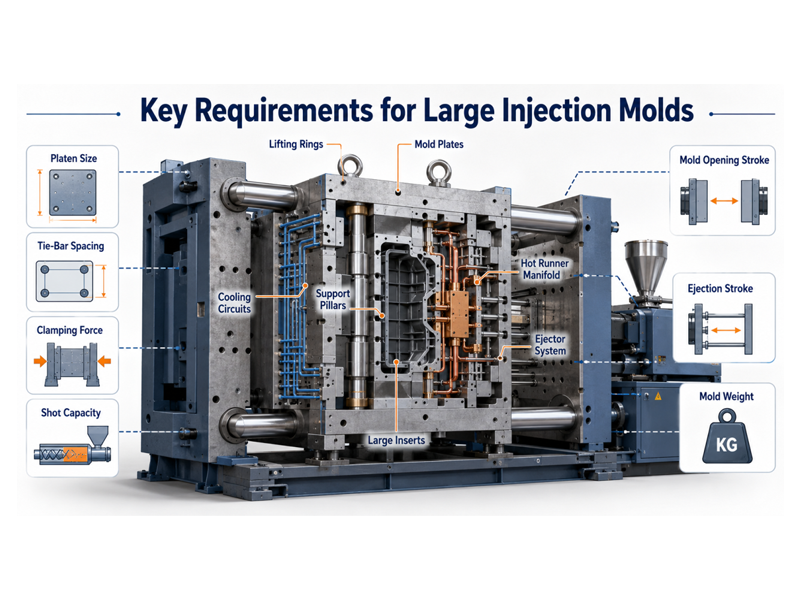
Large injection molds require strong structures, accurate machining, reliable cooling systems, and stable mold movement. The main manufacturing processes include:
CNC machining
EDM and wire cutting
Grinding
Mold fitting
Polishing
Cooling-circuit testing
Mold assembly
For large part plastic injection molding, mold plate flatness, cavity alignment, insert fitting, and support strength are especially important. Small machining or assembly errors may cause flash, uneven movement, or dimensional problems across the entire part.
A professional large part injection molder should also verify that the mold fits the selected machine, including the platen size, tie-bar spacing, opening stroke, and ejection system.
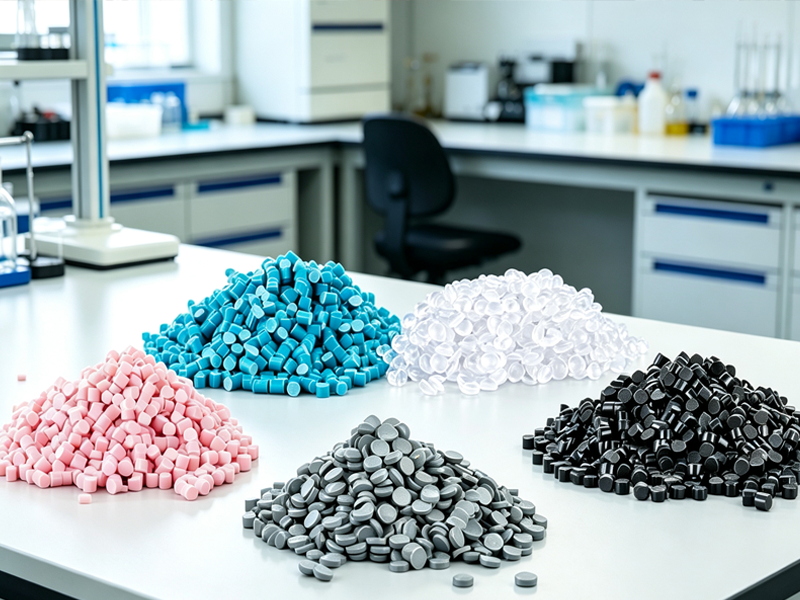
Choosing the right resin is essential in Large Part Injection Molding because the material affects flow length, shrinkage, warpage, surface quality, strength, cycle time, and total production cost. When you are injection molding large parts, you should select the material according to the product application, working environment, expected load, appearance requirements, and annual production volume.
Polypropylene is one of the most commonly used materials in large part plastic injection molding. It offers low density, good flowability, chemical resistance, and a relatively low material cost, making it suitable for large plastic components produced in medium- or high-volume production.
In large plastic injection molding, PP is often used for automotive interior panels, storage boxes, plastic pallets, waste bins, household products, and industrial containers. However, because PP has a relatively high shrinkage rate, your large part injection molder must carefully control cooling, holding pressure, and warpage.
Some of its advantages are:
Lightweight
Low-cost
Chemical resistant
Good flowability
Recyclable
High-Density Polyethylene is widely used for large industrial products that require good impact resistance, moisture resistance, and chemical durability. It performs well in the injection molding of large plastic parts, especially for heavy-duty products used indoors or outdoors.
For Large Part Injection Molding, HDPE is commonly selected for transport crates, large storage bins, plastic pallets, waste containers, and material-handling products. Since HDPE can shrink significantly during cooling, the mold temperature and molding parameters must be controlled to reduce dimensional variation and deformation.
Some of its advantages are:
High impact resistance
Moisture resistant
Chemical resistant
Durable
Recyclable
ABS is a popular material for large injection molded parts that require good appearance, impact strength, and dimensional stability. It is easier to paint, print, plate, or texture than many commodity plastics, making it suitable for visible housings and exterior components.
When you use ABS for large part plastic injection molding, it can be applied to appliance housings, electronic enclosures, automotive interior panels, medical equipment covers, and industrial machine housings. Proper drying is important because moisture may cause silver streaks, bubbles, or unstable surface quality.
Some of its advantages are:
Good impact strength
Smooth surface finish
Easy to paint and print
Good dimensional stability
Suitable for visible parts
Polymethyl Methacrylate, commonly known as PMMA or acrylic, is a transparent thermoplastic widely used when large injection molded parts require high optical clarity, weather resistance, and an attractive surface finish. Compared with glass, PMMA is lighter and easier to form into complex shapes through large plastic injection molding.
In Large Part Injection Molding, PMMA is often used for transparent covers, lighting components, display panels, automotive light parts, appliance windows, and large decorative housings. When injection molding large parts with PMMA, your large part injection molder must carefully control material drying, melt temperature, mold temperature, injection speed, and cooling time. Poor process control may cause bubbles, silver streaks, flow marks, internal stress, cracking, or uneven transparency.
Some of its advantages are:
High optical clarity
Good weather resistance
Lightweight compared with glass
Smooth and glossy surface
Good UV resistance
Suitable for transparent large plastic parts
Large Part Injection Molding is used across many industries where you need oversized plastic components with stable dimensions, repeatable quality, and efficient mass production. Compared with standard molding, the injection molding of large plastic parts requires larger molds, higher shot capacity, and large tonnage injection molding machines. A capable large part injection molder must also control filling balance, cooling, warpage, surface quality, and assembly accuracy throughout production.
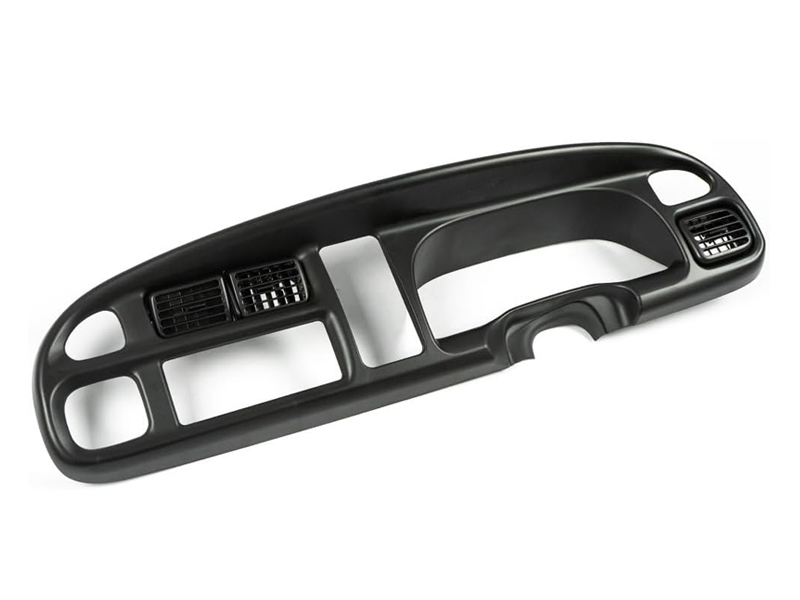
The automotive industry is one of the largest users of large part plastic injection molding because many vehicle components have wide surfaces, complex shapes, and strict appearance and assembly requirements. Through large plastic injection molding, you can produce bumpers, door panels, dashboards, instrument panels, wheel arch liners, underbody covers, battery housings, and large interior trim parts. These components often require materials such as PP, PP+GF, ABS, or PC/ABS to provide impact resistance, stiffness, heat resistance, and low weight. When injection molding large parts for automotive applications, the manufacturer must carefully control warpage, weld lines, texture consistency, dimensional accuracy, and mounting features to ensure that each part fits correctly during vehicle assembly.
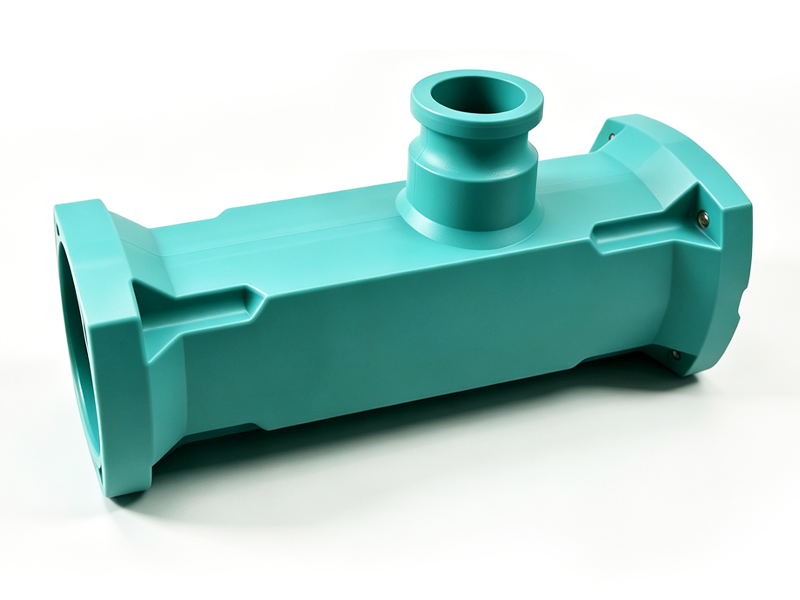
Large Part Injection Molding is widely used for industrial machinery and equipment because plastic housings and covers can replace heavier metal structures while reducing corrosion, assembly time, and overall product weight. Common applications include machinery covers, pump housings, electrical enclosures, industrial control panels, protective guards, equipment bases, and large structural components. When you use large plastic injection molding for industrial products, the resin must be selected according to impact strength, chemical resistance, working temperature, and load requirements. A professional large part injection molder may recommend ABS, PC/ABS, PP, PA+GF, or flame-retardant engineering plastics to help your product maintain stable performance in demanding operating environments.
The household appliance industry relies on large part plastic injection molding to manufacture products that need clean surfaces, accurate dimensions, and efficient assembly. Refrigerator liners, freezer compartments, washing machine housings, air-conditioner panels, dishwasher parts, vacuum cleaner covers, and kitchen appliance components can all be produced through the injection molding of large plastic parts. This process allows you to combine ribs, clips, bosses, ventilation openings, and decorative textures into one molded component, reducing the number of separate parts. For visible appliance housings, the large part injection molder must also control color consistency, gloss level, flow marks, sink marks, and deformation so that the finished product meets both functional and cosmetic requirements.
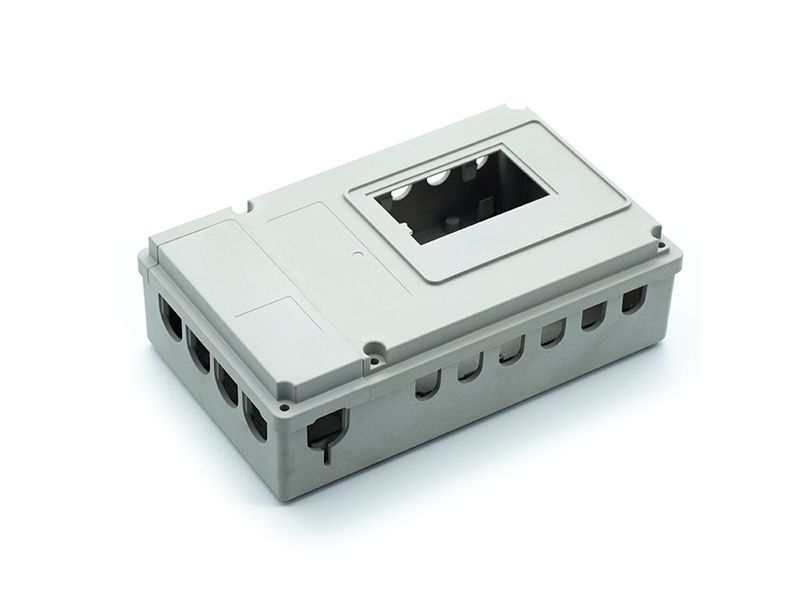
The injection molding of large plastic parts is also used for medical and laboratory equipment that requires smooth surfaces, accurate assembly, and easy cleaning. Typical applications include diagnostic equipment housings, hospital machine covers, laboratory instrument panels, medical storage components, scanner enclosures, and other large healthcare products. Depending on the application, you may need flame-retardant, chemical-resistant, or impact-resistant materials with stable color and surface quality. In medical large part injection molding, the manufacturer must pay close attention to gaps, sharp edges, surface defects, and dimensional variation because these issues may affect assembly, cleaning, or long-term use. Reliable process control and inspection are therefore essential for maintaining consistent quality.
Large Part Injection Molding requires the right equipment, mold design, materials, cooling, and process control. Alpine Mold provides complete support from DFM and mold manufacturing to trials and mass production, with injection molding machines up to 2,000 tons. Send us your 3D drawings for a free project review and quotation.
Yes. Large Part Injection Molding can produce complex one-piece plastic components, reducing separate fasteners, assembly operations, and potential joint failures. Whether your product can be molded as one piece depends on its geometry, material flow length, undercuts, mold size, required shot weight, and machine capacity. A large part injection molder should evaluate the 3D model before confirming the final manufacturing solution.
The achievable tolerance depends on the overall part size, resin shrinkage, geometry, mold accuracy, cooling balance, and process stability. Larger dimensions generally experience greater variation than small precision features, so tolerances should be assigned according to the functional and assembly requirements of each area. Tight tolerances may require precision tooling, stable material batches, controlled molding parameters, and dimensional inspection after the part has fully cooled.
It can be suitable, but the decision depends on tooling cost, part complexity, product size, material, and total production demand. For low-volume large plastic parts, manufacturers may consider simplified tooling, aluminum molds, prototype molds, structural foam molding, thermoforming, or urethane casting. Conventional steel injection molds usually provide better long-term consistency when production volume is sufficient to distribute the initial tooling investment across more parts.
The service life of a large injection mold depends on the mold steel, heat treatment, plastic material, filler content, molding pressure, production environment, maintenance, and number of cycles. Glass-filled or abrasive materials may increase wear, while appropriate steel selection, replaceable inserts, regular lubrication, cleaning, and preventive maintenance can extend mold life. The required mold life should therefore be confirmed before tooling so the large part injection molder can recommend a suitable mold structure and steel grade.
There is no universal maximum size for an injection molded part. The practical limit depends on the molding machine’s clamping force, shot capacity, platen dimensions, tie-bar spacing, opening stroke, and mold weight capacity. Large tonnage injection molding machines can produce components weighing tens of pounds and measuring several feet across, but the manufacturer must confirm that both the part and mold fit the selected equipment.


