WhatsApp: +86 18126157548 Email: kerry@alpinemold.com

Views: 0 Author: Site Editor Publish Time: 2026-07-20 Origin: Site


| 5. Conclusion |
Grinding is essential for precision parts and injection molds, improving dimensional accuracy, flatness, fit, and surface quality. Understanding grinding methods helps customers set realistic tolerances, choose suitable processes, avoid unnecessary machining costs, and improve mold performance and service life. This guide explains the basics, key types, and mold-making applications.
In manufacturing, grinding is commonly used as a finishing process after CNC machining, heat treatment, or rough cutting. A grinding machine can process hardened steel, tool steel, stainless steel, carbide, cast iron, and many other materials that are difficult to machine with conventional cutting tools.
Different grinding methods are used for different part shapes and accuracy requirements. Surface grinding is used for flat surfaces, cylindrical grinding is used for shafts and round parts, while precision grinding is often applied to molds, dies, cutting tools, and high-accuracy mechanical components.
The grinding process works by bringing a high-speed rotating grinding wheel into controlled contact with the workpiece. The wheel contains many abrasive grains, and each grain acts like a small cutting edge that removes a tiny amount of material from the surface.
Unlike milling or turning, grinding uses a very small depth of cut. This allows the grinding machine to achieve tight tolerances, fine surface finishes, and accurate control of flatness, roundness, and dimensions. The final result depends on several grinding parameters, including wheel speed, feed rate, depth of cut, workpiece speed, and coolant flow.
During precision grinding, coolant is often applied to reduce friction, remove grinding debris, and control heat. Proper temperature control is important because excessive heat may cause grinding burns, cracks, distortion, or changes in material hardness. The grinding wheel must also be dressed regularly to expose fresh abrasive grains and maintain its correct shape.
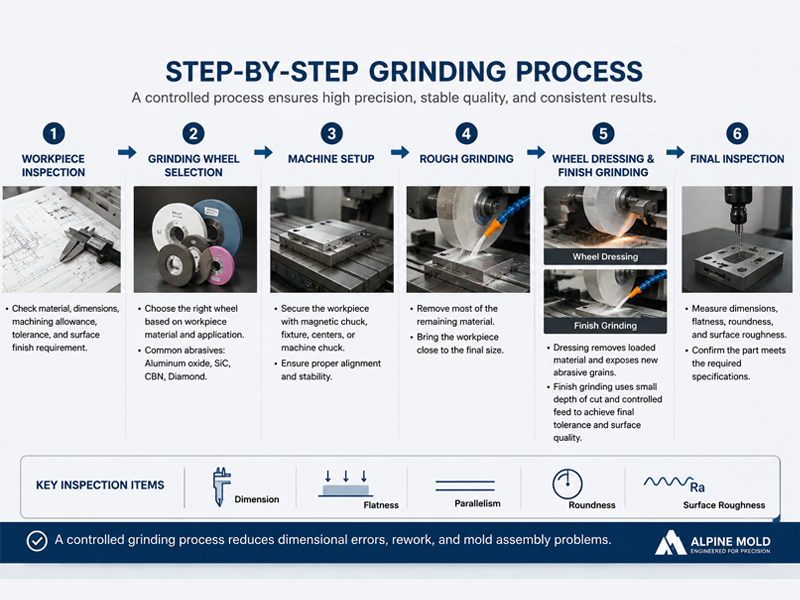
The typical grinding process includes the following steps:
1.Inspect the workpiece
The operator checks the material, dimensions, machining allowance, tolerance, and required surface finish.
2.Select the grinding wheel
The wheel is chosen according to the workpiece material and grinding application. Aluminum oxide, silicon carbide, CBN, and diamond are common abrasive materials.
3.Set up the grinding machine
The workpiece is fixed securely using a magnetic chuck, fixture, centers, or a machine chuck, depending on the type of grinding.
4.Adjust the grinding parameters
Wheel speed, feed rate, cutting depth, workpiece speed, and coolant supply are set to match the machining requirements.
5.Perform rough grinding
Rough grinding removes most of the remaining material and brings the workpiece close to its final size.
6.Dress and true the grinding wheel
Dressing removes loaded material and exposes new abrasive grains, while truing restores the wheel geometry.
7.Perform finish grinding
Finish grinding uses a smaller depth of cut and more controlled feed to reach the final tolerance and surface quality.
8.Inspect the finished part
The component is measured for dimensions, flatness, roundness, and surface roughness to confirm that it meets the required specifications.
Through accurate setup, proper wheel selection, and controlled grinding parameters, the grinding process can produce high-precision parts for molds, dies, tools, and other industrial applications.
Different types of grinding are used according to the workpiece shape, material, tolerance, and required surface finish. The most common grinding methods include surface grinding, cylindrical grinding, internal grinding, centerless grinding, and jig grinding.
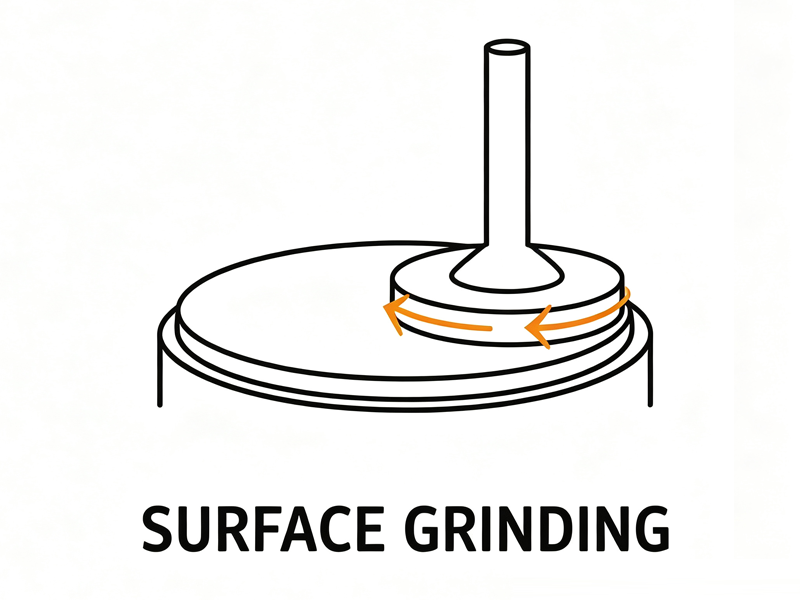
Surface grinding is used to produce flat and smooth surfaces. The workpiece is usually fixed on a magnetic chuck while the grinding wheel moves across the surface in controlled passes.
This grinding process is commonly used for mold plates, inserts, machine components, gauges, and precision tooling. Surface grinding can improve flatness, parallelism, dimensional accuracy, and surface quality.
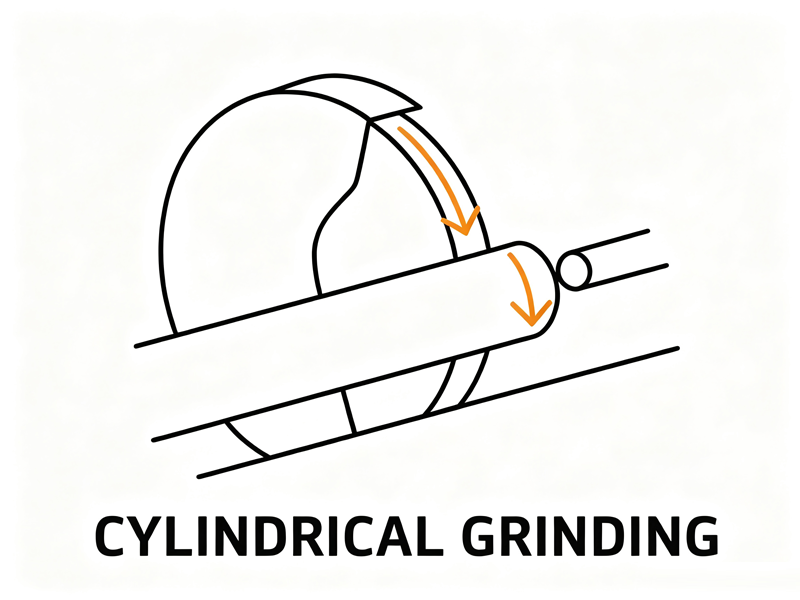
Cylindrical grinding is designed for round parts such as shafts, pins, rollers, guide pillars, and bushings. During the process, both the workpiece and the grinding wheel rotate while material is removed from the outer diameter.
External cylindrical grinding is suitable for straight, tapered, or stepped surfaces. It is widely used when components require accurate diameter control, good roundness, and a fine surface finish.
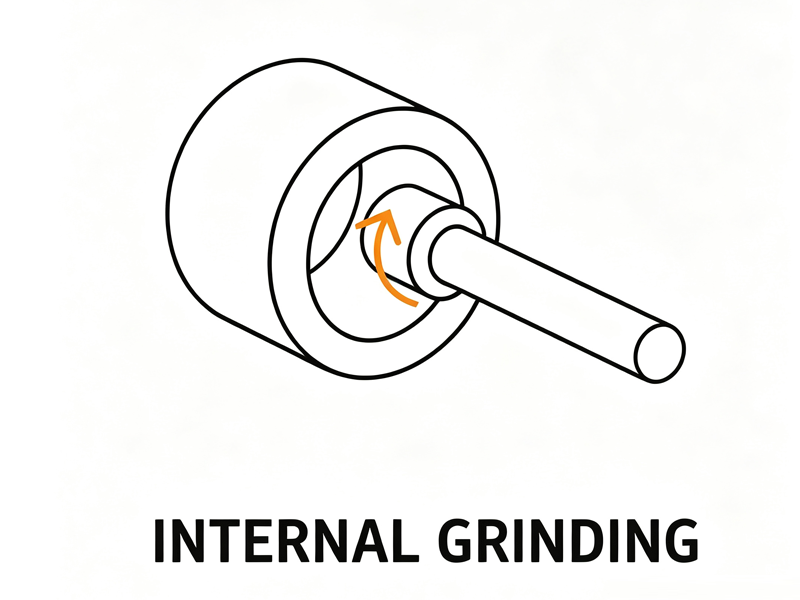
Internal grinding removes material from holes, bores, and other internal cylindrical surfaces. A small grinding wheel rotates inside the workpiece to improve the inner diameter, concentricity, and surface roughness.This type of precision grinding is often used for bearing holes, sleeves, bushings, dies, and mold components with tight internal tolerances.
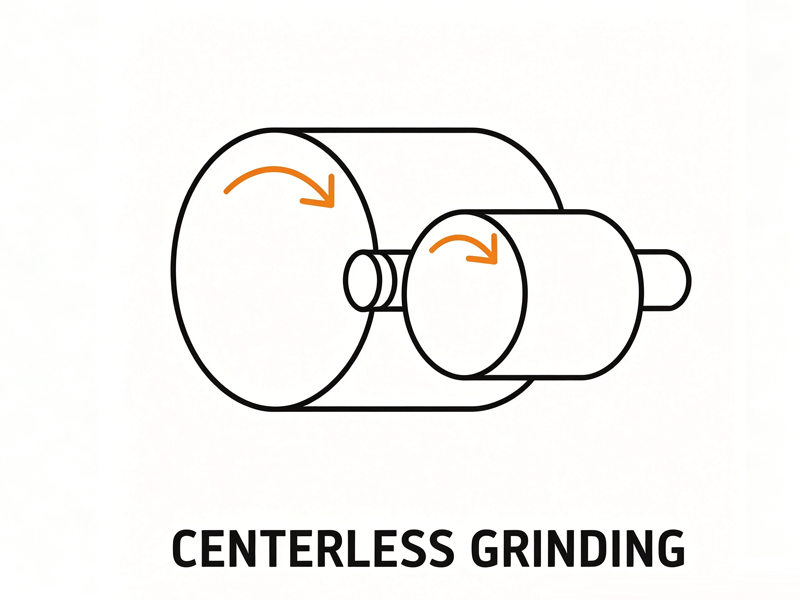
Centerless grinding processes cylindrical parts without holding them between centers or in a chuck. The workpiece is supported between a grinding wheel, a regulating wheel, and a work-rest blade.
Because parts can be fed continuously through the machine, centerless grinding is efficient for high-volume production. It is commonly used for pins, rods, shafts, tubes, and other long cylindrical components.
Grinding plays an important role in mold manufacturing because many mold components require tight tolerances, accurate flatness, and smooth contact surfaces. After CNC machining, EDM, or heat treatment, precision grinding is often used to remove small allowances and bring the part to its final dimensions.
Surface grinding is widely used for mold bases, cavity plates, core plates, support plates, and ejector plates. These large flat components must have good flatness, parallelism, and thickness accuracy to ensure proper mold assembly.
Accurate mold plate grinding helps prevent misalignment, uneven clamping, and gaps between mold components. It also improves the stability of the mold during injection molding production.
Mold cores, cavities, and inserts often require precision grinding after rough machining or heat treatment. The grinding process can control critical dimensions, locating surfaces, and fitting areas without removing too much material.
Surface grinding and profile grinding are commonly used for hardened mold steel, especially when the component requires tight tolerances or a fine surface finish. Precision grinding also helps improve the fit between inserts and surrounding mold components.
Slides, lifters, and other moving mold parts rely on accurate guide surfaces and stable clearances. Grinding these components improves straightness, parallelism, and contact accuracy, allowing them to move smoothly during mold opening and closing.Poorly ground sliding surfaces may cause friction, wear, jamming, or unstable demolding. Precision mold grinding helps maintain reliable movement and extends the service life of slides and lifters.
Parting surfaces and shut-off surfaces must fit closely to prevent plastic leakage and excessive flash. Surface grinding is often used to improve flatness and contact between the core and cavity sides of the mold.For angled shut-offs, profile grinding or jig grinding may be required to achieve the correct geometry. Accurate grinding of these sealing surfaces improves mold performance and reduces the need for repeated fitting and manual correction.
Cylindrical grinding and internal grinding are used for round mold components such as guide pins, ejector pins, sleeves, bushings, and core pins. These parts require precise diameters, good roundness, and smooth surfaces.Accurate grinding helps maintain alignment between the moving and fixed mold halves. It also reduces friction and wear during repeated injection molding cycles.
Overall, grinding in mold manufacturing is mainly used to improve dimensional accuracy, flatness, parallelism, surface finish, and component fit. By combining CNC machining, EDM, surface grinding, cylindrical grinding, and precision inspection, mold manufacturers can produce reliable molds for stable long-term production.
At Alpine Mold, we combine precision grinding, CNC machining, EDM, mold assembly, mold trials, and injection molding production within one manufacturing system. Our in-house capabilities help us control mold dimensions, surface quality, component fitting accuracy, project lead time, and long-term production stability. With experience in custom injection mold manufacturing for automotive, electronics, medical, household, and industrial products, we can support both export molds and complete plastic part production. Send us your 3D drawings, material details, surface requirements, and estimated production quantity, and our engineering team will review your project and provide a professional mold solution and quotation.
Precision grinding can achieve micron-level dimensional control when the machine, grinding wheel, workholding method, coolant system, and inspection process are properly managed. The actual grinding tolerance depends on the part size, material, geometry, grinding method, and equipment capability. High-precision cylindrical grinding can achieve diameter tolerances below ±1 μm in suitable applications.
Grinding can produce a much smoother surface than many conventional cutting processes. The achievable surface finish depends on the grinding wheel grit, wheel condition, feed rate, cutting depth, coolant delivery, machine rigidity, and workpiece material. A finer grinding wheel and controlled finish-grinding parameters generally produce a lower surface roughness value.
Milling uses defined cutting edges to remove relatively large chips and is commonly used for rough machining, pockets, contours, and complex shapes. Grinding uses abrasive grains to remove much smaller amounts of material and is usually selected when the part requires tighter tolerances, hardened-material machining, or a finer surface finish. Some modern machines combine milling and grinding to reduce setups and production time.
Grinding coolant helps reduce heat, remove abrasive debris, prevent grinding burns, and improve surface finish. Proper cooling also reduces the risk of cracks, distortion, and changes in material hardness.
Grinding burns are usually caused by excessive heat, an unsuitable grinding wheel, insufficient coolant, excessive cutting depth, or incorrect wheel speed. Regular wheel dressing and proper parameter control can help prevent this defect.


