WhatsApp: +86 18126157548 Email: kerry@alpinemold.com

Views: 0 Author: Site Editor Publish Time: 2026-11-21 Origin: Site
A thorough understanding of POM—from its material properties and available grades to its processing methods and application requirements—is essential for selecting the right material and ensuring reliable product performance. With its high stiffness, excellent wear resistance, and good dimensional stability, POM is widely used in automotive systems, industrial equipment, electronic products, medical devices, and a range of mechanical applications. Could it be the right material for your product?
This guide explores the key properties, types, common applications, and processing methods of POM, and compares it with other thermoplastics to help you make an informed material-selection decision.
Table of Contents
What Is POM Plastic?
POM Properties and Specifications
Types of POM Plastic
Common Applications of POM
Processin Methods for POM Plastic
POM vs. Other Thermoplastics
Conclusion
FAQ
POM is a semi-crystalline engineering thermoplastic. Its full name is polyoxymethylene, and it is also known as acetal or polyacetal. POM is a polymer made up of repeating formaldehyde-derived units. Its molecular structure determines its ability to form crystalline regions. Depending on how the polymer chains are composed, POM is divided into two basic types:

POM Homopolymer (POM-H):
Its molecular chains consist mainly of repeating (-CH₂-O-) units. This relatively regular repeating structure allows the chains to pack more orderly and form a greater proportion of crystalline regions. As a result, POM-H offers high stiffness, good mechanical strength, a low coefficient of friction, and excellent dimensional stability.
POM Copolymer (POM-C):
Other comonomer-derived units are introduced into the molecular chain, disrupting the regularity of some chain segments and making orderly chain packing more difficult. POM-C therefore generally has a slightly lower degree of crystallinity than POM-H. However, the modified molecular structure gives it better thermal stability and alkali resistance.
Both types are semi-crystalline plastics with excellent mechanical properties. This is why POM plastic, also commonly called acetal plastic, is widely used to manufacture gears, bearings, automotive components, and other functional parts. During material selection, however, you should determine whether POM-H or POM-C is more suitable based on your product's strength, stiffness, wear-resistance requirements, and operating environment.
Property | Typical Value |
Density | 1.39–1.43 g/cm³ |
Water Absorption (24 h) | 0.2–0.8% |
Mold Shrinkage | 1.5–3.0% |
POM has a relatively high density and low water absorption, making it suitable for precision parts that must withstand mechanical loads. Changes in ambient humidity also have a relatively small effect on its dimensions.
Property | Typical Value |
Melting Temperature (POM-H) | 175–180°C |
Melting Temperature (POM-C) | 160–170°C |
Heat Deflection Temperature | 90–120°C |
Continuous Service Temperature | 90–100°C |
Coefficient of Thermal Expansion | 80–120 × 10⁻⁶/K |
Plastic components used in automotive systems, electrical equipment, and mechanical assemblies may be exposed to elevated temperatures during operation. POM can maintain its mechanical properties and dimensional stability within a certain temperature range, giving it good heat resistance.
Property | Typical Value |
Tensile Strength | 60–75 MPa |
Tensile Modulus | 2,400–3,200 MPa |
Flexural Modulus | 2,400–3,200 MPa |
Notched Impact Strength | 5–10 kJ/m² |
Hardness | 80–90 Shore D |
Coefficient of Friction | 0.2–0.35 |
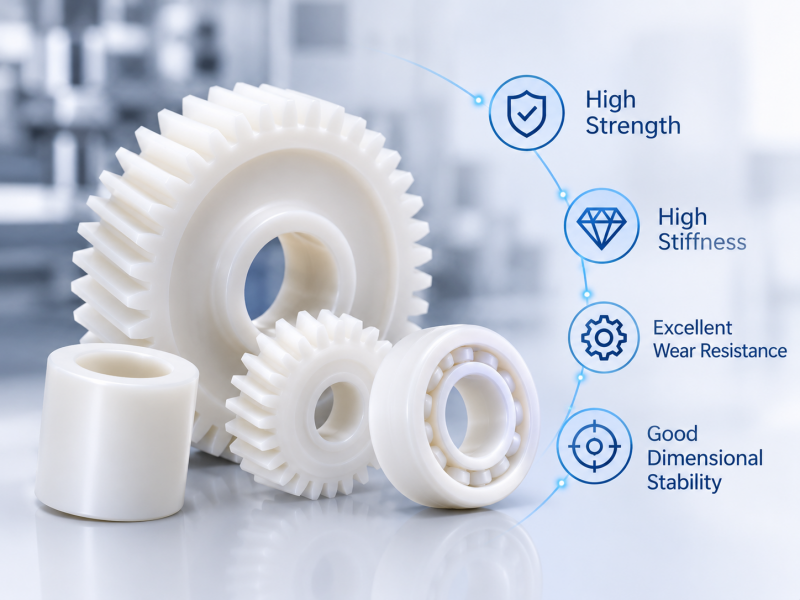
POM offers good stiffness, strength, hardness, and wear resistance, together with a low coefficient of friction. These properties make it suitable for gears, bearings, sliding components, and other precision mechanical parts.
Property | Typical Value |
Dielectric Strength | 20–30 kV/mm |
Dielectric Constant (1 MHz) | 3.5–4.0 |
Volume Resistivity | 10¹²–10¹⁴ Ω·cm |
POM's good insulating properties and high electrical resistivity make it suitable for insulating structural components, connectors, and internal switch components in electronic equipment.
Property | Typical Value |
Oils and Fuels | Generally resistant |
Organic Solvents | Generally good |
Alkalis | Resistant to alcohols and many hydrocarbons |
Strong Acids | Not resistant |
Strong Oxidizing Agents | Not resistant |
Chemical resistance depends on temperature, concentration, and exposure time. POM offers good resistance to many oils, fuels, and organic solvents, but performs poorly when exposed to chemicals such as strong acids and strong oxidizing agents. It is therefore commonly used in components for fuel systems, fluid-handling equipment, and other industrial machinery.
In addition to standard homopolymer and copolymer grades, POM's mechanical properties, wear resistance, heat resistance, and other characteristics can be adjusted by adding functional additives or fillers to meet specific application requirements.
Glass-Fiber-Reinforced POM
Adding glass fibers increases stiffness, tensile strength, and resistance to deformation. These properties make glass-fiber-reinforced POM more suitable for structural brackets, automotive components, and load-bearing mechanical parts.
However, adding glass fibers also reduces impact toughness and may result in a rougher finished surface, with fine glass fibers sometimes visible on the surface.
Mineral-Filled POM
Mineral fillers such as talc and other inorganic particles can improve stiffness, molding shrinkage, and dimensional stability. If your product requires high dimensional consistency, this type of POM may be suitable for precision housings, mechanical assemblies, structural components, and similar applications.
If the filler content is too high, however, impact strength may decrease and melt flow may be affected. The formulation should therefore be selected according to the specific dimensional and mechanical requirements of the part.
Lubricated POM
Lubricating additives, such as PTFE and silicone-based additives, are incorporated into POM to reduce friction between contact surfaces and improve sliding performance. This makes lubricated POM particularly suitable for gears, bushings, bearings, and sliding components that move frequently.
Different lubricant formulations produce different friction characteristics. When selecting a specific grade, you should also consider factors such as contact pressure, sliding speed, and the material it will run against.
Antistatic POM
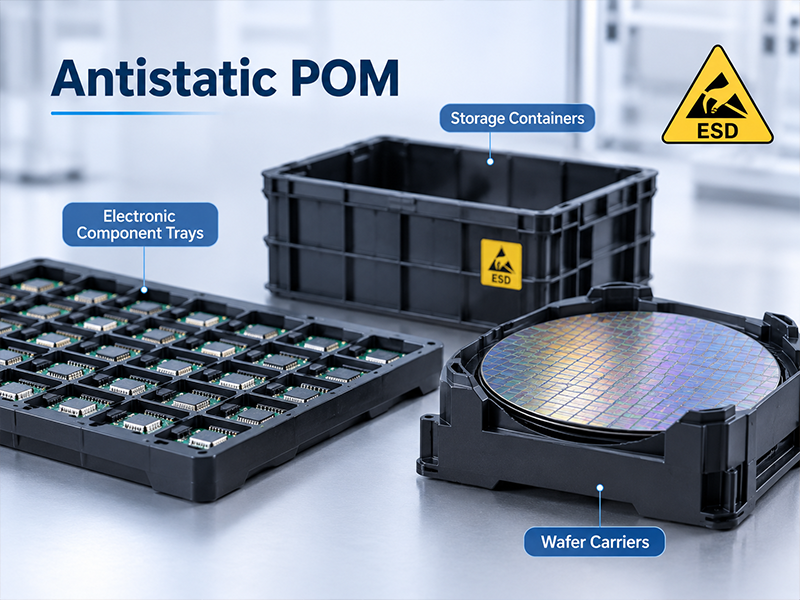
Antistatic agents or suitable conductive additives are added to reduce the accumulation of static charges on the material's surface. This helps minimize the risks of dust attraction and electrostatic discharge, making the material suitable for products used in electrostatic-sensitive environments, such as trays for electronic components, storage containers, and semiconductor wafer carriers.
Impact-Modified POM
Elastomeric impact modifiers are added to improve toughness and resistance to sudden mechanical loads. This makes impact-modified POM suitable for snap-fits, latching components, and other fastening parts.
When selecting this type of POM, a balance must be found between impact performance and structural stiffness. Adding elastomers may reduce the material's stiffness, hardness, and tensile strength.
In practical applications, the required surface resistivity should be considered when determining which electrostatic discharge (ESD) standard the material needs to meet.
UV-Stabilized POM
UV stabilizers help outdoor equipment and automotive components retain their appearance and mechanical properties when exposed to ultraviolet radiation.
When selecting a suitable grade, you should also consider the expected exposure duration, light intensity, operating temperature, and required service life.
Low-Emission POM
Formulations using formaldehyde scavengers or tightly controlled resin purity can reduce the release of formaldehyde and other volatile substances during processing or use. This makes low-emission POM particularly suitable for applications in enclosed equipment, such as automotive interior components and cosmetic packaging.
Automotive components often undergo repeated movement and withstand mechanical loads throughout their service life. POM's good fatigue resistance, dimensional stability, and low-friction characteristics make it suitable for frequently moving or rubbing components such as power-window gears, seat-adjustment mechanisms, and seat-belt mechanisms. It helps maintain smooth mechanical operation, reliable component fit, and consistent performance.
For applications involving direct contact with fuel, make sure the selected POM grade is compatible with the specific fuel to avoid potential failures.
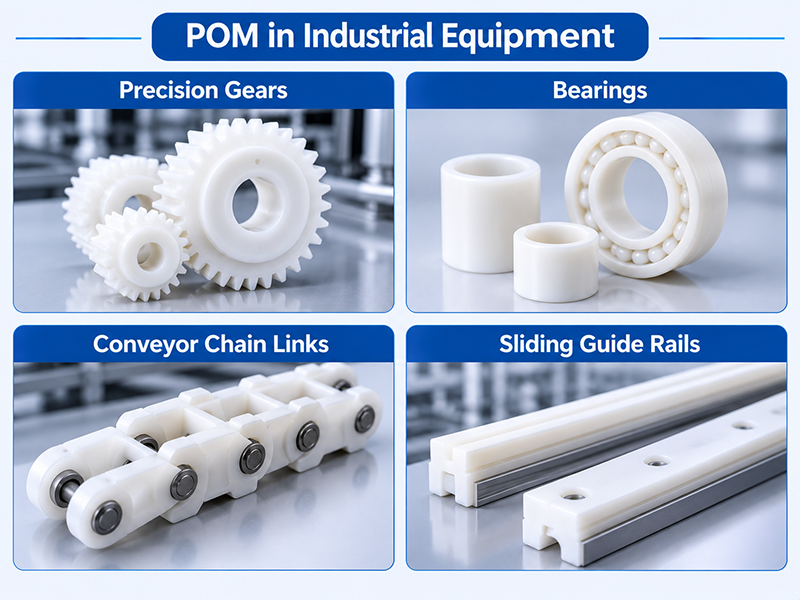
In industrial machinery, POM's good machinability and injection-molding characteristics make it suitable for manufacturing precision mechanical components with complex geometries. In parts that are regularly subjected to mechanical loads—such as gears, bearings, conveyor-chain links, and sliding guide rails—POM helps reduce wear at sliding contact surfaces and maintain consistent clearances.
POM is widely used in connector housings, switch mechanisms, and various internal mechanical structures in electronic equipment. Its excellent dimensional stability and low moisture absorption help maintain assembly accuracy, while its good electrical insulating properties make it suitable for certain non-conductive structural components.
Depending on the selected grade, conductive POM can also be used to manufacture PCB handling racks, electronic-component trays, and handling fixtures. These materials help control static-charge accumulation or provide a conductive path.

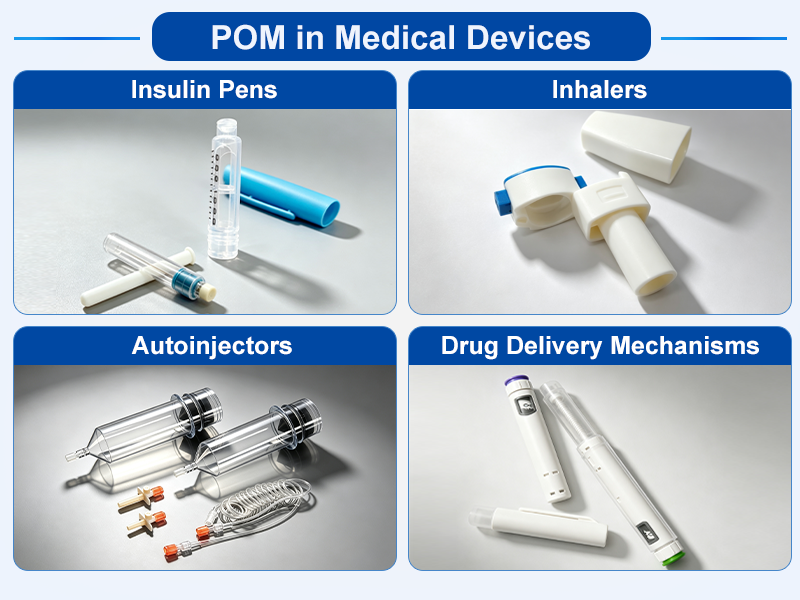
Precise drug delivery in medical devices often relies on small mechanical components for control. This makes POM suitable for drug-delivery devices such as insulin pens, inhalers, and autoinjectors. Its good dimensional consistency helps ensure precise engagement between components and repeatable mechanical movement.
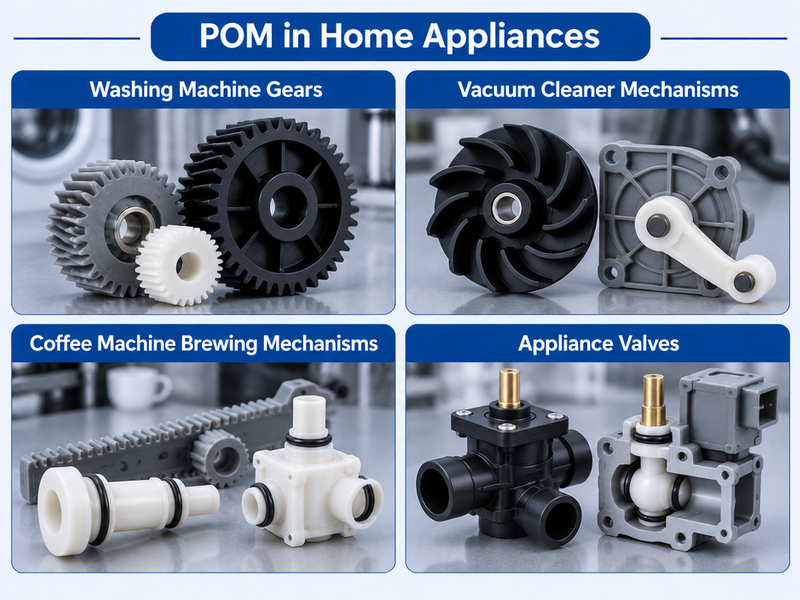
POM is commonly used in appliance control systems and internal mechanisms, including components in washing machines and vacuum cleaners, as well as brewing mechanisms in coffee machines. Many household appliances rely on internal gears, rotary mechanisms, valves, and moving components to perform their everyday functions.
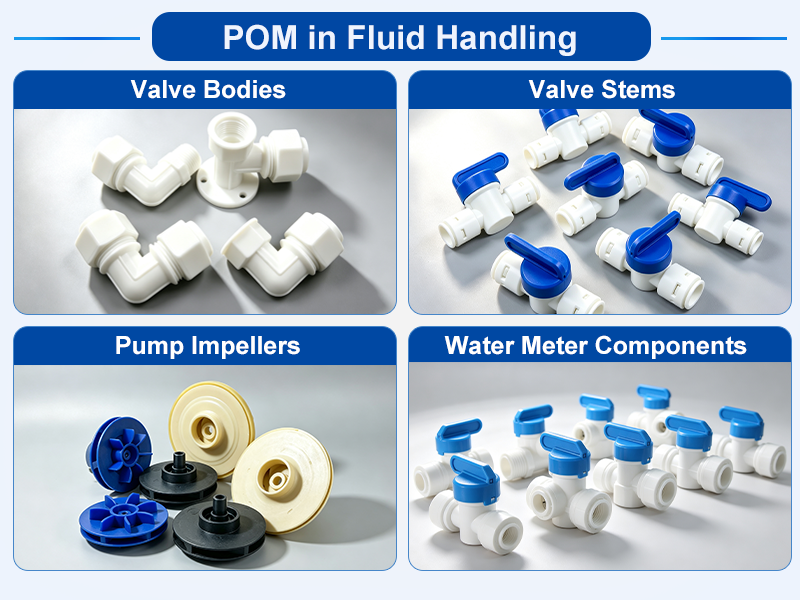
Components used in fluid-handling applications must maintain dimensional accuracy while in contact with liquids under operating pressure. Common examples include valve bodies, valve stems, pump impellers, and water-meter components. POM's low moisture absorption and resistance to many common fluids, when combined with suitable sealing elements, help ensure stable valve operation and good sealing performance.
As a commonly used semi-crystalline engineering thermoplastic, POM can be processed into different types of parts through melt processing and machining. The three common methods are outlined below. Among them, injection molding is particularly suitable for the mass production of precision POM plastic components.
Injection molding is one of the most common processing methods for POM. It offers good dimensional consistency, supports complex product geometries, and enables relatively short production cycles. Ribs, bosses, snap-fits, and integrated fastening features can also be molded directly into the part, reducing the need for subsequent assembly. This process is commonly used to manufacture gears, bushings, connectors, and other mechanically complex components.

Process Overview
POM pellets are heated until molten, and the injection-molding machine's screw then pushes the melt through the runner system and gate into the mold cavity. Once the cavity is filled, holding pressure is applied to compensate for material shrinkage. The cooling system then removes heat so the material solidifies and retains its shape. Finally, the ejection system removes the finished part from the mold.
Processing Parameters
If the melt temperature is too high or POM remains in the barrel for too long, thermal degradation may occur and release formaldehyde. Actual processing temperatures should therefore follow the recommendations provided by the material supplier.
Parameter | Typical Reference Conditions |
Melt Temperature | 190–220°C |
Barrel Temperature | Rear: 160–190°C; Middle: 170–200°C; Front: 180–210°C |
Mold Temperature | 60–100°C |
Injection Pressure | 60–150 MPa |
Holding Pressure | 50%–70% of injection pressure |
Injection Speed | 100–300 mm/s |
Cooling Time | For small, thin-wall parts, 10–15 s can be used as an initial mold-trial reference. |
Design Considerations
l Wall Thickness: For common part designs, a uniform wall thickness of approximately 1.5–3.0 mm can be used as an initial guideline. Thicker sections can be optimized with hollow structures or ribs.
l Draft Angles: For smooth surfaces, a draft angle of 0.5°–1° per side is a common starting point. Textured surfaces generally require a larger draft angle, such as 1°–3°.
l Gate Design: The gate should be positioned as close as practical to thicker sections to prevent the melt from cooling too early. For gear-like parts, for example, particular attention should be paid to how gate location affects the tooth profile and weld lines.
l Shrinkage Compensation: For unreinforced POM, a mold-shrinkage value of approximately 1.5%–2.5% can be used as an initial reference, then adjusted according to the specific grade and mold-trial results.
l Cooling System: Cooling channels should be distributed as evenly as possible. Avoiding excessive temperature differences across the cavity helps reduce differential shrinkage and warpage.
Extrusion is a continuous process mainly used to produce POM stock shapes with a consistent cross-section. Common extruded products include POM rods, sheets, and profiles. The process offers continuous production and relatively high material utilization. However, it is mainly suitable for products with a uniform cross-section and cannot directly produce complex three-dimensional parts.
Process Overview
POM pellets are fed into the extruder barrel, where they gradually melt under heat and screw rotation before being continuously conveyed to the die. The molten material passes through the die to form the required cross-sectional shape. It is then cooled and calibrated, continuously pulled by a haul-off unit, and cut to the specified length.
Processing Parameters
The temperature ranges can be referenced against Delrin extrusion-processing data. Screw speed and haul-off speed depend on the equipment and product, so they should not be treated as fixed values applicable to all production lines.
Parameter | Typical Reference Conditions |
Melt Temperature | 195–205°C |
Barrel Temperature | Rear: 170–180°C; Middle: 180–195°C; Front: 190–205°C |
Die Temperature | 190–205°C |
Screw Speed | 20–60 rpm |
Cooling Method | Air cooling or water cooling |
Pulling Speed | Matched to the extrusion output and target cross-sectional dimensions |
Design Considerations
l Cross-Section Geometry: Keep wall thickness as uniform as possible and avoid excessive local variations in thickness.
l Die Design: The flow channels in the die should be balanced to avoid excessive differences in melt-flow rates between different areas.
l Cooling Control: Rods and sheets should be cooled as uniformly as possible to reduce internal stress and bending deformation.
l Dimensional Tolerances: For precision rods, diameter tolerances can be specified according to downstream assembly requirements, with dimensional compensation provided for cooling shrinkage.
l Machining Allowance: If the extruded stock will undergo further CNC machining, leave sufficient machining allowance to correct the surface and dimensions.
CNC machining is a subtractive manufacturing process that typically uses POM rods, sheets, or other solid stock shapes as the starting material. It offers high machining accuracy and design flexibility without requiring a dedicated injection mold, making it particularly suitable for prototypes, small-batch production, and custom parts.
Process Overview
The workpiece is secured with a fixture on a CNC milling machine or lathe. The product's 3D model or 2D engineering drawing is then converted into a machining program, with parameters such as toolpaths, spindle speed, feed rate, and depth of cut defined. During machining, the spindle rotates the cutting tool at high speed, or the lathe rotates the workpiece, while the tool progressively removes material along the programmed path.
Different machining operations can be used depending on the part geometry:
l Milling: A rotating cutting tool removes material. This operation is suitable for machining flat surfaces, steps, grooves, cavities, and complex contours.
l Turning: The workpiece rotates while the cutting tool moves in a specified direction. This operation is suitable for cylindrical surfaces, internal bores, external diameters, and threads.
l Drilling: A drill bit is used to create holes in the workpiece, including bolt holes, locating holes, and through-holes.
l Finishing: After rough machining, a smaller depth of cut is used for the final operation to improve dimensional accuracy and surface quality.
Processing Parameters
Parameter | Typical Reference Conditions |
Cutting Speed | 150–300 m/min |
Milling Feed per Tooth | 0.05–0.15 mm/tooth |
Turning Feed Rate | 0.05–0.20 mm/rev |
Roughing Depth of Cut | 1.0–3.0 mm |
Finishing Depth of Cut | 0.1–0.5 mm |
Spindle Speed | Calculated based on tool diameter and cutting speed |
Design Considerations
l Wall Thickness: Avoid overly thin structures. For example, large thin-wall areas should be supported to reduce deformation caused by clamping and cutting forces.
l Tool Access: For deep cavities, consider the ratio of tool length to diameter and avoid using tools that are excessively long and slender.
l Corner Radii: Internal corner radii should be no smaller than the radius of the selected tool. For example, when using a 6 mm-diameter milling cutter, the internal corner radius should be at least R3 mm.
l Clamping: Use soft jaws or fixtures that conform to the workpiece shape. Excessive clamping force may deform the POM.
l Machining Allowance: An allowance of approximately 0.2–0.5 mm can be left before finishing to correct dimensions and improve surface quality.
Both POM and PA offer good mechanical properties and are commonly used to manufacture precision parts with complex structures. POM has better wear resistance and lower moisture absorption, while PA generally offers better toughness and fatigue resistance.
Both materials can be used to manufacture plastic parts that require a certain level of stiffness and structural strength. Compared with ABS, POM offers better low-friction properties and generally higher stiffness, while ABS performs better in impact resistance and surface appearance.
Both POM and PC offer good mechanical properties and dimensional stability. However, POM's lower coefficient of friction makes it more suitable for applications involving repeated mechanical loads and movement, while PC's main advantages are its excellent impact resistance and transparency.
Both materials are commonly used in automotive, electrical and electronic, and industrial equipment applications. POM performs particularly well in friction and wear environments, while PBT offers good electrical insulation, dimensional stability, and heat resistance.
Both POM and PP have low moisture absorption and offer a degree of resistance to many common chemicals, making them suitable for some industrial components. However, under sustained mechanical loads and in friction environments, POM is better able to maintain structural stability. PP has a lower density, good flex-fatigue resistance, and is generally more economical.
Material | Recommended Applications | Considerations |
POM | Precision gears, bearings, bushings, sliding components, and automotive transmission parts | Mechanical parts requiring a low coefficient of friction, good wear resistance, relatively high stiffness, and dimensional stability |
PA (Nylon) | Automotive structural parts, gears, mechanical brackets, bearings, and fasteners | Parts requiring high mechanical strength, toughness, and fatigue resistance; dimensional changes caused by moisture absorption should be considered |
ABS | Appliance housings, electronic equipment housings, automotive interior components, and control panels | Products prioritizing impact resistance, surface appearance, and subsequent finishing processes such as painting or electroplating |
PC | Safety guards, transparent viewing windows, automotive lighting components, and protective housings for electronic equipment | Products requiring high impact resistance, transparency, and good heat resistance |
PBT | Electrical connectors, terminal housings, automotive electronic components, and electrical insulation parts | Parts requiring good electrical insulation, dimensional stability, and heat resistance; glass-fiber-reinforced grades can further increase stiffness |
POM is often an ideal choice for precision components, particularly in applications that involve repeated movement, mechanical loads, and demanding operating conditions while requiring reliable performance. For these requirements, injection molding is an efficient and reliable manufacturing solution. Proper mold design, shrinkage compensation, cooling-system design, and injection parameters are all critical to ensuring dimensional accuracy and molding quality.
At AlpineMold, we combine mold design and manufacturing capabilities with professional injection-molding services. Whether you need custom POM components or an integrated mold-making and injection-molding solution, AlpineMold can provide strong support for your project.
POM has low moisture absorption and generally does not require routine pre-drying when stored and packaged under normal conditions. However, drying is necessary if the packaging has been damaged or the material has been exposed to a humid environment for an extended period.
Yes. POM has good flow properties and can be used for injection molding thin-wall parts. The achievable wall thickness depends on the part dimensions, flow length, gate design, and injection-molding parameters.
Overheating or thermal degradation of POM may release formaldehyde gas, which is harmful to human health. Processing temperature therefore requires careful control. For food-contact or medical applications, select a grade that complies with the relevant regulations and certification requirements.
Not exactly. Acetal is a general name for POM, while Delrin is a brand of POM homopolymer (POM-H) owned by DuPont. In addition to POM-H, POM is also available as POM-C. These materials have different molecular structures and may differ in strength, thermal stability, and processing characteristics.
POM can be reused through mechanical recycling. Clean sprues and runner material can also be reground and blended with virgin resin. However, repeated heating may cause thermal degradation and reduce the material's mechanical properties.


