WhatsApp: +86 18126157548 Email: kerry@alpinemold.com

Views: 0 Author: Site Editor Publish Time: 2026-06-06 Origin: Site


Plastic shrinkage is a common challenge in injection molding. If it is not properly controlled, it can lead to dimensional errors, assembly problems, sink marks, or warpage. This article explains what causes plastic shrinkage and how to control it through material selection, mold design, and process optimization.
1. What Is Shrinkage in Injection Molding? |
2. Main Causes of Shrinkage in Injection Molding |
3. How to Reduce Shrinkage in Injection Molding |
4. Conclusion |
5. FAQ |
Plastic shrinkage in injection molding refers to the reduction in size or volume of a molded plastic part as it cools and solidifies. During the injection molding process, molten plastic is injected into the mold cavity under pressure. As the material cools, its molecules move closer together, causing the part to become slightly smaller than the mold cavity.
Shrinkage is a natural behavior of thermoplastic materials, but the shrinkage rate varies depending on the material type, part structure, wall thickness, mold temperature, and processing conditions. For example, semi-crystalline plastics such as PP, PA, and POM usually have higher shrinkage rates than amorphous plastics such as ABS, PC, and PMMA.
In mold design, shrinkage must be considered before steel cutting. If the shrinkage allowance is not calculated correctly, the final plastic part may be too small, out of tolerance, difficult to assemble, or unstable during mass production.
Plastic shrinkage is usually not caused by one single problem. It is the result of material behavior, part design, mold design, and injection molding parameters working together. To control shrinkage effectively, you first need to understand where it comes from.
Different plastics shrink at different levels because their internal molecular structures are different. When molten plastic cools down, the molecules move closer together, and the part becomes smaller.
Semi-crystalline plastics, such as PP, PA, and POM, usually have higher shrinkage because their molecules form a more organized structure during cooling. This structure takes up less space, so the material shrinks more. Amorphous plastics, such as ABS, PC, and PMMA, usually have lower shrinkage because their molecules remain more randomly arranged.
Fillers also affect shrinkage. For example, glass fiber can limit material contraction, so glass-filled materials usually have better dimensional stability than unfilled materials.
Wall thickness has a strong influence on shrinkage because thick and thin areas cool at different speeds. Thin walls cool quickly, while thick sections take longer to cool and solidify.
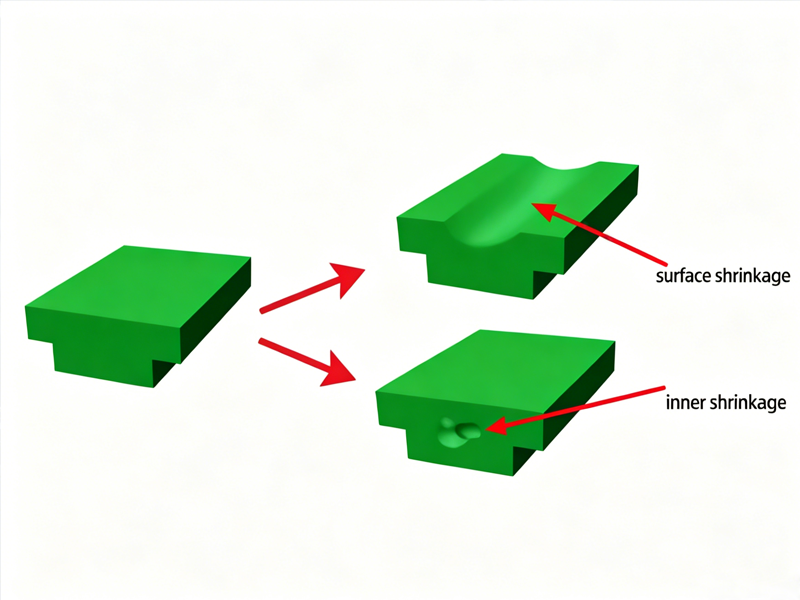
When a thick area cools slowly, the material inside continues to shrink after the surface has already hardened. This can create sink marks on the surface, internal voids, or local dimensional changes. If one area of the part is much thicker than another, the shrinkage will not be even, which may cause warpage or assembly problems.
For this reason, uniform wall thickness is one of the most important design rules for controlling plastic shrinkage.
Mold temperature controls how fast the plastic cools inside the mold. If the mold temperature is too high, the plastic stays hot for a longer time and may shrink more before it fully solidifies. If the mold temperature is too low, the surface may freeze too quickly while the inside is still hot, creating uneven shrinkage or internal stress.
The key is not simply using a high or low mold temperature. The most important point is keeping the mold temperature stable and balanced across the cavity. A stable mold temperature helps each part cool in the same way, which improves dimensional consistency during mass production.
After the cavity is filled, the plastic continues to shrink as it cools. The packing stage is used to push extra molten plastic into the cavity to compensate for this shrinkage.
If the packing pressure is too low, there is not enough material being added to the cavity. If the holding time is too short, the compensation stops before the gate freezes. In both cases, the part may become smaller than expected, and thick areas may show sink marks.
Proper packing pressure and holding time help keep the cavity full during cooling, which is very important for controlling final part dimensions.
The gate is the entrance where molten plastic flows into the mold cavity. Its size and position directly affect how well the part can be filled and packed.
If the gate is too small, it may freeze too early. Once the gate freezes, no more material can enter the cavity, even if the part is still shrinking inside. This can lead to sink marks, short packing, or unstable dimensions.
Gate location is also important. If the gate is far away from thick sections, the packing pressure may not reach those areas effectively. A properly designed gate helps maintain pressure, improve material flow, and reduce local shrinkage.
Cooling design has a direct impact on shrinkage because most shrinkage happens during cooling. If one area of the mold cools faster than another, the plastic part will shrink unevenly.
For example, if one side of the part cools quickly while the other side stays hot longer, the two sides will contract at different rates. This can cause bending, twisting, or dimensional variation after ejection.
A well-designed cooling system keeps the mold temperature more uniform, reduces uneven shrinkage, shortens cycle time, and improves part stability in mass production.
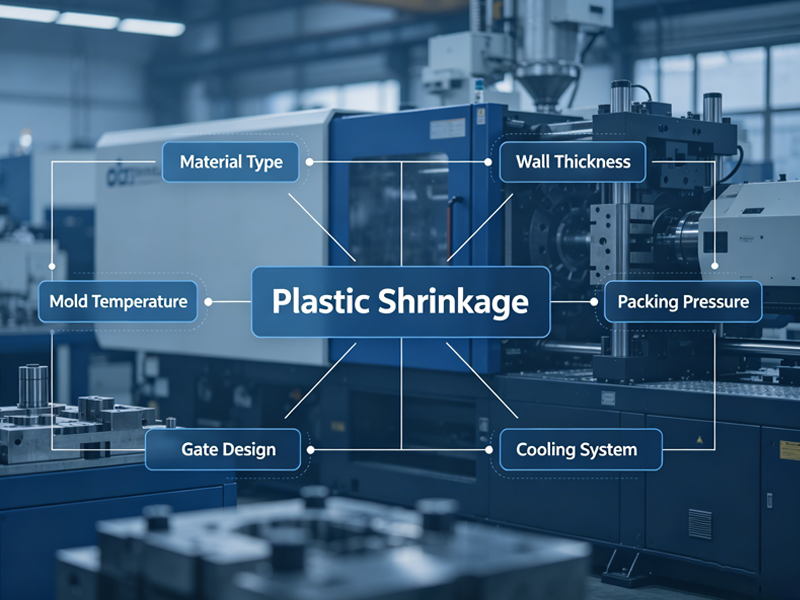
Plastic shrinkage cannot be completely avoided, but it can be controlled. The key is to make the part cool and shrink as evenly as possible. In real projects, shrinkage control should start from part design, then continue through mold design, material selection, and molding parameter adjustment.
Wall thickness is one of the first things to check when shrinkage problems appear. If the part has thick and thin areas, the thick sections will cool more slowly and shrink more. This often causes sink marks, internal voids, warpage, or poor dimensional stability.
To reduce this risk, the wall thickness should be kept as uniform as possible. When extra strength is needed, it is better to use ribs instead of simply increasing the wall thickness. As a general design reference, rib thickness is often designed at about 50%–60% of the nominal wall thickness to reduce the risk of sink marks.
For example, if a plastic housing has a 2.5 mm wall thickness, the rib thickness should usually be around 1.25–1.5 mm, depending on the material and part structure. This helps improve strength while avoiding excessive material buildup.
Material selection has a direct effect on shrinkage. Some plastics naturally shrink more than others, so understanding typical shrinkage rates is essential for mold design. In general, amorphous plastics such as ABS, PC, and PMMA have lower and more stable shrinkage, while semi-crystalline plastics such as PP, PA, and POM usually shrink more during cooling.
The table below shows typical shrinkage rates for common injection molding materials, which can serve as a reference when selecting materials:
Material | Typical Shrinkage Rate (%) | Characteristics |
ABS | 0.4–0.8 | Good dimensional stability; widely used for housings and enclosures |
PC | 0.5–0.8 | Low shrinkage, high impact strength; suitable for precision parts |
PP | 1.0–2.5 | Higher shrinkage; sensitive to wall thickness and processing conditions |
PA6 / PA66 | 0.8–2.0 | Shrinkage affected by moisture absorption and glass fiber content |
POM | 1.5–3.0 | High shrinkage; good wear resistance and mechanical strength |
PMMA | 0.3–0.8 | Low shrinkage; excellent optical clarity |
PBT | 1.2–2.0 | Good electrical properties; shrinkage depends on reinforcement |
PE | 1.5–4.0 | High shrinkage; commonly used for flexible or chemical-resistant parts |
PVC | 0.2–0.6 | Relatively low shrinkage; good dimensional control |
If the part requires tight tolerances or stable assembly, engineers should review the material shrinkage rate before mold design. For some structural parts, glass-fiber reinforced materials can help reduce shrinkage and improve dimensional stability. However, material selection should not focus solely on shrinkage. Strength, toughness, heat resistance, surface appearance, cost, and working environment also need to be considered.
A practical approach is to confirm the material grade early and use its shrinkage data to design the mold cavity. Changing material after mold manufacturing can lead to dimensional differences, defects, or additional mold modifications.
Gate design affects how the plastic fills the cavity and how pressure is maintained during cooling. If the gate is too small or freezes too early, the material cannot continue to compensate for shrinkage inside the cavity. This may cause sink marks, smaller dimensions, or unstable part quality.
Gate location is also important. For parts with thick sections, the gate should be designed so that packing pressure can reach these areas effectively. If the gate is too far from the thick area, the pressure loss may be too high, and the thick area may shrink more than expected.
For large or complex parts, a single gate may not be enough. Multiple gates, hot runners, or optimized runner systems can help improve filling balance and reduce uneven shrinkage. The goal is not only to fill the part, but also to keep enough pressure during the packing stage.
Packing pressure and holding time are important process parameters for reducing shrinkage. After the cavity is filled, the plastic starts to cool and contract. During this stage, packing pressure pushes additional material into the cavity to compensate for volume shrinkage.
If packing pressure is too low, the part may shrink too much. If holding time is too short, the compensation stops before the gate freezes, and the part may show sink marks or dimensional shortage. For many thermoplastics, packing pressure is often set at about 50%–80% of the injection pressure, but the final setting should be adjusted based on part structure, material, and actual molding results.
A useful way to optimize holding time is to check the gate freeze time. Once the gate is frozen, increasing holding time will no longer improve shrinkage. This helps avoid unnecessary cycle time while keeping the part dimension stable.
Cooling design is one of the most important factors in shrinkage control because most shrinkage happens during cooling. If one area cools faster than another, the part will shrink unevenly and may warp after ejection.
A good cooling system should keep the mold temperature as balanced as possible. Cooling channels should be designed near thick sections, deep ribs, bosses, and areas with strict dimensional requirements. For large parts or complex structures, independent cooling circuits may be needed to control different temperature zones.
In production, mold temperature stability is also important. Even a small temperature change can affect part dimensions, especially for precision parts. Therefore, water flow, cooling channel blockage, and mold temperature should be checked regularly during mass production.
Mold temperature affects material flow, cooling speed, crystallization, and final shrinkage. A mold temperature that is too high may increase shrinkage and cycle time. A mold temperature that is too low may cause fast surface freezing, poor filling, internal stress, or uneven shrinkage.
The correct mold temperature depends on the material and part requirements. For example, PP can often be molded with a lower mold temperature, while PC or PA usually requires a higher mold temperature to achieve better filling and dimensional stability.
The most important point is consistency. If mold temperature changes during production, the shrinkage rate may also change. For parts with tight tolerance requirements, stable mold temperature control is necessary to keep dimensions repeatable from shot to shot.
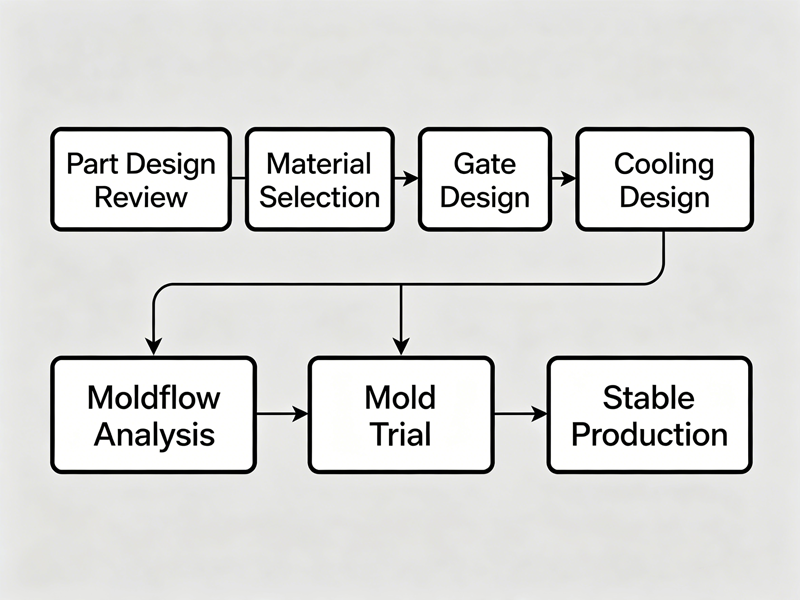
The best time to control shrinkage is before the mold is built. Once the steel has been cut, solving shrinkage problems usually means mold modification, longer lead time, and higher cost.
During DFM analysis, engineers can check wall thickness, ribs, bosses, gate position, material selection, draft angles, and potential shrinkage risk areas. Moldflow analysis can further help predict filling balance, packing pressure, cooling efficiency, shrinkage distribution, and warpage risk before manufacturing.
For precision plastic parts, this early analysis is especially valuable. It allows engineers to optimize the part and mold design before production, instead of solving problems after repeated mold trials.
Plastic shrinkage is a common challenge in injection molding, but it can be controlled through proper material selection, uniform wall thickness, optimized gate design, balanced cooling, and stable molding parameters.
At Alpine Mold, we support your project from DFM analysis and Moldflow simulation to precision mold manufacturing and injection molding production, helping you reduce shrinkage risks and achieve stable, high-quality plastic parts.
For most injection molded parts, an acceptable shrinkage typically ranges from 0.3%–0.8% for amorphous plastics and 1%–3% for semi-crystalline plastics, with tighter tolerance parts aiming for less than 1% variation.
The shrinkage rate for injection molding varies by material. Amorphous plastics such as ABS, PC, and PMMA usually have lower shrinkage rates, often around 0.3%–0.8%. Semi-crystalline plastics such as PP, PA, and POM usually have higher shrinkage rates, commonly around 1.0%–3.0% or more, depending on the material grade and molding conditions.
Yes. Adding glass fiber or other fillers can reduce plastic shrinkage because the fibers limit material contraction during cooling. Fiber-reinforced plastics usually offer better dimensional stability than unfilled materials. However, fiber orientation can also cause uneven shrinkage or warpage, so gate design, flow direction, and mold structure should be carefully considered.
Shrinkage in injection molding is calculated using the formula: Shrinkage (%) = (Mold Dimension − Part Dimension) ÷ Mold Dimension × 100, which allows designers to adjust mold cavity size to compensate for material contraction during cooling.
Uneven wall thickness causes different cooling speeds: thick sections cool slower and shrink more, which can lead to sink marks, warpage, or dimensional variation, so uniform wall thickness is important for shrinkage control.


