WhatsApp: +86 18126157548 Email: kerry@alpinemold.com

Views: 0 Author: Site Editor Publish Time: 2026-05-19 Origin: Site


SAN/AS injection molding is widely used for manufacturing transparent, rigid, and dimensionally stable plastic parts. As product designers and buyers look for materials that can balance appearance, performance, and cost, SAN/AS has become a practical option for household products, appliance components, cosmetic packaging, electronic parts, and clear plastic containers.
In many manufacturing projects, terms such as AS injection molding, SAN plastic injection molding, and SAN resin injection molding may appear together because AS and SAN refer to similar styrene-acrylonitrile copolymer materials. These materials are valued for their clarity, surface gloss, stiffness, and better chemical resistance compared with general-purpose polystyrene.
SAN injection molding is a plastic manufacturing process that uses SAN resin, also known as Styrene Acrylonitrile, to produce rigid, transparent, and dimensionally stable plastic parts. In some markets, this material is also called AS, which stands for Acrylonitrile Styrene. Because AS and SAN refer to very similar styrene-acrylonitrile copolymer materials, terms such as AS injection molding, SAN plastic injection molding, and SAN resin injection molding are often used interchangeably in product design and manufacturing discussions.
The main reason SAN/AS material is suitable for injection molding is its balanced combination of clarity, stiffness, surface gloss, and chemical resistance. Compared with general-purpose polystyrene, SAN usually offers better rigidity and improved resistance to oils, greases, and certain chemicals. These SAN plastic properties make it a practical choice for plastic components that require a clear appearance, stable shape, and good surface quality.
During SAN resin injection molding, SAN pellets are melted and injected into a precision mold cavity under controlled temperature and pressure. After cooling and solidification, the molded part is ejected from the mold. This process allows manufacturers to produce SAN injection molded parts with consistent dimensions, smooth surfaces, and repeatable quality, especially for medium- to high-volume production.
For projects with specific appearance, tolerance, or assembly requirements, custom SAN injection molding can help match the material, mold design, and molding process to the final product application. Since SAN/AS is more brittle than materials such as ABS or PC, proper part design, wall thickness control, mold structure, and processing parameters are important to reduce cracking, sink marks, warpage, and other molding defects.
Before starting a SAN plastic injection molding project, it is important to understand how the material behaves during molding and in final use. SAN/AS is often selected for transparent plastic parts that need a balance of appearance, rigidity, and dimensional stability. However, its advantages and limitations should be considered carefully before mold design and mass production.
One of the main advantages of SAN plastic is its good transparency and natural surface gloss. SAN/AS can be molded into clear or semi-transparent parts with a clean and bright appearance, making it suitable for display windows, transparent covers, cosmetic packaging, household containers, and appliance water tanks.
Compared with general-purpose polystyrene, SAN offers a better balance of appearance and rigidity. It is a practical choice for products that need both visual quality and functional performance.
SAN/AS material has good rigidity, allowing molded parts to maintain their shape and structure after cooling. This makes SAN plastic injection molding suitable for caps, housings, panels, transparent boxes, appliance components, and daily-use plastic parts.
Its dimensional stability also makes it useful for products that require flat surfaces, stable assembly, or a cleaner molded appearance. For many custom SAN injection molding projects, this property helps improve part consistency in production.
SAN has better resistance to oils, greases, and some household chemicals than general-purpose polystyrene. Because of this, SAN resin injection molding is often used for cosmetic packaging, kitchenware components, transparent containers, appliance parts, and other daily-use products.
However, SAN is not suitable for all chemical environments. For products exposed to strong solvents, harsh cleaning agents, or long-term outdoor conditions, material testing is recommended before mass production.
Although SAN has good transparency, rigidity, and surface gloss, it also has some limitations:
Limited heat resistance: SAN is not suitable for high-temperature working environments or products exposed to continuous heat.
Brittle material behavior: SAN is more brittle than ABS or PC, so it is not ideal for parts requiring high impact strength, drop resistance, or strong toughness.
Poor UV resistance: Standard SAN is not recommended for long-term outdoor applications because UV exposure may cause yellowing, aging, or performance reduction.
Higher initial mold cost: Like other custom injection molding projects, SAN plastic injection molding requires upfront mold investment, so it is more suitable for stable production needs rather than very small one-time quantities.

Before molding begins, SAN/AS resin should be stored in a clean and dry environment to avoid contamination. Although SAN does not absorb moisture as strongly as some engineering plastics, proper drying is still recommended when the material has been exposed to air for a long time or when the final product has high appearance requirements.
For transparent SAN injection molded parts, material cleanliness is especially important. Dust, black spots, degraded material, or mixed resin can directly affect the surface appearance of clear parts. During AS injection molding, the machine barrel, hopper, and mold cavity should also be checked to reduce the risk of contamination. If recycled material is used, the proportion should be carefully controlled according to the product’s quality requirements. Poor material handling may lead to silver streaks, bubbles, color variation, weak strength, or unstable dimensions.
The basic SAN resin injection molding process includes material drying, plasticizing, injection, holding pressure, cooling, and part ejection. During plasticizing, SAN resin is heated and melted in the barrel. The molten plastic is then injected into the mold cavity under controlled speed and pressure. After the cavity is filled, holding pressure helps compensate for material shrinkage and improves the dimensional stability of the molded part.
Cooling is another important stage. Since SAN is often used for products with flat surfaces, transparent areas, or assembly dimensions, uneven cooling may cause warpage, sink marks, or internal stress. After sufficient cooling, the part is ejected from the mold. For glossy or transparent SAN injection molded parts, the ejection system should be designed carefully to avoid visible marks, scratches, deformation, or stress whitening on the appearance surface.

Quality control in SAN plastic injection molding should focus on both appearance and dimensional performance. Because of the material’s transparency and surface gloss, defects such as black spots, flow marks, silver streaks, scratches, sink marks, and stress marks are easier to notice than on opaque plastic parts. Mold polishing, stable process settings, and clean production conditions are important for improving visual quality.
Dimensional inspection is also necessary, especially for parts that need assembly with other components. The key dimensions, flatness, fitting areas, and functional features should be checked during trial molding and mass production. Since SAN plastic properties include good rigidity but limited impact strength, the product should also be inspected for cracking, weak areas, and stress concentration. For custom SAN injection molding, quality control should be planned from the beginning, not only after the mold is completed.
Process Stage | Key Control Point | Why It Matters for SAN/AS Parts |
Material preparation | Keep resin clean and properly dried | Reduces bubbles, silver streaks, black spots, and appearance defects |
Plasticizing | Control barrel temperature and material residence time | Prevents material degradation, yellowing, and unstable melt quality |
Injection filling | Use stable injection speed and pressure | Helps reduce flow marks, short shots, weld lines, and internal stress |
Holding pressure | Balance pressure and holding time | Improves shrinkage control and dimensional stability |
Cooling | Maintain even cooling throughout the mold | Reduces warpage, sink marks, and deformation |
Ejection | Avoid excessive force and poor ejector placement | Prevents scratches, stress whitening, cracking, and part deformation |
Inspection | Check appearance, dimensions, and assembly areas | Ensures consistent quality for mass production |
Household and appliance products are among the most common applications of SAN plastic injection molding. SAN/AS material is often used for transparent covers, water tanks, food containers, blender cups, refrigerator parts, coffee machine components, and other clear plastic parts used in daily products.
These applications benefit from important SAN plastic properties, such as good clarity, high surface gloss, and stable dimensions. For example, a transparent water tank needs a clean appearance so users can easily see the water level, while a blender cup or appliance cover needs enough rigidity to maintain its shape during use. Through a stable SAN resin injection molding process, manufacturers can produce clear plastic parts with consistent dimensions and smooth surfaces.
However, product design still needs to consider SAN’s limited impact strength. For household products that may be dropped, hit, or assembled with force, wall thickness, corners, ribs, and snap-fit structures should be carefully designed to reduce cracking risks.
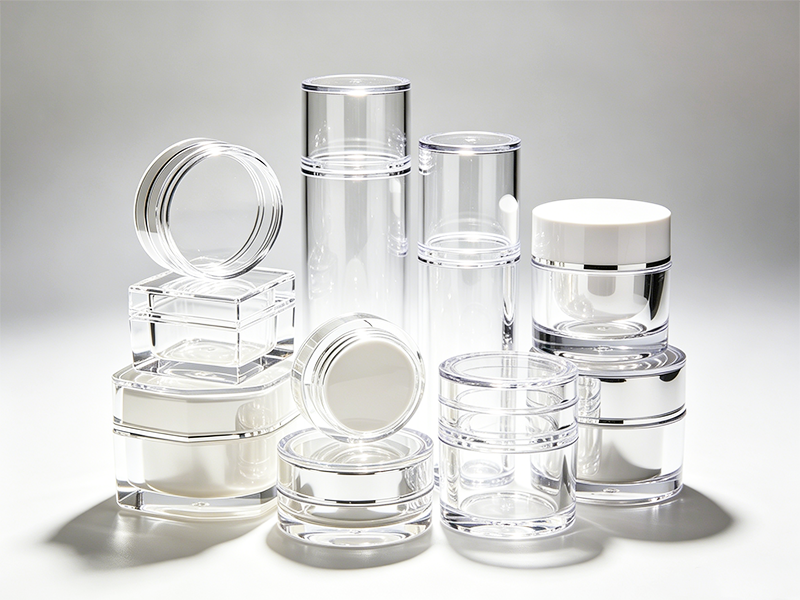
SAN/AS material is also commonly used in cosmetic packaging, transparent containers, caps, jars, boxes, and display packaging. In these products, appearance is often just as important as function. The material’s natural gloss and transparency allow SAN injection molded parts to present a clean, bright, and premium visual effect.
For cosmetic packaging, SAN can be used for cream jars, transparent caps, protective covers, sample containers, and outer shells. Compared with some softer or opaque plastics, SAN provides better rigidity and a harder surface feel, which can improve the perceived quality of the final product. Its resistance to oils and certain chemicals also makes it suitable for selected packaging applications, depending on the actual formulation inside the product.
In custom SAN injection molding, surface quality control is very important for this type of application. Black spots, flow marks, scratches, weld lines, or stress whitening may directly affect the customer’s first impression. Therefore, mold polishing, material cleanliness, stable molding parameters, and careful packaging after production are all important for clear SAN plastic parts.
SAN resin injection molding can also be used for certain electronic and industrial plastic components, especially when the part requires a transparent or semi-transparent appearance. Typical examples include display windows, indicator covers, transparent panels, protective covers, light-duty housings, and inspection windows.
In electronic products, transparent parts often need stable dimensions and good surface quality to fit with other components. SAN’s rigidity and dimensional stability make it suitable for parts that require a fixed shape and clean appearance. For some industrial applications, SAN can be used for clear protective covers or viewing windows where users need to observe internal parts or operating conditions.
That said, SAN/AS is not suitable for all electronic or industrial environments. If the part needs strong impact resistance, high heat resistance, flame-retardant performance, or outdoor UV stability, other engineering plastics may be more appropriate. Before choosing AS injection molding or SAN plastic injection molding, the product’s working conditions, assembly method, safety requirements, and long-term use environment should be reviewed carefully.
Uniform wall thickness is one of the most important design rules for SAN injection molded parts. If the wall thickness changes too sharply, the plastic melt may cool unevenly, which can lead to sink marks, warpage, internal stress, or dimensional variation. This is especially important for transparent or glossy SAN/AS parts, because small defects are easier to notice on clear surfaces.
For SAN resin injection molding, designers should avoid thick sections, sudden transitions, and unnecessary material accumulation. If ribs, bosses, or reinforced areas are required, they should be designed carefully to improve strength without creating sink marks on the appearance surface. Smooth transitions, proper rib thickness, and balanced wall design can help the part fill more evenly and cool more consistently.
In custom SAN injection molding, wall thickness should also be reviewed together with the product’s function and production volume. A part that is too thin may have filling difficulty or weak strength, while a part that is too thick may increase cooling time and deformation risk. A balanced structure helps improve both part quality and molding efficiency.
Because SAN/AS material has limited impact strength, stress concentration should be avoided in product design. Sharp corners, tight snap-fit structures, thin connection areas, and forced assembly features may increase the risk of cracking, stress whitening, or breakage after molding or during use. This is one of the key points engineers should consider in AS injection molding and SAN plastic injection molding projects.
Adding proper radii to internal and external corners can help reduce stress concentration and improve part durability. For screw bosses, clips, hooks, and assembly structures, the design should allow enough flexibility and avoid excessive force during assembly. If the product requires repeated opening, pressing, locking, or impact resistance, SAN/AS may not always be the best material choice.
The actual SAN plastic properties should be matched with the product’s working conditions. SAN is suitable for rigid, clear, and dimensionally stable plastic parts, but it is not ideal for parts that must absorb strong impact or bending force. Early design review can help reduce cracking risks and improve the success rate of SAN injection molded parts in mass production.
Many SAN/AS products are transparent or high-gloss parts, so appearance requirements should be considered from the beginning of the design stage. In custom SAN injection molding, the location of parting lines, gate marks, ejector marks, weld lines, and visible surfaces can directly affect the final product quality. If these details are ignored before mold manufacturing, they may be difficult or expensive to correct later.
For clear or cosmetic SAN injection molded parts, designers should define which surfaces are appearance-critical and which areas can accept minor marks. This helps mold engineers plan the mold structure, gate position, ejection system, and polishing requirements more reasonably. A good mold design can reduce visible defects and improve consistency during SAN resin injection molding.
SAN/AS injection molding is a practical choice for plastic parts that require transparency, surface gloss, rigidity, and dimensional stability. SAN plastic injection molding can produce clear and stable plastic components for household products, appliances, cosmetic packaging, electronic parts, and selected industrial applications.
At Alpine Mold, we provide custom SAN injection molding solutions from mold design and mold manufacturing to injection molding production. Our engineering team can review your 3D drawings, material requirements, surface finish, tolerance needs, and production volume to help optimize the mold structure and improve part quality. If you are looking for a reliable partner for your next insert molding or overmolding project, contact us today to discuss how we can turn your ideas into high-quality molded products.
SAN and AS are often used to describe very similar styrene-acrylonitrile copolymer materials. In many markets, AS plastic is commonly understood as Acrylonitrile Styrene, while SAN means Styrene Acrylonitrile. In practical injection molding projects, both terms are often used when discussing transparent, rigid plastic parts.
SAN material itself is often used in food-contact applications such as containers, cups, and kitchenware, but whether it is food grade depends on the specific resin grade and supplier certification. For food-contact products, customers should choose certified food-grade SAN resin and confirm compliance with FDA, LFGB, EU, or other required standards.
Yes. SAN is commonly used for transparent or semi-transparent plastic parts. It offers good clarity and surface gloss, making it suitable for clear covers, containers, display windows, cosmetic packaging, and appliance parts. However, mold polishing, clean production conditions, and stable molding parameters are important for appearance quality.
SAN and acrylic can both be used for clear plastic parts, but they are not the same. Acrylic generally has better optical clarity and weather resistance, while SAN usually offers good rigidity, easier processing, and better chemical resistance than general-purpose polystyrene. The final choice depends on product function, cost, appearance, and use environment.
Yes. SAN plastic can be molded in transparent, translucent, or colored versions depending on the resin grade and color masterbatch. For transparent colored parts, color control must be handled carefully because impurities, uneven mixing, or material degradation can easily affect the final appearance.


