
Views: 0 Author: Site Editor Publish Time: 2026-09-04 Origin: Site


Have you ever encountered a situation where product order volumes are rising, yet the production efficiency of a single-cavity injection mold can no longer keep up with demand? Or perhaps long production cycles are driving up delivery times and costs? Multi-cavity injection molding offers a solution to these challenges. This article explores the working principles, advantages, design considerations, and common applications of multi-cavity injection molding to help you select the right solution for your products.
Table of Contents
| 1. What is multi-cavity injection molding? |
| 2. Advantages of multi-cavity injection molding |
| 3. Key factors in multi-cavity mold design |
| 4. Applications of multi-cavity injection molding |
| 5. Conclusion |
| 6. FAQ |
Multi-cavity injection molding involves using a mold with multiple cavities to produce several identical parts within a single injection cycle. In high-volume manufacturing, multi-cavity molds meet large-scale production demands while ensuring product quality and cost-effectiveness. The most common type is the two-cavity mold, which produces two identical parts per cycle; however, configurations producing eight, sixteen, or even more parts in a single cycle are also common.
Multi-cavity injection molding produces multiple parts per cycle, making it ideal for high-volume production. Here are some of the advantages:
Compared to single-cavity molds, multi-cavity molds produce more parts in the same amount of time, thereby shortening delivery schedules. For instance, while a single-cavity mold might produce one part in 30 seconds, an eight-cavity mold can produce eight parts in that same timeframe.
Balanced cavity filling is achieved through sophisticated runner and cooling channel systems. All parts undergo identical material conditions, injection pressures, cooling times, and production parameters, ensuring consistent dimensions and weight, as well as stable aesthetic quality.
By producing multiple parts simultaneously, multi-cavity molds effectively reduce machine run time, labor costs, and energy consumption. For products with an annual production volume of hundreds of thousands or even over a million units, although multi-cavity injection molds have a higher upfront cost, the total expense is lower when amortized across the production cost of each individual part.
Poor design of multi-cavity injection molds can lead to inconsistencies in product weight, dimensions, appearance, and shrinkage rates across different cavities. Therefore, the following aspects require careful consideration during the design process:
First, determine whether a 2-cavity, 4-cavity, 8-cavity, or higher-cavity configuration is appropriate. A higher number of cavities allows for more parts to be produced per injection cycle, thereby increasing production efficiency. However, more cavities are not always better; increasing the cavity count complicates the mold structure, runner layout, and cooling system, while also raising manufacturing costs and increasing the difficulty of future maintenance.
Consequently, the decision regarding cavity count should be based on a comprehensive assessment of your specific needs to select the solution best suited to your project.
Key factors to consider include:
Projected annual production volume
Product dimensions and weight
Structural complexity of the product
Material type
Injection molding machine clamping force
Mold dimensions
Target cycle time
Mold budget
For example, a small, lightweight product with a simple structure and an annual demand of millions of units might be suitable for an 8-cavity, 16-cavity, or even higher-cavity mold. Conversely, for a large, structurally complex product with low annual demand, a single-cavity or 2-cavity mold would be more appropriate.
If you are unsure about the optimal number of cavities for your injection mold, please share your product design drawings and requirements with us, and we will provide the best design solution.
Wall thickness directly affects the flow of the plastic melt, cooling rates, product shrinkage, and dimensional stability. In multi-cavity molds, consistent wall thickness makes it easier to maintain uniform filling and molding results across all cavities.
Maintain uniform wall thickness: Wall thickness should be as consistent as possible across all areas of the product. Abrupt changes in thickness should generally be avoided; if a change is necessary, a gradual transition is recommended—ideally with a transition length approximately three times the magnitude of the thickness change—to minimize sink marks, warpage, and internal stress.
Avoid excessive wall thickness: The typical wall thickness for most injection-molded parts ranges from 1 to 4 mm. Excessive wall thickness increases material usage and prolongs cooling time, as cooling time typically rises significantly with increased thickness.
Avoid excessively thin walls: Areas that are too thin increase resistance to melt flow, making short shots more likely. Recommended wall thickness ranges for common materials include: ABS (approx. 1.1–3.5 mm), PC (approx. 1.0–3.8 mm), PP (approx. 1.0–3.8 mm), and PA (approx. 0.8–2.9 mm).
Do not make reinforcing ribs too thick: Rib thickness is generally recommended to be 40%–60% of the adjacent main wall thickness; this enhances strength while minimizing sink marks.
Adjust design based on material: Flow characteristics and shrinkage rates vary significantly between materials; therefore, the final wall thickness should be evaluated by considering the material, product dimensions, flow-length ratio, and number of cavities.
The draft angle directly affects the ease of part ejection and the likelihood of surface defects such as scuffing, stress whitening, or deformation. For multi-cavity molds, an appropriate draft angle helps maintain consistent ejection conditions across cavities, reducing product variations caused by uneven ejection resistance.
General draft angle for outer surfaces: A minimum of 0.5°–1° is usually recommended.
Draft angle for inner surfaces: 1°–2° is typically recommended; since the part grips the core tightly upon cooling, the inner surfaces usually require a larger draft angle.
Textured surfaces: These require larger draft angles. The angle is generally increased based on texture depth; common designs range from 2°–5° or higher.
Deep-cavity products: The deeper the part, the greater the ejection resistance; therefore, the draft angle usually needs to be increased accordingly.
Avoid zero draft: Vertical walls with no draft angle are prone to scratching and stress whitening, and increase the risk of deformation during ejection.
Specific draft angles should be determined based on part depth, material shrinkage, surface texture, aesthetic requirements, and the direction of ejection. For multi-cavity products with deep cavities or high aesthetic standards, it is advisable to confirm the ejection direction and draft angles during the DFM (Design for Manufacturability) stage to avoid costly mold modifications later.
When using multi-cavity molds, it is crucial to ensure consistency in the dimensions of parts produced across different cavities; otherwise, assembly issues—such as parts being too tight, too loose, or even impossible to assemble—can easily arise.
Dimensional tolerances for standard injection-molded parts generally range from ±0.1 to ±0.3 mm. Critical dimensions—such as assembly holes, snap-fits, and mating surfaces—are usually controlled more strictly, often to within ±0.05 mm, with precision parts requiring even tighter tolerances.
However, tighter tolerances are not always better. Stricter tolerances increase the difficulty of mold machining, mold trials, and subsequent production control, thereby raising costs.
Therefore, the design process typically focuses on the critical dimensions that directly impact assembly and functionality.
The choice between a hot runner system and a cold runner system directly affects mold costs, material utilization rates, and molding stability:
Cold runner systems feature a simple structure and lower mold costs, making them suitable for projects with low production volumes, simple product designs, or limited budgets. However, they generate runner waste during every injection cycle, resulting in higher material loss.
Hot runner systems keep the plastic within the runners in a molten state, virtually eliminating cold runner waste. They are better suited for high-cavity molds (e.g., 16, 32, or 64 cavities) and facilitate automated production.
The final choice should not be based solely on mold price; factors such as the number of cavities, annual production volume, material costs, product structure, and downstream production costs must all be considered.
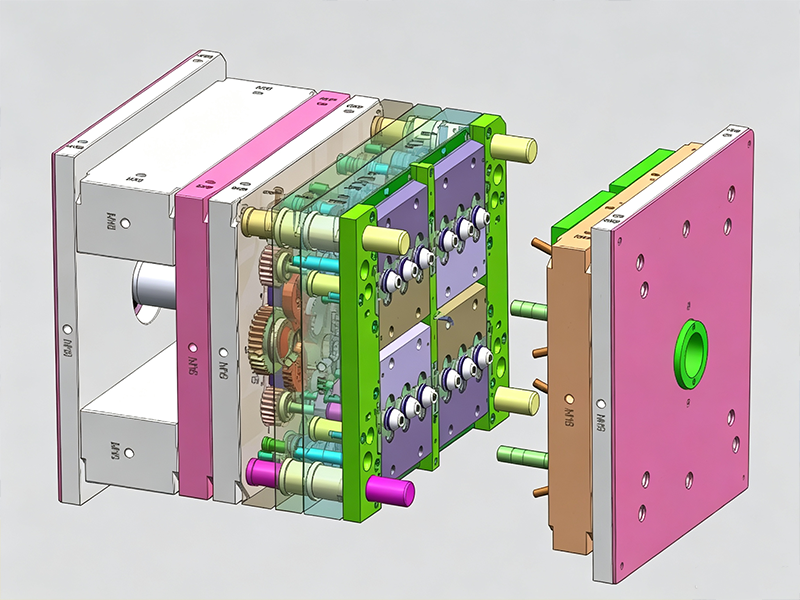
When production requirements reach hundreds of thousands of units or more per month, single-cavity molds often struggle to balance production capacity with per-unit costs. In such cases, multi-cavity solutions—featuring 4, 8, 16, or even more cavities—should be considered. These allow for the production of multiple parts within a single injection cycle, shortening production time and distributing equipment, labor, and tooling costs across a larger volume of products.
Multi-cavity injection molding is typically well-suited for the following product categories:
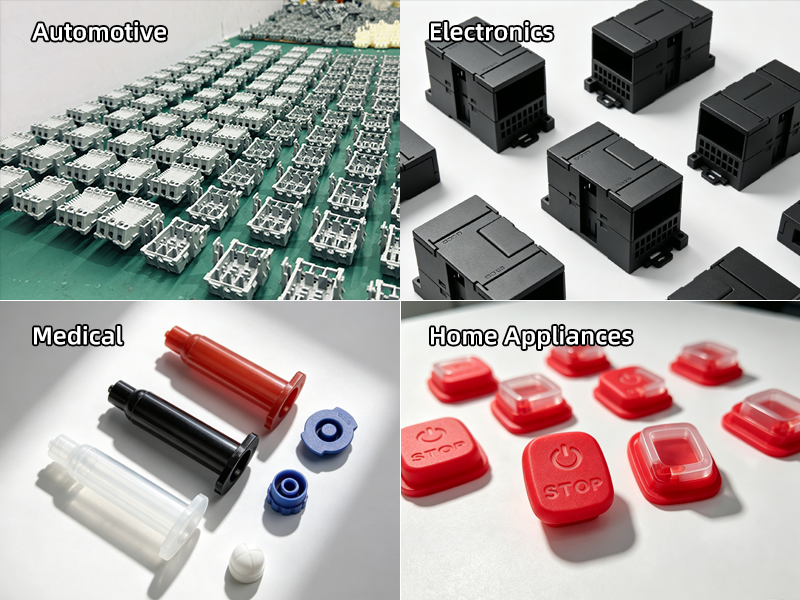
Automotive Industry: Connector housings, clips, buttons, switch components, etc. These products generally have high demand and stable dimensional and assembly requirements, making them ideal for long-term mass production. Multi-cavity molds increase output per machine and reduce cycle times, offering significant advantages for high-volume automotive projects.
Electronics Industry: Plug housings, relay casings, terminal protective covers, etc. These parts are usually small, allowing for a higher number of cavities per mold. For products with mature designs and stable order volumes, multi-cavity solutions can substantially lower per-unit production costs.
Medical Industry: Medical connectors, tubing fittings, syringe components, etc. Medical plastic parts often demand high dimensional consistency and batch-to-batch stability; therefore, multi-cavity mold design must prioritize controlling dimensional and weight variations between cavities alongside maximizing output.
Home Appliance Industry: Small control panels, sensor housings, switch panels, etc. These products typically undergo long production runs with stable order volumes. Using multi-cavity molds reduces the time injection machines are occupied and improves delivery efficiency for entire batches.
If your project has reached the stage of stable mass production, we generally advise against selecting a mold simply based on the rule "higher volume equals more cavities." A more appropriate approach involves calculating the optimal configuration by considering product dimensions, part weight, material, target annual output, and injection machine specifications.
In some instances, the overall production cost of an 8-cavity mold may actually be more economical than that of a 16-cavity mold. Determining the right number of cavities is not merely about increasing output; it is about striking the optimal balance between tooling investment, production efficiency, and per-unit cost.
Multi-cavity injection molding involves configuring multiple cavities within a single mold to produce multiple identical parts in one injection cycle, making it ideal for high-volume, efficient plastic part production. Key considerations during design include the number of cavities, runner system layout, wall thickness, draft angles, part tolerances, cooling systems, and the choice between hot and cold runner systems. A well-designed mold not only boosts production efficiency but also ensures consistent quality across parts produced in different cavities.
If you are looking for a manufacturer of multi-cavity injection molds, please contact us. Alpine Mold boasts over twenty years of experience in multi-cavity mold design and offers comprehensive support for mold manufacturing and injection molding production.
Mold lifespan depends on the mold material, production conditions, and maintenance. Generally, injection molds can produce anywhere from hundreds of thousands to over a million cycles. For long-term mass production projects, the appropriate mold steel is selected based on projected output.
No. While more cavities increase production efficiency, they also result in more complex mold structures and higher manufacturing costs. Actual design decisions require a comprehensive assessment of product dimensions, annual volume, material, injection molding machine tonnage, and budget.
Cost advantages typically become apparent at annual volumes exceeding 200,000–300,000 units. For small parts with monthly demands in the hundreds of thousands—such as connector housings or clips—starting with an 8-cavity mold is common. For annual volumes under 100,000 units, single-cavity or 2-cavity molds are usually more cost-effective.
Yes. Compared to single-cavity molds, multi-cavity molds require greater precision in runner balancing, cooling system design, and cavity machining to ensure consistent dimensions and quality for parts produced in every cavity.
A multi-cavity injection mold features multiple cavities within a single mold assembly, allowing for the simultaneous production of multiple identical plastic parts during a single injection molding cycle. Common cavity counts include 2, 4, 8, and 16 cavities, primarily for high-volume production.


