WhatsApp: +86 18126157548 Email: kerry@alpinemold.com

Views: 0 Author: Danny Publish Time: 2026-03-24 Origin: Site


In the field of injection molding, understanding the structure of injection molds is key to ensuring the successful mass production of injection-molded parts. Injection mold components not only determine the dimensional accuracy and surface quality of plastic products but also play a key role in optimizing cycle times and reducing production costs. Below, let's delve into the structure and components of injection molds.
| Table of Contents |
| 1. The Core Components of an Injection Mold |
| 1.1 Mold Base Structure |
| 1.2 Feeding System |
| 1.3 Molding System |
| 1.4 Ejection System |
| 1.5 Venting System |
| 1.6 Cooling System |
| 1.7 Positioning System |
| 1.8 Guiding System |
| 2. Conclusion |
| 3. FAQs |
| 3.1 What is The Average Cost of an Injection Mold? |
| 3.2 How Long Does It Take to Make an Injection Mold? |
| 3.3 What Material are Injection Molds Made of? |
| 3.4 What is the Life Expectancy of an Injection Mold? |
The core components of a plastic injection mold include the mold base structure, feeding system, molding system, ejection system, cooling system, venting system, and positioning and guiding system.
Next, I will outline the names and functions of these mold components. For certain components requiring special attention, I will also note key design considerations.
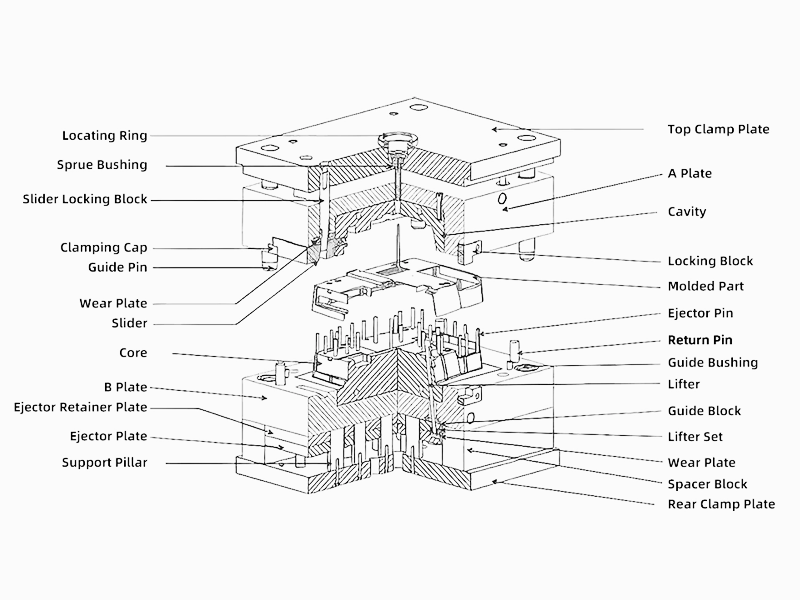
The mold base, also known as the plate set or die set, is more than just a collection of plates. It serves as the foundation ensuring the entire mold's alignment, rigidity, ejection stability, cooling integration, mold change efficiency, and long-term maintainability. Common standard mold base systems include HASCO, DME, MISUMI, and LKM.
The mold base comprises the following components: A-side plate, B plate, C plate (spacer plate), top clamping plate,runner Stripper plate, support plate, ejector retainer plate, ejector plate, bottom clamping plate, and others.
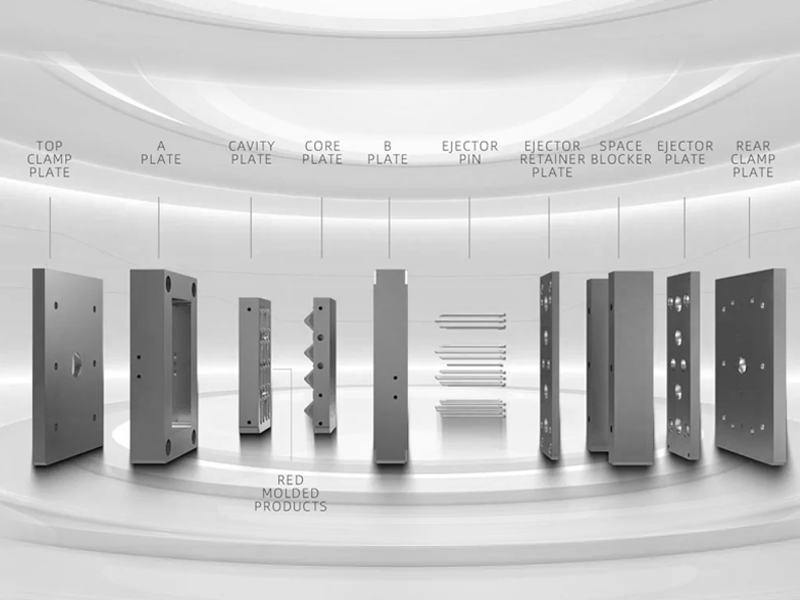
A Plate: The A plate is located on the fixed mold side (A side) and serves as the core template for installing and supporting the cavity. The A plate directly determines the surface quality of the product, the fit of the parting line, and the overall rigidity of the mold. During injection, molten plastic exerts immense pressure on the parting line, making the A plate the first template to bear this force. If the A plate is too thin, it can cause the parting line to open, leading to flash and cosmetic defects. Therefore, material selection requires careful consideration. Choose materials with high rigidity such as S50C, P20, 718, H13, or S136.

B Plate: The B plate is located on the moving mold side (B side). It is the key template that bears the product core and directly connects to the ejection system. The B plate has a more complex structure than the A plate and determines whether the product can be ejected smoothly, stably, and over the long term. If the B plate is too thin and lacks sufficient rigidity, it can lead to poor ejection and inadequate cooling, resulting in white marks on the product and deformation. As the load-bearing core of the ejection system, the B plate must be sufficiently thick and hard, typically made from materials like P20, 718, or 718H.

C Plate (Spacer Plate): Positioned on the moving mold side beneath the B plate, the C plate provides movement space for the ejection system, offers support, and absorbs ejection reaction forces to protect the B plate from deformation. While non-functional for molding, it directly determines ejection smoothness and mold durability. Common materials for C-plates include P20, 1.2311, 718, 1.2738, S50C, C45, etc.

Top Clamping Plate: The top clamping plate is the outermost plate on the fixed mold side, serving as the first plate on that side. Its function is to securely mount the mold on the injection molding machine, transmit and distribute clamping force and injection reaction force, provide precise installation and positioning, and facilitate mold lifting, maintenance, and safe transportation. Common materials for the top clamping plate include P20 / 1.2311 / 718 / 1.2738 / S50C / C45.

Runner Plate: The Runner Plate specifically refers to the middle plate in a three-plate mold, positioned on the fixed mold side between the Upper Clamping Plate and the A Plate. It is a structural plate designed to support and form the main runner/sprue, enabling automatic separation of the runner from the part and creating a point gate.
Support Plate: The Support Plate is located on the moving mold side, mounted beneath the B Plate. It is a structural plate used to support the core area, distribute ejection reaction forces and molding stresses, and prevent deformation of the B Plate.
Ejector Retainer Plate: The ejector retainer plate is positioned on the moving mold side. It is a structural plate used to secure the positions of ejector pins, ejector sleeves, ejector blocks, and other ejection components.
Ejector Plate: The ejector plate is located on the moving mold side (B side). It is the power plate directly connected to the injection molding machine's ejection system, responsible for driving the forward and backward movement of ejector pins and other ejection components.
Bottom Clamping Plate: The bottom clamping plate is positioned at the outermost edge of the moving mold side and is the final plate on this side. It is a structural plate that directly contacts and secures the moving mold plate of the injection molding machine. It is responsible for mounting, force transmission, ejector alignment, and overall stability.

Feeding System conveys molten plastic from the injection molding machine nozzle into the mold, ensuring it is delivered accurately, stably, and uniformly into the molding cavity. It serves as the passageway for plastic entering the mold cavity, comprising the main runner, runner system, gate, and cold runner cavity.

Sprue: The sprue is the initial segment of the internal flow channel system through which molten plastic enters the mold from the injection machine nozzle. Typical sprue types include tapered sprues, straight-bore sprues, and sprues in hot runner systems.
Sprue design considers the following factors: taper design, surface roughness, diameter size, and cold runner well fit.
Runner: Located between the sprue and the gate, the runner is the channel structure that evenly distributes molten plastic from the sprue to one or more cavities. Common runner types include circular runners, semi-circular runners, trapezoidal/U-shaped runners, and runners in hot runner systems.
Key runner design principles: balance principle, dimensional design principle, bend and branch design, cold runner well coordination, surface condition.
Gate: The gate serves as the final passage connecting the feeding system to the molding system. Various gate types exist, such as sprue gates, submarine gates, and pin gates, with selection determined by product requirements.
Key engineering considerations for gate design: gate location selection, gate dimensions, relationship with product geometry, relationship with mold structure, and relationship with material properties.
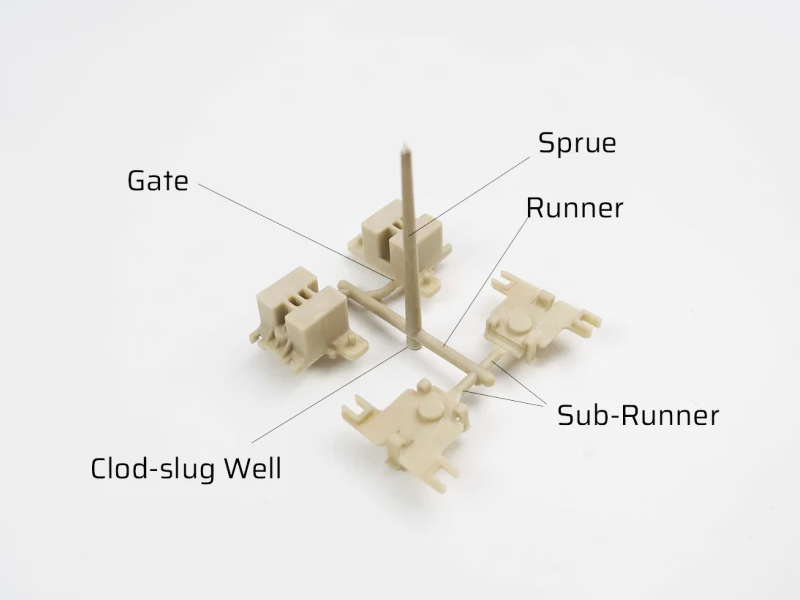
Cold Slug Well: The cold slug well is a cavity structure within the injection mold's feed system specifically designed to contain and intercept low-temperature, partially cooled plastic melt. Common types include straight-hole cold slug wells, tapered cold slug wells, stepped cold slug wells, and cold slug wells integrated with pull rods.
Design considerations: Positioning must align directly with the material flow direction; sufficient depth and volume are required; dead corners must be avoided; surface polishing is unnecessary.
The molding system is the core functional system in a mold, responsible for forming the shape and dimensions of the product. It includes structures such as the front mold, back mold, parting surface, molding inserts, gate surface, shut-off surface, core pin surface, pillow block, and side core pulling (slide). The molding system includes structures such as the cavity, core, inserts, and parting surface.

Cavity: The cavity is the concave space in an injection mold used to form the external shape and appearance of the plastic product. It is the core molding part that determines the product's shape and appearance quality, and it is also the most intuitive part of the injection mold and the part whose value is most easily perceived by the customer. The selection of cavity material mainly depends on the product's appearance requirements, plastic material, annual product output & mold life requirements, product structure complexity, and polishing and processing difficulty. Commonly used materials include S136/1.2083, H13/SKD61, 718/1.2738, etc.
Cavity design prioritizes the following points: dimensional accuracy and shrinkage compensation, surface quality and texture, parting line position, venting design, rigidity and stress resistance.
Core: The core is the convex molding component in an injection mold used to form the internal shape, inner cavity, and functional structures of the plastic product. It determines whether the product can be assembled, whether it can be used, and whether demolding is smooth. The selection of core material mainly depends on the plastic material, annual product output & mold life requirements, and the complexity of the product's internal structure. Commonly used materials include S136/1.2083, H13/SKD61, 718/1.2738/P20, etc.
Core design prioritizes the following points: draft angle, surface condition, rigidity and anti-breakage design, cooling design, and coordination with the ejection system.
Inserts: Inserts refer to molding components in an injection mold where part of the product's molding area is made into a removable independent part and embedded in the cavity or core. Using molding inserts helps improve mold maintainability, facilitates the processing of complex structures, solves cooling and heat dissipation problems, and supports later modifications and upgrades. Common types of mold inserts include cavity inserts, core inserts, local functional inserts, and replaceable identification inserts.
The structural design of molding inserts prioritizes positioning methods, fixing methods, parting line treatment, and venting design.
Parting Surface: Parting Surface refers to the interface in an injection mold where the stationary mold (A-side) and the moving mold (B-side) come into contact during mold closing, forming a sealed molding space. The parting surface determines the boundary lines of the product's appearance and affects the demolding direction and method. Common forms of parting surfaces include: planar parting surfaces, curved parting surfaces, and stepped parting surfaces.
The following points should be considered in parting surface design: prioritizing appearance, ensuring easy demolding, guaranteeing rigidity, ensuring controllable venting, and minimizing the number of parting surfaces.
The ejection system is responsible for safely, smoothly, and without deformation ejecting the cooled and molded plastic product from the mold after the mold opens. It is one of the crucial mold systems that determines the quality of product demolding, the appearance quality, and the mold lifespan. Common ejection methods include ejector pin ejection, ejector sleeve ejection, ejector block ejection, ejector plate ejection, and air ejection assistance.

The ejection system consists of the following key components:
Ejection Elements: Ejection elements mainly include ejector pins, ejector sleeves, ejector blades, ejector blocks, stripper plates, air ejectors, and lifters.
Ejector Retainer Plate: This mainly includes counterbored or stepped fixing holes for securing the ejector pin heads, ejector pin through holes, screw holes for connecting to the ejector plate, and through-hole structures for the passage or cooperation of ejector components such as return pins and guide pins.
Ejector Plate: This includes ejector pin through holes, sleeve ejector holes, angle pin/lifter rod holes, ejector guide pin holes, return pin holes, ejector rod contact pads, and bolt holes for screw connections.
Return System: Return pins, springs, and gas springs.
Ejection Guiding System: Ejector guide pins, ejector guide bushings, stop pins, and stop blocks.
An improperly designed ejection system can lead to injection molding defects such as deformation, whitening, or cracking during the ejection process. Therefore, we must design the ejection system rationally and follow the following design principles: ejection must be "uniform," ejector pins should not be placed on the visible surface, the ejection stroke must be sufficient, and the ejection system must operate smoothly.
The venting system is a structural system that allows air, gases, and volatile substances to be smoothly expelled from the mold cavity during the injection molding process, preventing them from being trapped by the molten plastic. The venting system typically includes the following types: parting line venting, ejector pin venting, vent grooves/channels, and insert venting.

An improperly designed venting system can lead to molding defects such as burning, short shots, and gas marks. Considerations for venting location design include: the vent location should be placed at the last point to be filled, do not rely solely on parting line venting, the vent groove depth must be less than the critical value for material flashing, and the vent groove should be narrower at the front and wider at the back, etc.
The cooling system is a system that rapidly removes the heat generated by the molten plastic during the molding process, allowing the plastic to solidify and take shape, and enabling smooth demolding. Types of cooling systems include: straight drilled channels, parallel cooling, series cooling, baffle cooling, bubbler cooling, spiral cooling, conformal cooling, insert cooling, etc.

The cooling system is not just a few holes drilled in the mold; it consists of several key components:
Internal Channel Structure: Cooling channels and manifolds
Diversion & Dissipation Elements: Baffles, bubblers, thermal pins/heat pipes
Connection & Sealing Fittings: Connectors/nipples, plugs, o-rings
External Equipment: Mold temperature controller and chiller
Considerations for cooling system design: Cooling should be uniform; areas with concentrated heat should have enhanced cooling; cooling channels should be as close to the mold cavity as possible while maintaining strength; both the mold core and mold cavity should have independent cooling, etc.
The positioning system is a structural mechanism that ensures the correct orientation and precise alignment between the male and female mold halves during assembly and adjustment. Its primary structural types include: Tapered Interlocks; Straight Interlocks; Dowel Pins; Parting Line Locks; Slide Positioning; Lifter Positioning; Insert Positioning; and Locating Ring.

Design Principles for Positioning Systems:Positioning structures must be located near the cavity.
- Taper angles should be reasonable (typically 5°–10°).
- Positioning blocks must be replaceable.
- Guidance contacts first, followed by locking after positioning.
- Large molds require multi-point positioning.
The guiding system is a structural mechanism that ensures all moving components of the mold follow precise trajectories during opening and closing operations, preventing misalignment and collision damage. The guiding system comprises: guide pillar, guide bushing, inner guide pins, ejector guide pin, ejector guide bushing, slide guide rail, angle pin, lifter guiding, and return system guiding and more.

Guiding System Design Considerations: Guide pillars must contact before locating blocks to prevent hard impacts; Lubrication is mandatory; Slide guide surfaces must be sufficiently large, with adequate guide pillar length; Symmetrical arrangement is required to avoid unilateral stress.
The structures mentioned above constitute the fundamental components of an injection mold, constituting a highly coordinated system that determines product quality, production efficiency, and mold longevity. A precision-engineered mold is more than just steel and structure; it lies in understanding how these systems work together to better serve stable, long-term mass production of plastic parts.
At Alpine Mold, we specialize in designing and manufacturing precision injection molds, placing high emphasis on component optimization and system integration. With 24 years of engineering expertise and advanced manufacturing capabilities, we help clients transform complex product designs into reliable, production-ready mold solutions. If you have any request for injection molds, contact us today!
The typical price range for molds is generally between $1,000 and $100,000, with an average price of $15,000.
Prototype mold prices range from $800 to $5,000.
Simple production mold prices range from $3,000 to $6,000.
Medium-complexity production mold prices range from $6,000 to $15,000+.
Large or high-volume production mold prices range from $15,000 to $100,000+.
Injection mold manufacturing typically takes 2 to 20 weeks, depending on the complexity of the product design.
Generally, a simple mold requires 2 to 4 weeks to complete.
A moderately complex mold requires 4 to 8 weeks or longer to complete.
A highly complex mold usually requires 8 to 20 weeks to complete.
Injection Molds are made of aluminum or steel material.
aluminum: 7075,6061, 5052 and more.
Steel: P20, NAK80, 718, 718H, 738 ,S136,H13,S7,420,SKD61 and more.
Class 101: 1,000,000+ cycles for high volume.
Class 102: Up to 1,000,000 cycles for medium-high volume.
Class 103: 100,000 to 500,000 cycles for medium volume.
Class 104: Under 100,000 cycles for low volume.
Class 105 Under 500 cycles for prototype.


