WhatsApp: +86 18126157548 Email: kerry@alpinemold.com

Views: 0 Author: Site Editor Publish Time: 2026-06-01 Origin: Site


PPA injection molding is a practical solution for producing plastic parts that need to withstand high temperatures, mechanical stress, and strict dimensional requirements. Because of its excellent heat resistance, strength, and stability, PPA is widely used in automotive, electrical, electronics, and industrial applications.
However, PPA is also a material that requires careful processing. Material drying, mold temperature, gate design, cooling balance, and injection parameters can all affect the final part quality. In this guide, we will explain PPA material properties, the PPA injection molding process, key design considerations, common defects, and typical applications of PPA injection molded parts.
Table of Contents
| 1. What Is PPA Injection Molding? |
| 2. PPA Material Properties |
| 3. PPA Injection Molding Process |
| 4. Key Design Considerations for PPA Injection Molding |
| 5. Common PPA Injection Molding Defects and Solutions |
6. Applications of PPA Injection Molded Parts |
7. Conclusion |
8. FAQ |
PPA injection molding is a manufacturing process used to produce plastic parts from PPA, also known as polyphthalamide. PPA is a high-performance engineering thermoplastic in the polyamide family. Compared with standard nylon materials such as PA66, PPA offers better heat resistance, higher strength, lower moisture absorption, and improved dimensional stability.
In the PPA injection molding process, dried PPA resin is heated until it melts, then injected into a precision mold cavity under pressure. After cooling and solidification, the molded part is ejected from the mold. This process is suitable for producing complex, high-strength, and heat-resistant plastic components with stable repeatability.
PPA plastic injection molding is commonly used for automotive parts, electrical connectors, electronic components, industrial parts, and other applications that require long-term performance in demanding environments. For projects with strict tolerance, high temperature, or metal replacement requirements, PPA injection molded parts can provide a strong balance between performance, weight reduction, and production efficiency.
PPA is a high-performance engineering plastic known for its excellent heat resistance, mechanical strength, and dimensional stability. In PPA injection molding, these material properties make it suitable for demanding applications such as automotive parts, electrical connectors, electronic components, and industrial structural parts.
However, PPA is not a universal material for every plastic part. It also has certain processing challenges and cost considerations. Understanding both the advantages and limitations of PPA helps engineers and buyers choose the right material for their injection molded parts.
Aspect | Advantages | Limitations |
Heat Resistance | PPA can maintain good strength and stiffness in high-temperature environments. | It requires higher processing temperatures, so mold temperature control and machine capability are important. |
Mechanical Strength | PPA offers high strength, rigidity, and creep resistance, especially with glass fiber reinforcement. | Glass-filled PPA may cause higher mold wear and requires careful mold steel selection. |
Dimensional Stability | PPA absorbs less moisture than standard nylon materials, helping reduce dimensional changes. | Shrinkage and warpage still need to be controlled through proper part design and mold design. |
Chemical Resistance | PPA has good resistance to oils, fuels, and many chemicals. | Material compatibility should still be checked based on the actual working environment. |
Electrical Performance | PPA provides good electrical insulation, making it suitable for connectors and electronic components. | Poor drying or unstable molding conditions may affect part appearance and performance. |
Metal Replacement | PPA injection molded parts can sometimes replace metal parts to reduce weight and improve production efficiency. | Material cost is usually higher than common plastics such as ABS, PP, or PA66. |
PPA material properties make it a strong choice for high-temperature, high-strength, and dimensionally stable plastic parts. But to achieve reliable results, PPA plastic injection molding requires proper material drying, mold design, gate design, cooling balance, and injection molding parameter control.

PPA injection molding requires careful control throughout the process because PPA (polyphthalamide) is sensitive to moisture and requires high processing temperatures. Each step directly affects the quality and performance of the final parts. Below is a detailed step-by-step workflow for producing high-quality PPA injection molded parts:
PPA absorbs moisture easily, and any residual water can cause silver streaks, bubbles, poor surface finish, or reduced mechanical strength. Before molding, the resin must be fully dried.
Typically, PPA is dried in a dehumidifying dryer at 160–180°C for 4–6 hours, depending on the material grade and moisture content. After drying, the material should be stored in sealed containers to prevent moisture absorption before injection.
Before mold manufacturing, engineers carefully review the part structure and mold design:
Maintain uniform wall thickness to reduce warpage and shrinkage
Design ribs and bosses to strengthen parts without creating thick sections that cause sink marks
Select gate locations that allow smooth flow and minimize weld lines
Optimize cooling channels to balance temperature and reduce residual stress
Ensure ejection mechanisms allow smooth demolding, especially for complex parts
Conducting a DFM review and Moldflow analysis at this stage helps prevent potential molding issues and ensures the mold will produce stable PPA injection molded parts.
PPA requires relatively high mold temperatures, typically 120–160°C.
Before production, check that the cooling circuits are functioning correctly, vents are sufficient, and ejection systems operate smoothly. Mold-release coatings may be used if needed to protect both the mold and the part surface.
The dried PPA resin is heated to 300–330°C (depending on the material grade) and injected into the mold cavity.
Key injection parameters must be carefully controlled: injection pressure, injection speed, holding pressure, holding time, and cooling time all influence cavity filling, shrinkage, and part warpage.
For glass-filled PPA, flow orientation must be managed carefully to ensure mechanical strength and dimensional accuracy.
After mold completion, the first trial run verifies mold design and processing parameters:
Check surface quality for flow marks, weld lines, or silver streaks
Measure critical dimensions to ensure they meet design specifications
Evaluate assembly fit or functional performance
Any issues found at this stage—such as short shots, warpage, or surface defects—require adjustment of gate design, venting, cooling layout, or injection parameters to ensure stable production.
Once the trial run is successful, process parameters are fine-tuned for repeatable production:
Adjust injection speed and holding pressure to achieve uniform filling
Optimize mold temperature and cooling layout to reduce residual stress and warpage
Refine gate or venting design if needed to prevent defects
The goal is consistent part quality throughout the production run while maintaining an efficient cycle time.
During mass production, strict quality control ensures that all PPA injection molded parts meet dimensional, mechanical, and functional requirements:
Measure critical dimensions with calipers or CMM
Inspect surface finish and check for warpage or deformation
Perform assembly or functional tests as needed
Monitor batch-to-batch consistency
A well-controlled process ensures PPA parts deliver high strength, heat resistance, and dimensional stability in demanding automotive, electronics, and industrial applications.

Designing PPA injection molded parts requires careful attention to material behavior, part geometry, and mold layout. Each factor directly affects part quality, dimensional stability, and surface finish. Below is a detailed breakdown of the main design considerations with practical parameters.
Maintain uniform wall thickness between 0.3–1.5 mm. Excessively thick areas can cool slowly, leading to sink marks and internal stresses, while overly thin sections may cause short shots or weak points. Consistent wall thickness ensures dimensional stability and reduces warpage during cooling.
Engineering note: In CAD models, highlight wall thickness variations with a gradient to quickly identify potential problem areas.
Use ribs for structural reinforcement rather than increasing wall thickness. Rib thickness should be 40–60% of the main wall thickness to avoid sink marks. Bosses should be supported with ribs to maintain uniform flow and part strength.
Engineering note: Annotate rib and boss thickness ratios in CAD to guide mold design and maintain flow balance.
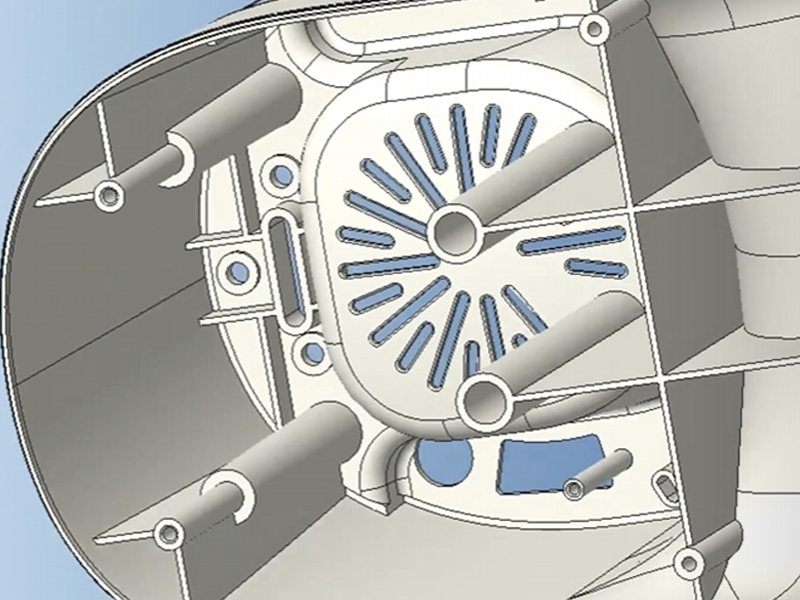
Position gates to enable smooth flow into the cavity and minimize weld lines. For glass-filled PPA, gate location also affects fiber orientation, which impacts strength and shrinkage. Proper gate design helps prevent short shots and reduces internal stress.
Engineering note: Show recommended gate positions on the mold cavity diagram for reference during tool design.
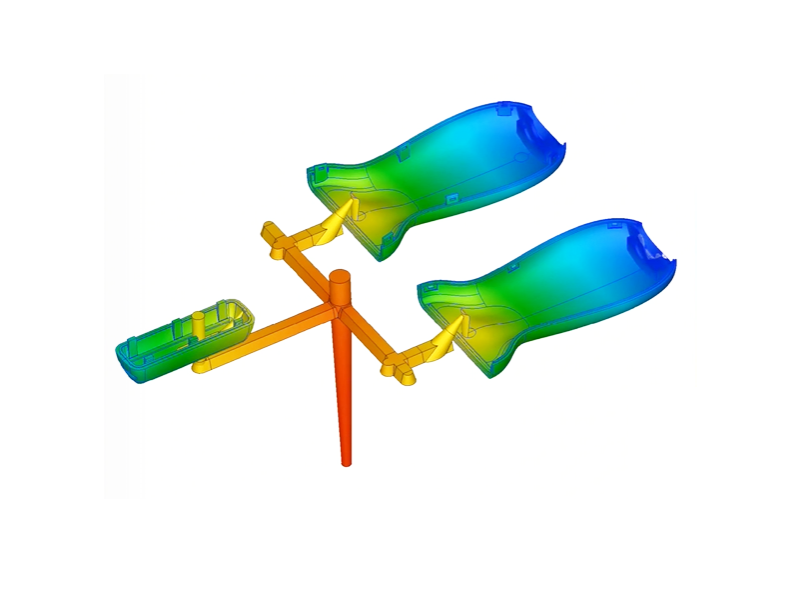
Balanced cooling is critical to reduce residual stress and warpage. Design cooling channels to ensure uniform mold temperature, especially for large or complex parts. Optimized cooling also shortens cycle time and improves dimensional consistency.
Engineering note: Include cooling channel paths in 3D mold views to visualize heat dissipation and support tooling planning.
Glass-filled PPA exhibits predictable shrinkage and flow-dependent warpage. Designers should account for material properties and fiber orientation to achieve proper dimensions and assembly fit. Using Moldflow or similar simulations helps anticipate and correct potential deformation.
Engineering note: Overlay shrinkage and fiber orientation data on part models to evaluate potential warpage before production.
Include draft angles of 0.5–1° for thin walls and 1–2° for thicker sections to facilitate smooth ejection. Ejection system design must complement draft angles to prevent sticking, reduce mold wear, and maintain consistent part quality.
Engineering note: Mark draft angles and ejector pin positions on CAD cross-sections for easy review by the mold-making team.
Surface finish affects aesthetics and functionality. Specify polish or texture depending on component requirements. Proper mold finishing improves appearance, reduces assembly friction, and ensures consistent cosmetic quality for connectors, housings, or visible parts.
Engineering note: Include surface finish specifications directly in mold drawings and CAD notes for reference during machining and polishing.
Even with proper design and optimized process parameters, PPA injection molded parts can still encounter defects if material handling, mold design, or processing is not carefully controlled. Below are the most common defects in PPA molding, their underlying causes, and professional solutions for preventing or correcting them.
Description:
Warpage occurs when parts twist, bend, or deform after ejection from the mold. This can cause assembly misalignment, gaps, or uneven surfaces, particularly in thin-walled or large components.
Causes:
Non-uniform wall thickness or abrupt changes in section thickness
Uneven cooling due to improperly designed cooling channels
Flow-induced stress and fiber orientation in glass-filled PPA
Differential shrinkage between thick and thin sections
Solutions:
Maintain uniform wall thickness and smooth transitions between thick and thin areas during part design
Optimize cooling channel layout to ensure balanced temperature distribution
Position gates to promote balanced flow and reduce fiber orientation effects
Use Moldflow simulation to predict and compensate for warpage in the design stage
For critical parts, consider using support ribs or inserts to reinforce geometry
Description:
Short shot occurs when the molten PPA does not fully fill the mold cavity, leaving incomplete sections or missing features. This is common in thin walls, complex geometries, or long flow paths.
Causes:
Insufficient injection pressure or velocity
High melt viscosity of PPA, especially in reinforced grades
Poor venting or blocked air escape points
Cold spots in the mold due to uneven heating or cooling
Solutions:
Adjust injection pressure, speed, and screw backpressure to ensure complete cavity filling
Ensure material is properly dried to reduce viscosity-related flow problems
Design and maintain adequate venting channels to allow trapped air to escape
Preheat molds and balance mold temperatures to avoid cold spots
For long or thin features, consider using multiple gates or sub-gates to reduce flow length
Description:
Flash is the unwanted thin layer of plastic that escapes along the parting line or around ejector pins, often requiring post-processing to remove.
Causes:
Excessive injection pressure exceeding mold clamping capacity
Poor mold fit or wear on parting surfaces
Inadequate clamping force during injection
Warping or shrinkage causing gap formation between mold halves
Solutions:
Set injection pressure within the optimal range for the specific PPA grade
Ensure mold components are precisely machined, aligned, and maintained
Increase clamping force appropriately for high-pressure applications
Use simulation or trial runs to detect potential flash areas and modify mold design if necessary
Consider adding backup pins or interlocks in critical areas of the mold
Description:
Sink marks appear as depressions or dimples on the surface, typically in thicker sections or behind ribs and bosses. They are caused by uneven cooling or insufficient packing.
Causes:
Localized thick sections that cool slower than surrounding areas
Inadequate holding pressure or insufficient packing time
Uneven cooling or temperature gradients in the mold
Solutions:
Reduce wall thickness or add ribs to distribute material and heat more evenly
Increase holding pressure and optimize packing time to compensate for shrinkage
Balance cooling channels to maintain uniform mold temperature
For high-precision cosmetic parts, perform trial runs and adjust parameters iteratively
Description:
Silver streaks or flow lines are surface defects that appear as thin white lines following the melt flow direction. They affect aesthetics and can indicate internal stress.
Causes:
Moisture in the resin leading to vapor formation during molding
Inadequate melt temperature causing premature solidification
Rapid cooling or abrupt flow changes in the cavity
Solutions:
Ensure PPA resin is thoroughly dried before molding, using the recommended temperature and time
Maintain correct barrel and mold temperatures to allow smooth flow
Adjust injection speed and optimize flow paths to reduce turbulence
For reinforced grades, position gates to minimize abrupt flow direction changes
Description:
Parts fail to meet dimensional specifications or assembly tolerances. Even small deviations can affect fit, performance, or assembly.
Causes:
Unstable process parameters (temperature, pressure, cooling)
Uneven shrinkage due to fiber orientation or thick sections
Mold wear over repeated production cycles
Solutions:
Continuously monitor and stabilize process parameters during production
Use simulation tools to predict shrinkage and compensate in mold or part design
Inspect molds regularly and maintain precision of cavities, cores, and inserts
Implement quality control checkpoints during production to detect and correct variations early
By understanding the root causes and applying these professional solutions, manufacturers can produce PPA injection molded parts with high dimensional stability, surface quality, and mechanical performance, suitable for automotive, electronics, and industrial applications.
PPA injection molded parts are widely used in applications that require high heat resistance, mechanical strength, dimensional stability, and chemical resistance. The material’s versatility makes it suitable for automotive, electronics, and industrial components.
PPA is commonly used for under-the-hood and structural components in vehicles. Its high temperature and chemical resistance allow it to perform reliably in demanding automotive environments. Typical applications include:
Engine covers and housings
Fuel system components
Cooling system connectors and ducts
Electrical connectors and sensor housings
Clips, brackets, and fasteners that replace metal parts
PPA injection molded parts in automotive applications provide weight reduction, corrosion resistance, and long-term dimensional stability, making them ideal for both performance and cost efficiency.

The excellent electrical insulation properties and heat resistance of PPA make it ideal for electronic components and connectors. Common applications include:
Electrical connectors and terminals
Switch housings and insulating components
Coil bobbins and transformer parts
High-temperature electronic enclosures
In electronics, using PPA plastic injection molding ensures components maintain their form and function under thermal stress and repeated operation cycles.
PPA is also used in industrial equipment and machinery where mechanical strength and chemical resistance are required. Examples include:
Pump housings and impellers
Valve components
Gear or structural components in mechanical assemblies
High-strength supports or brackets exposed to heat or chemicals
For industrial applications, PPA injection molded parts offer long-term reliability, dimensional stability, and the ability to replace metal parts in some cases, improving production efficiency and reducing weight.
When PPA is properly molded, it delivers reliable performance across automotive, electronics, and industrial applications. High-temperature resistance, mechanical strength, and dimensional stability make it suitable for demanding parts. Achieving consistent quality depends on careful material selection, precise mold design, and stable processing parameters.
PPA injection molding enables engineers to produce durable, high-performance parts for applications where heat resistance, strength, and dimensional stability are critical. Proper design, mold construction, and process control ensure that PPA parts can meet the most demanding functional and cosmetic requirements.
If you are planning a project with PPA, collaborating with an experienced custom PPA injection molding manufacturer can streamline development and ensure reliable results. At Alpine Mold, we offer one-stop support from design review and mold manufacturing to production. Share your 3D drawings, material requirements, and production volume to get a technical evaluation and quote.
8.1 What is the difference between PA and PPA?
PA (polyamide, e.g., PA6, PA66) is a commonly used engineering plastic, but it has limitations in high-temperature performance and moisture absorption. PPA (polyphthalamide) is a semi-aromatic polyamide with higher heat resistance, lower moisture uptake, better dimensional stability, and improved chemical resistance. Compared with standard PA, PPA is better suited for demanding automotive, electronics, and industrial applications.
8.2 What is PPA 30% GF?
PPA 30% GF refers to PPA reinforced with 30% glass fiber by weight. The addition of glass fiber significantly increases stiffness, mechanical strength, and dimensional stability, while reducing shrinkage and warpage. Glass-filled PPA is commonly used in high-strength components, such as automotive connectors, sensor housings, and industrial parts.
8.3 Is PPA the same as nylon?
PPA is a type of polyamide (nylon), but it is not the same as standard nylon like PA6 or PA66. Unlike conventional nylon, PPA has higher heat resistance, lower moisture absorption, and superior dimensional stability, making it suitable for high-temperature or high-performance applications where regular nylon would fail.
8.4 Is PPA a thermoplastic?
Yes. PPA is a thermoplastic polymer, meaning it can be melted, shaped, and re-melted multiple times. This property allows it to be processed using injection molding, extrusion, or other standard thermoplastic manufacturing techniques, while providing excellent mechanical and thermal performance in the finished parts.


