WhatsApp: +86 18126157548 Email: kerry@alpinemold.com

Views: 0 Author: Site Editor Publish Time: 2026-07-08 Origin: Site


| 1. What is CNC Machining? |
| 2. How Does CNC Machining Work? |
| 3. Common CNC Machining Materials |
| 4. The Role of CNC Machining in Mold Manufacturing |
| 5. Conclusion |
| FAQ |
When you are developing a new product or preparing a manufacturing project, you may need parts with accurate dimensions, stable quality, and repeatable results. This is where CNC machining becomes an important manufacturing process. By using computer-controlled machines, CNC machining helps turn your digital design into a real part through cutting, drilling, milling, or turning.
Before choosing a supplier or manufacturing method, it is helpful to understand what is CNC machining and how the CNC machining process works. In this article, you will learn the basic CNC machining definition, common CNC machining materials, and how CNC machining is used in mold manufacturing. This will help you better evaluate part quality, production requirements, and the right solution for your project.
CNC machining, short for Computer Numerical Control machining, is a manufacturing process that uses computer-controlled machines to remove material from a workpiece and create a required shape. In simple terms, the CNC machining process follows digital instructions from a programmed file, allowing the machine tool to cut, drill, mill, or turn the material with high consistency.
Unlike manual machining, CNC machining does not rely mainly on hand operation. The movement of the cutting tool, spindle speed, cutting depth, and machining path are controlled by a computer program. This helps improve machining accuracy, repeatability, and production efficiency.
The basic CNC machining definition can be understood as: a subtractive manufacturing method where a computer-controlled machine removes material step by step to produce a finished part according to the design drawing.
For you, understanding what is CNC machining is the first step to evaluating part quality, machining precision, production cost, and the right manufacturing method for a project.

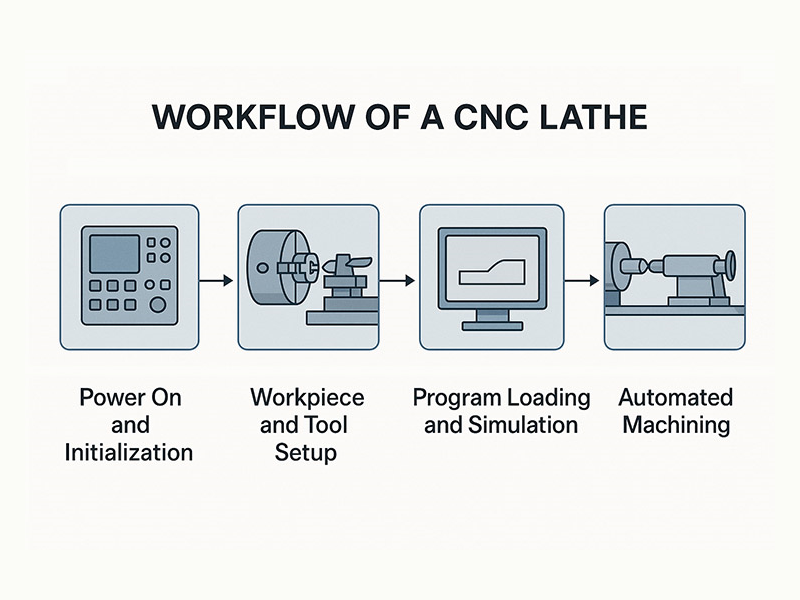
To understand how CNC machining works, it helps to look at the process from design to finished part. The CNC machining process starts with a digital product design, usually a 3D CAD file. This file shows the shape, dimensions, holes, surfaces, and key features that need to be machined.
After the design is confirmed, engineers use CAM software to create the machining program. This program tells the CNC machine how the cutting tool should move, where to remove material, how deep to cut, and which machining path to follow. In other words, the machine does not decide by itself — it follows precise instructions from the CNC program.
During machining, the workpiece is fixed on the machine table or chuck. The cutting tool then moves according to the programmed tool path. Depending on the part structure, the machine may perform milling, drilling, boring, tapping, or turning operations. Each step removes material gradually until the part reaches the required shape and size.
1.CAD design preparation
The product or part design is created in 2D or 3D format.
2.CAM programming
Engineers convert the design into a CNC machining program.
3.Material and tool setup
The workpiece is fixed, and suitable cutting tools are selected.
4.CNC machining operation
The machine cuts the material according to the programmed tool path.
5.Inspection and adjustment
The finished part is checked for size, tolerance, and surface quality.
The advantage of computer numerical control machining is that the cutting path can be repeated again and again with stable accuracy. This makes CNC machining more consistent than manual machining, especially for parts that require accurate dimensions, complex details, or repeatable production quality.
In simple terms, CNC machining works by combining digital design, CNC programming, machine control, cutting tools, and inspection. Each step affects the final result, so a good CNC machined part depends not only on the machine itself, but also on proper programming, tool selection, setup, and quality control.
Material selection is an important part of the CNC machining process. Different CNC machining materials have different strength, hardness, machinability, surface finish, and cost. Choosing the right material can help improve machining quality, reduce production risk, and make the final part more stable.
In general, common materials for CNC machining can be divided into three main groups: metal materials, plastic materials, and mold steel materials.
Metal materials are widely used for CNC machined parts because they offer good strength, durability, and dimensional stability. The right metal material depends on the part function, tolerance requirements, surface finish, and working environment.
Metal Material | Main Features | Common Applications |
Aluminum | Lightweight, easy to machine, good surface finish, cost-effective | Housings, brackets, prototypes, precision CNC machined parts |
Stainless Steel | Strong, corrosion-resistant, durable, but harder to machine | Industrial parts, medical parts, mechanical components |
Brass | Easy to machine, good electrical conductivity, stable dimensions | Connectors, fittings, electrical parts, small precision parts |
Carbon Steel | Good strength, stable performance, relatively economical | Fixtures, tools, mechanical parts, industrial components |
Among these materials, aluminum CNC machining is very common because aluminum is easy to cut and can achieve a clean surface finish. Stainless steel is more difficult to machine, but it is often selected when the part needs higher strength or better corrosion resistance.
Plastic is also commonly used in CNC machining, especially for functional prototypes, lightweight parts, and low-volume plastic components. Compared with metal, plastic is easier to cut, but it may be more sensitive to heat, deformation, and clamping pressure during machining.
Plastic Material | Main Features | Common Applications |
ABS | Good impact resistance, easy to machine, cost-effective | Plastic prototypes, housings, functional test parts |
PC | Strong, tough, transparent options available | Covers, protective parts, transparent components |
POM | High stiffness, low friction, good dimensional stability | Gears, bushings, precision plastic parts |
PA / Nylon | Strong, wear-resistant, good mechanical performance | Functional parts, industrial plastic components |
PMMA | Good transparency, smooth surface finish | Clear covers, display parts, optical appearance parts |
For plastic CNC machining, material choice should be carefully evaluated. Some plastics may deform during machining if the wall is too thin or the clamping force is too high. Therefore, engineers need to consider the product structure, cutting heat, tolerance, and surface requirements before machining.
In injection mold manufacturing, mold steel CNC machining is especially important. Mold steel affects mold life, machining difficulty, polishing quality, wear resistance, and long-term production stability. Different plastic materials and production volumes may require different mold steels.
Mold Steel Material | Main Features | Common Applications |
P20 | Common mold steel, good machinability, suitable for general molds | General plastic injection molds |
718H | Better hardness and stability than P20, suitable for medium-volume molds | Mold cores, cavities, general production molds |
S136 | Good corrosion resistance and polishing performance | Transparent parts, high-gloss parts, medical or cosmetic molds |
NAK80 | Good surface finish, stable performance, suitable for precision molds | Precision mold inserts, appearance parts |
H13 | High hardness, good heat resistance and wear resistance | High-temperature molds, high-wear mold components |
For CNC machining for injection molds, mold steel should be selected based on the plastic material, mold life, surface finish, and production requirements. For example, glass fiber materials may require better wear resistance, while transparent plastic parts usually require mold steel with better polishing performance.
Overall, the best CNC machining material is not always the most expensive one. It should match the real application, part structure, tolerance requirements, surface finish, production quantity, and cost target.
In mold manufacturing, CNC machining is one of the most important processes used to create accurate mold components. A plastic injection mold is not a simple block of steel. It is made of many precision parts, including mold cavities, mold cores, inserts, sliders, lifters, plates, and other custom components. Many of these parts need CNC machining before the mold can be assembled and tested.
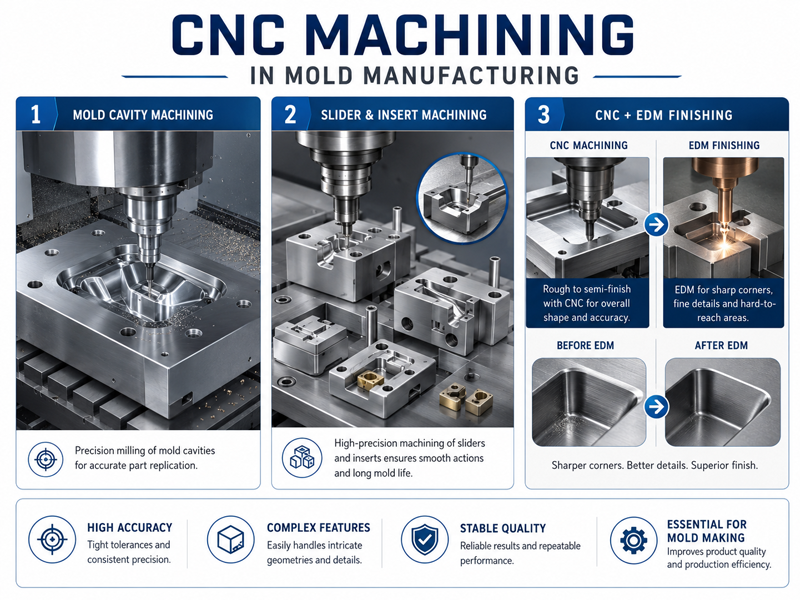
One major application of CNC machining for injection molds is machining mold cavities and cores. These two areas directly affect the shape, size, and appearance of the final plastic product.
During injection mold CNC machining, engineers need to control the machining path, cutting depth, tool selection, and machining allowance carefully. Rough CNC machining is usually used first to remove most of the steel material. Then semi-finishing and finishing operations are used to improve accuracy and surface quality.
For complex plastic parts, the mold cavity may include curved surfaces, ribs, bosses, holes, assembly areas, and sealing structures. CNC machining helps create these features with good consistency, but for very deep ribs, narrow slots, or sharp internal corners, EDM machining may still be needed after CNC machining.
Besides cavities and cores, precision CNC machining is also widely used for mold inserts, sliders, lifters, and other moving components. These parts are important because they help form undercuts, side holes, clips, threads, or special product structures.
For example, a slider must move smoothly during mold opening and closing. A lifter must eject the product without damaging the part. If these components are not machined accurately, the mold may have fitting problems, unstable movement, or even product deformation.
This is why precision mold machining is not only about cutting steel. It is also about controlling tolerance, matching different mold components, and making sure the mold can run smoothly during trial and mass production.
In plastic injection mold manufacturing, CNC machining quality directly affects the final result. Accurate CNC machining can help improve mold fitting, reduce modification time, shorten mold trial cycles, and improve product consistency.
Poor CNC machining, on the other hand, may cause many problems later, such as unstable dimensions, flash, mismatch, difficult assembly, poor appearance, or repeated mold modifications.
This is why an experienced injection mold manufacturer needs not only CNC machines, but also skilled engineers, proper programming, suitable cutting tools, stable quality inspection, and a complete mold manufacturing process.
At Alpine Mold, we focus on custom plastic injection mold manufacturing and injection molding production. With in-house CNC machining, EDM, WEDM, mold assembly, trial molding, and quality inspection, we help customers turn product designs into reliable production molds. If you have a new plastic product project, please send us your 3D drawing in STEP, IGS, or X-T format. Our engineering team will review your design and provide a suitable mold solution and quotation.
Yes, CNC machining is suitable for small to medium batch production, especially when high precision and consistency are required.
CNC machining removes material from a solid block, while injection molding forms parts by injecting molten material into a mold cavity.
Common surface finish options for CNC machined parts include as-machined finish, polishing, sandblasting, anodizing, plating, painting, and texture finishing. The best option depends on the material, appearance requirements, function, and final application.
3-axis CNC machining moves the cutting tool along X, Y, and Z directions. 4-axis CNC machining adds rotation for more flexible machining, while 5-axis CNC machining allows the tool or workpiece to move from more angles, making it suitable for complex surfaces and precision parts.
For CNC machining, 3D CAD files are usually required. Common file formats include STEP, IGS, X-T, and sometimes STL. For accurate quotation and machining evaluation, STEP format is usually preferred because it contains clear solid model information.


