WhatsApp: +86 18126157548 Email: kerry@alpinemold.com

Views: 0 Author: Site Editor Publish Time: 2026-11-28 Origin: Site
Known for its toughness, elasticity, abrasion resistance, and mechanical strength, thermoplastic polyurethane (TPU) is widely used in automotive components, medical devices, consumer electronics, and industrial equipment. Its performance varies depending on its chemical composition, hardness, grade, and processing conditions. Is it the right material for your product?
This guide explores the key properties, advantages, common types, and processing methods of TPU. We also compare TPU with other flexible materials to help you choose the most suitable material for different applications.
Table of Contents
What Is TPU Plastic
Key Properties of TPU Plastic
Types of TPU Plastic
Common Applications of TPU
Processing Methods for TPU Plastic
TPU vs. Other Flexible Materials
Conclusion
FAQ
TPU, short for thermoplastic polyurethane, is a thermoplastic elastomer (TPE) that combines the flexibility and elasticity of rubber with the processing characteristics of thermoplastics. This allows it to be repeatedly softened by heating and solidified by cooling, making it possible to manufacture products in a wide range of shapes and structures.
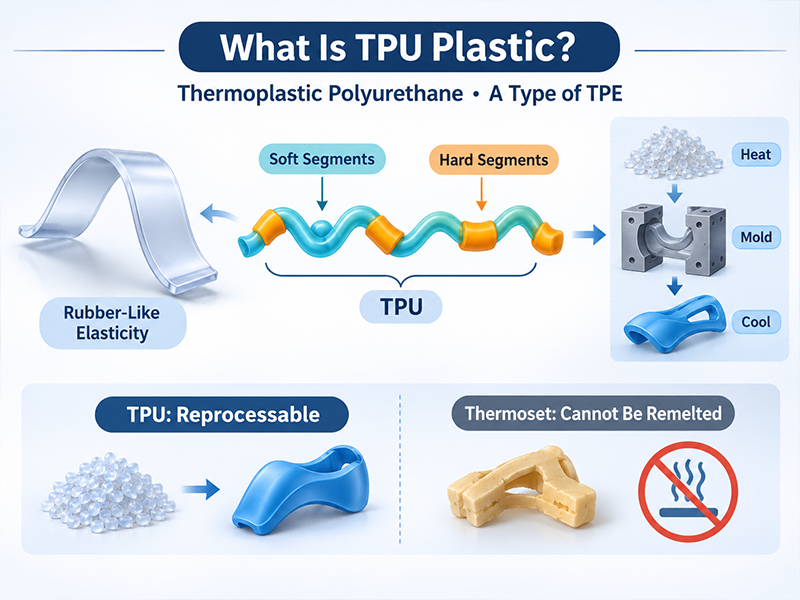
The molecular structure of TPU contains two important types of segments within the same polymer chain.
Soft Segments
Soft segments give TPU its flexibility, elasticity, and low-temperature performance. These are the soft, elastic portions of the material that deform under an external force and can recover, to some extent, once the force is removed.
Hard Segments
Hard segments act as the internal supporting structure, providing TPU with mechanical strength, hardness, and dimensional stability.
The interaction between soft and hard segments gives TPU its distinctive elastomeric properties. As a result, TPU can be used to make both soft, flexible products and industrial components that require high abrasion resistance and mechanical strength.
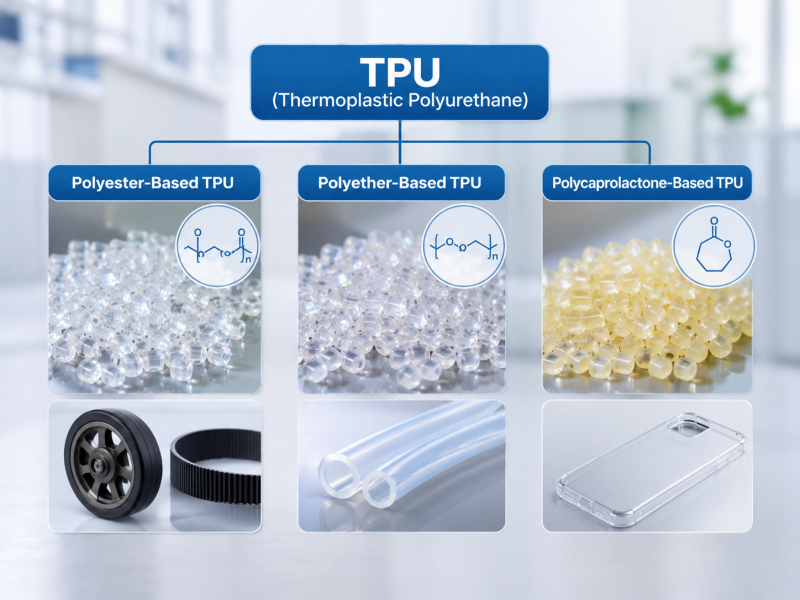
Different types of TPU are classified according to the chemical structure of the polyol used to form the soft segments. The three most common chemical types of TPU are described below.
Polyester-Based TPU
The soft segments of this type of TPU are primarily made from polyester polyols. Polyester polyols are typically formed through the polycondensation of dicarboxylic acids and diols. The resulting polyester chains contain a large number of ester linkages. This structure gives the material good tensile strength and load-bearing capacity, as well as the ability to withstand everyday wear.
Polyether-Based TPU
Common polyether polyols include PTMEG, PPG, and PEG, with PTMEG being the most widely used in TPU production.
The molecular backbone of polyether polyols contains ether linkages. This structure generally gives the material greater segmental flexibility and better resistance to hydrolysis.
Polycaprolactone-Based TPU
This is a special type of polyester-based TPU that uses polycaprolactone polyol (PCL polyol) as its primary soft-segment raw material.
PCL polyols are typically produced through the ring-opening polymerization of ε-caprolactone monomers. This type of TPU can offer a degree of balance between the mechanical properties of polyester-based TPU and the environmental resistance of polyether-based TPU.
Quick Comparison of TPU Types
Comparison Criteria | Polyester-Based TPU | Polyether-Based TPU | Polycaprolactone-Based TPU |
Soft-Segment Raw Material | Polyester polyol | Polyether polyol | Polycaprolactone polyol |
Main Chemical Linkages | Ester linkages | Ether linkages | Ester linkages |
Typical Advantages | Mechanical strength, abrasion resistance, and oil resistance | Hydrolysis resistance and low-temperature flexibility | A balance of mechanical properties and hydrolysis resistance |
Hydrolysis Resistance | Relatively low | Generally high | Generally better than conventional polyester-based TPU |
Typical Applications | Industrial rollers, conveyor belts, and hydraulic hoses | Medical tubing, waterproof cables, and outdoor products | Hydraulic seals and pneumatic seals |
TPU manufacturers formulate different grades to meet specific product performance and processing requirements. The following are eight common functional grades of TPU.
Functional TPU Grade | Modification Technology | Key Properties | Typical Applications |
Hydrolysis-Resistant TPU | Polyether soft segments to reduce ester linkages; hydrolysis stabilizers | Hydrolysis resistance and stability under heat and humidity | Hoses and underwater cables |
UV-Resistant TPU | Aliphatic structures and UV stabilizers | Resistance to yellowing and weathering | Outdoor and automotive components |
Flame-Retardant TPU | Addition of flame retardants | Flame retardancy and reduced flame propagation | Cable jackets and electronic components |
Reinforced TPU | Reinforcing fillers such as glass fiber | Improved stiffness and dimensional stability | Industrial structural components |
Antistatic / ESD TPU | Antistatic agents and conductive fillers | Static dissipation | Protective components for electronic equipment |
Transparent TPU | Optimization of polymer structure and formulation | Transparency and flexibility | Transparent protective components and tubing |
Antimicrobial TPU | Antimicrobial additives | Inhibition of the growth of specific microorganisms | Medical and healthcare equipment |
Medical-Grade TPU | Selection of medical-grade raw materials, formulation, and manufacturing controls | Biocompatibility and compatibility with specific sterilization methods | Medical tubing and catheters |
TPU hardness is primarily measured on two scales: Shore A and Shore D. The table below outlines common TPU hardness ranges and their corresponding material characteristics.
TPU Hardness | Material Characteristics | Typical Applications |
60A–70A | Very soft with good elasticity | Flexible tubing and soft seals |
75A–85A | Soft with good elasticity | Flexible protective covers and soft grips |
85A–95A | Medium to relatively high hardness, balancing flexibility and support | Phone cases, shoe soles, and industrial parts |
95A–100A | Harder, with good mechanical support | Wear-resistant components and structural flexible parts |
40D–50D | Relatively high hardness with good dimensional support | Industrial components and mechanical parts |
50D–75D | Harder, with relatively lower flexibility | High-stiffness engineering components |
If your product needs to bend or deform significantly, a Shore A grade is generally a good starting point. If greater hardness and structural support are required, consider a higher-hardness TPU grade, using the Shore D scale when appropriate.
l Elasticity and Flexibility
Flexibility allows TPU to bend or deform, while its elasticity helps it return to its original shape or close to it after the external force is removed. For example, a TPU phone case can flex without being as prone to brittle fracture as ordinary rigid plastics.
l Tensile Strength and Tear Resistance
TPU typically has a tensile strength of approximately 25–60 MPa. Its tear resistance helps prevent an existing cut or tear from propagating, making it suitable for components exposed to mechanical stress, such as flexible tubing and industrial seals.
l Abrasion and Wear Resistance
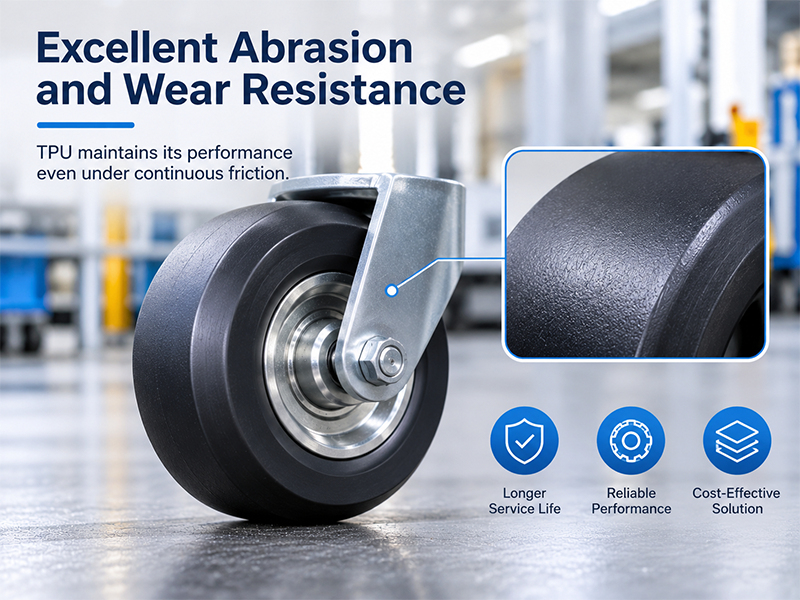
TPU can maintain good surface integrity under repeated friction, helping reduce material wear. This is an important advantage in many industrial components.
l Impact Resistance
When exposed to an external impact, TPU can absorb and dissipate some of the impact energy through material deformation, reducing the likelihood of cracks or breakage caused by sudden loading. This makes it suitable for products that may experience sudden impacts, including electronic-device cases, automotive protective components, and sports protective equipment.
l Chemical and Oil Resistance
TPU generally offers good resistance to lubricating oils, greases, and mineral oils. However, chemicals such as fuels, aromatic hydrocarbons, and ketone solvents may cause the material to swell and affect its mechanical properties.
l Low-Temperature Flexibility
TPU grades with good low-temperature performance can retain a degree of flexibility at temperatures of -30°C to -40°C. For example, GAPI offers a polyether-based TPU grade designed for low-temperature applications, with a glass transition temperature of approximately -54°C and a brittleness temperature of approximately -52°C.
l Hydrolysis Resistance
Hydrolysis occurs when certain chemical bonds in a material break in the presence of water. This damages the polymer chains and can consequently affect the material's mechanical properties.
Different chemical types of TPU have different levels of hydrolysis resistance. If your product will be used in a humid environment for an extended period, polyether-based TPU is often worth considering first.
l Transparency and UV Resistance
The transparency of TPU depends on its formulation and processing conditions, while its UV resistance also varies with its chemical structure. Aromatic TPU may yellow after prolonged exposure to ultraviolet (UV) radiation, whereas aliphatic TPU generally offers better UV resistance and resistance to yellowing. Therefore, if transparency and appearance are important to your product, you should also consider the material's weatherability.
TPU helps automotive components withstand long-term friction, vibration, and demanding operating conditions. It is commonly used in soft interior components, wire-harness jackets, seals, and protective components. These applications help protect internal wires from friction and mechanical damage and help limit the ingress of dust and moisture.
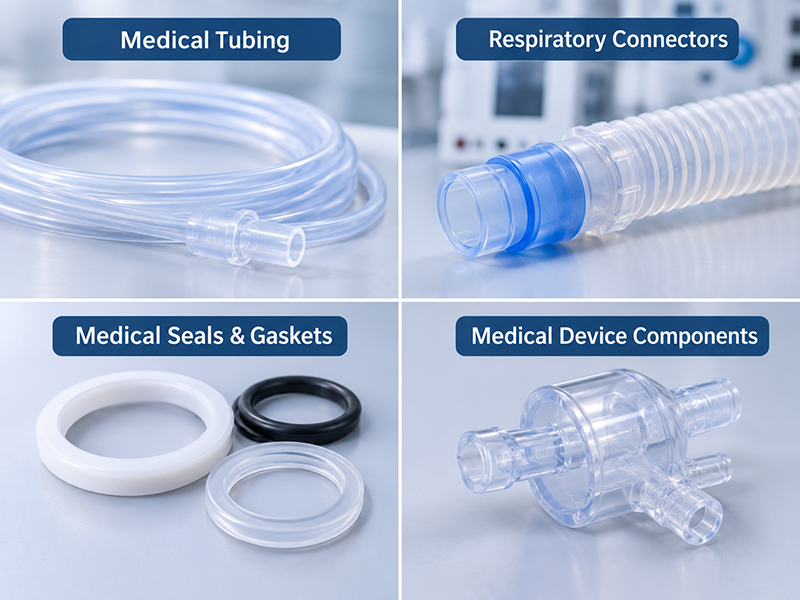
TPU's flexibility and elasticity make it suitable for medical tubing, catheters, respiratory-device connectors, and flexible components in medical equipment. It can maintain flexibility and structural integrity in contact with the human body, reducing the risk of restricted fluid flow caused by kinked tubing. Certain medical-grade TPU formulations can also meet specific biocompatibility and sterilization requirements.
TPU's abrasion resistance, tear resistance, and good resistance to certain lubricating oils make it suitable for industrial components that are regularly exposed to friction, compression, or mechanical impact. These properties can help extend component service life. Its elasticity also allows seals to accommodate minor variations in mating surfaces, helping improve sealing performance.
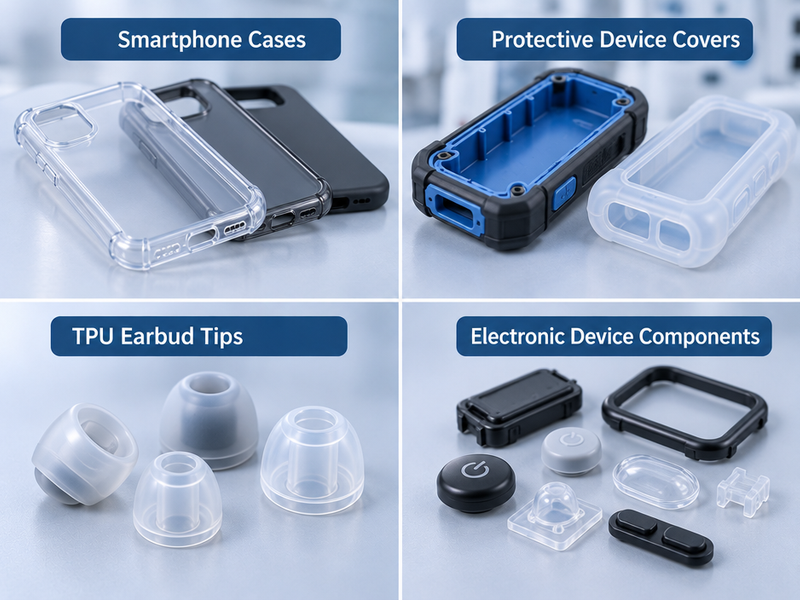
TPU is often used in cushioning and protective components for consumer electronics, such as phone cases, device covers, and earphone accessories. When a device is impacted by a drop or collision, TPU can absorb and dissipate some of the external force through elastic deformation. Its flexibility also makes it easier to design protective structures that fit the contours of a device.
TPU's electrical insulating properties also make it suitable for electrical applications, including flexible cable jackets, wire-insulation components, and flexible protective parts inside electronic equipment. During repeated bending or pulling, TPU can protect internal conductors and reduce jacket damage caused by external friction.
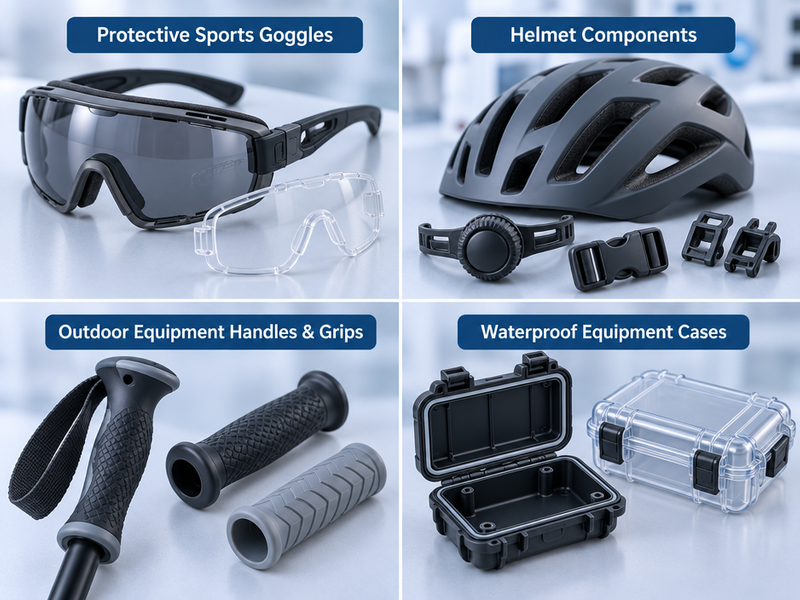
Outdoor sports products may need to withstand frequent bending, friction, and external impacts. Examples include shoe soles, sports protective gear, and cushioning components in helmets. TPU helps these components retain a degree of elasticity and wear resistance during repeated flexing and stepping. TPU cushioning components are also commonly used in protective sports equipment to absorb impact energy.
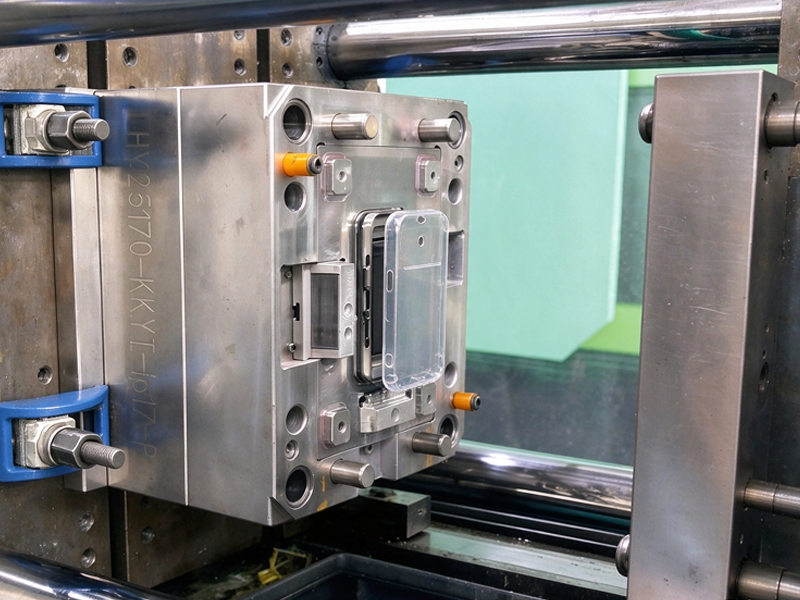
Injection molding supports high-volume production with good dimensional repeatability and can also be used for overmolding and insert molding. It is suitable for TPU parts with complex geometries and relatively demanding dimensional requirements, such as seals, rollers, sole components, and flexible grips.
Process Overview
After drying, TPU pellets are fed into the barrel of an injection molding machine. The rotating screw conveys the pellets forward, while heat from the barrel and shear heat generated by the screw soften and melt the TPU into a uniform melt.
Once the required shot size is reached, the molten TPU is injected through the nozzle, runner system, and gate into the mold cavity. The melt fills the cavity under pressure, and packing pressure then adds material to compensate for shrinkage during cooling.
The cooling system then removes heat from the part. Once the part has sufficient stiffness for ejection, the mold opens and the ejection system pushes the part out, completing one injection molding cycle.
Key Processing Parameters
Processing Parameter | Typical Range |
Drying Temperature | 80–110°C |
Drying Time | 2–4 hours |
Melt Temperature | 190–220°C |
Mold Temperature | 20–40°C |
Injection Pressure | 50–100 MPa |
Residual Moisture | Below 0.05% |
Design Considerations
l Draft Angle: For standard side walls, a draft angle of approximately 1°–3° is recommended. For deeper features or textured surfaces, consider 3°–5°.
l Wall Thickness: Keep the wall thickness as uniform as possible. For example, if the main wall is 2 mm thick, avoid sudden increases to 4 mm in localized areas to reduce uneven cooling and the risk of sink marks.
Extrusion is a continuous, high-productivity process mainly used to manufacture TPU products with a fixed cross-sectional profile, such as hoses, cable jackets, seals, films, and sheets.
Process Overview
Dried TPU pellets enter the extruder through the hopper. The screw conveys, compresses, plasticizes, and mixes the material to produce a TPU melt with a relatively uniform temperature and flow behavior.
Driven by the pressure generated by the screw, the melt passes through the die. The internal die channel determines the product's initial cross-sectional shape, such as a round tube, a flat film, or a seal profile with a specific cross-section.
After leaving the die, the TPU melt enters the cooling and sizing stage. The outer diameter and wall thickness of tubing can be controlled using a cooling bath or vacuum sizing equipment, while films and sheets can be cooled with chill rolls.
Finally, a haul-off unit pulls the continuous product at a steady speed. Cutting, winding, or other downstream equipment is then used to complete production.
Key Processing Parameters
Processing Parameter | Typical Range |
Drying Temperature | 80–110°C |
Drying Time | 2–4 hours |
Melt Temperature | 180–220°C |
Screw L/D Ratio | 25:1–30:1 |
Compression Ratio | 2:1–3:1 |
Screw Speed | 20–50 rpm |
Cooling Water Temperature | 15–30°C |
Design Considerations
l Wall Thickness: Tubing and cable jackets should have a uniform wall thickness around the circumference. For example, when designing a 2 mm wall, avoid making one side noticeably thicker than the other.
l Die Design: The die flow channel should be as symmetrical and balanced as possible. Allow for TPU die swell to help prevent the finished product's outer diameter and wall thickness from deviating from the target dimensions.
This process can directly produce hollow structures and is suitable for products with continuous curved surfaces and enclosed cavities. It can also reduce the number of assembly steps for some products. The basic principle is to use compressed air to expand a heated, softened tubular parison until it conforms to the inner surface of the mold.
Process Overview
After drying, TPU pellets enter the extrusion equipment, where they are heated and plasticized into a melt. The melt is then extruded through an annular die to form a continuous parison.
Once the parison reaches the required length, the blow mold closes and clamps it, sealing the bottom or the relevant section. Compressed air is introduced into the parison through a blow pin or air passage, causing the soft TPU tube wall to expand outward and gradually conform to the inner surface of the mold cavity.
The parison cools in the mold and retains its shape. Once it has sufficient stiffness, the mold opens and the hollow part is removed. Trimming, finishing, or other post-processing is then carried out according to the product requirements.
Key Processing Parameters
Processing Parameter | Typical Range |
Drying Temperature | 80–110°C |
Drying Time | 2–4 hours |
Melt Temperature | 180–220°C |
Blowing Pressure | 0.3–0.8 MPa |
Mold Temperature | 20–40°C |
Cooling Time | Depends on wall thickness |
Design Considerations
l Wall Thickness: Avoid sudden changes in the width of the product structure to reduce the risk of localized wall thinning during expansion.
l Corner Radius: Avoid sharp corners. As an initial design guideline, use a radius of approximately 1–2 mm or larger to improve material conformity to the mold and wall-thickness distribution.
Calendering is mainly used to produce TPU films and sheets. First, TPU pellets are heated and plasticized into a uniform melt, which is then fed into calendering equipment consisting of multiple rotating rolls.
The material is continuously compressed and spread between the rolls to form a film or sheet with the required thickness and width. It is then shaped by cooling rolls and wound into a roll. This process can also be used to laminate TPU film with fabric to produce waterproof textiles and flexible protective materials.
Solution processing involves dissolving TPU in a suitable organic solvent to form a uniform polymer solution. The solution is then applied to a substrate by methods such as coating, dipping, or casting.
As the solvent gradually evaporates, the TPU forms a continuous film or coating. This process is mainly used for textile surface treatments, flexible films, and protective coatings. Solvent evaporation, recovery, and residual-solvent control must be carefully managed.
Both TPU and TPE offer rubber-like elasticity and flexibility. TPU is suitable for products exposed to friction, repeated bending, and mechanical loads, and it generally offers better abrasion resistance, tensile strength, and oil resistance.
TPE is a broad category of materials. In this comparison, TPE mainly refers to commonly used SEBS-based TPE, which generally offers a wider range of softness options, greater flexibility in soft-touch design, easier processing, and good suitability for overmolding.
Both materials are commonly used in products such as seals and soft connectors. As a thermoplastic material, TPU can achieve high production efficiency through injection molding and offers better abrasion resistance, tear resistance, and mechanical strength.
Silicone, on the other hand, has a wider operating temperature range, excellent heat resistance, and good weatherability. It offers advantages in certain medical-grade and food-grade applications.
Both TPU and PVC are widely used for hoses, films, and flexible protective components. TPU is better suited to products exposed to frequent friction or repeated flexing.
With an established processing system and flexible formulation options, PVC offers a cost advantage in high-volume production.
Both materials can withstand a degree of stretching, compression, and repeated deformation. TPU can be remelted and reprocessed by heating, making it suitable for parts that require precision molding and high-volume injection molding.
Here, rubber refers to conventional vulcanized rubber. It offers better long-term elastic recovery and is suitable for products that must withstand sustained loads or repeated deformation over time.
Both materials can cushion and absorb impact energy, making them suitable for footwear, sports equipment, and protective materials. Compared with EVA, TPU is more suitable for components such as shoe soles that must withstand long-term abrasion, flexing, and relatively high loads.
EVA has a lower density and is easy to foam, offering good lightweighting and cushioning properties. It is suitable for cushioning components such as shoe midsoles.
Material | Recommended Applications | Considerations |
TPU | Wear-resistant shoe soles, protective cases, cable jackets, seals, and flexible connectors | Requires high abrasion resistance, tear resistance, elasticity, and mechanical durability |
TPE | Soft-touch handles, consumer-electronics cases, soft automotive interior components, and overmolded products | Requires a range of hardness options, a soft feel, and good processing flexibility |
Silicone | High-temperature seals, medical tubing, food-contact components, and flexible gaskets | Requires excellent heat resistance, weatherability, and long-term elasticity |
PVC | Wire and cable jackets, hoses, flooring, and flexible packaging | Cost-sensitive applications requiring good chemical resistance and an established processing solution |
Rubber | Tires, vibration-damping pads, industrial seals, and elastic rollers | Requires good elastic recovery, compression properties, and dynamic fatigue performance |
EVA | Shoe midsoles, sports cushioning pads, protective packaging, and foam liners | Requires lightweighting, good cushioning, and foam-processing capabilities |
Among flexible materials, TPU's key advantage is its well-balanced combination of elasticity, abrasion resistance, tear strength, and processability. This makes it particularly suitable for products that require both flexibility and mechanical durability.
At AlpineMold, we use TPU to manufacture flexible and durable injection-molded components for applications including automotive parts, protective products, and industrial components. With 25 years of industry experience, we provide integrated solutions covering mold design and manufacturing, injection molding, and large-scale production.
Contact AlpineMold to discuss your project requirements. Our team will help you find the right TPU injection molding solution for your application.
Yes. TPE is a broad category of materials that includes several families, such as TPU, TPO, TPV, and TPC. TPU is widely used because of its excellent abrasion resistance, tear strength, elasticity, and mechanical durability.
Yes. TPU can release tiny plastic particles as a result of wear or environmental degradation. The amount released depends on the TPU formulation, how the product is used, the level of friction, and the environmental conditions.
Yes. TPU can be overmolded onto rigid plastics such as ABS, PC, and PC/ABS. This allows a product to combine structural stability with a flexible surface.
LSR is a two-component liquid material. When injected into a heated mold, it undergoes a chemical crosslinking reaction and cures into an elastomer. TPU is supplied as solid pellets. It is softened and melted in a heated barrel, then injected into a mold and solidified through cooling.
Yes. TPU is a thermoplastic material, so clean production scrap can usually be ground and reused, either on its own or blended with virgin material.
For TPU injection-molded parts, maintain a uniform wall thickness of approximately 1.5–3.0 mm, use draft angles of 2°–5° for easier demolding, and provide internal corner radii of at least 0.5 times the wall thickness. Proper gate placement and mold venting are also essential to prevent incomplete filling and air traps. Finally, consider a preliminary shrinkage allowance of 0.4%–1.4%, depending on the TPU grade and part geometry.


