WhatsApp: +86 18126157548 Email: kerry@alpinemold.com

Views: 0 Author: Site Editor Publish Time: 2026-11-12 Origin: Site
From automotive taillight lenses and illuminated signage to transparent display stands, PMMA plastic, often referred to as acrylic plastic, is a popular choice for applications that require high transparency and reliable outdoor performance. What makes PMMA so versatile? What are its key properties, grades, and processing methods? In this guide, we take an in-depth look at PMMA plastic and compare it with other transparent materials to help you decide whether it is the right material for your product.
Table of Contents
What Is PMMA Plastic |
Key Properties of PMMA Plastic |
Different Types and Grades of PMMA |
Common Applications of PMMA Material |
Processing Methods for PMMA Plastic |
PMMA Plastic vs. Other Materials |
Conclusion |
| FAQ |
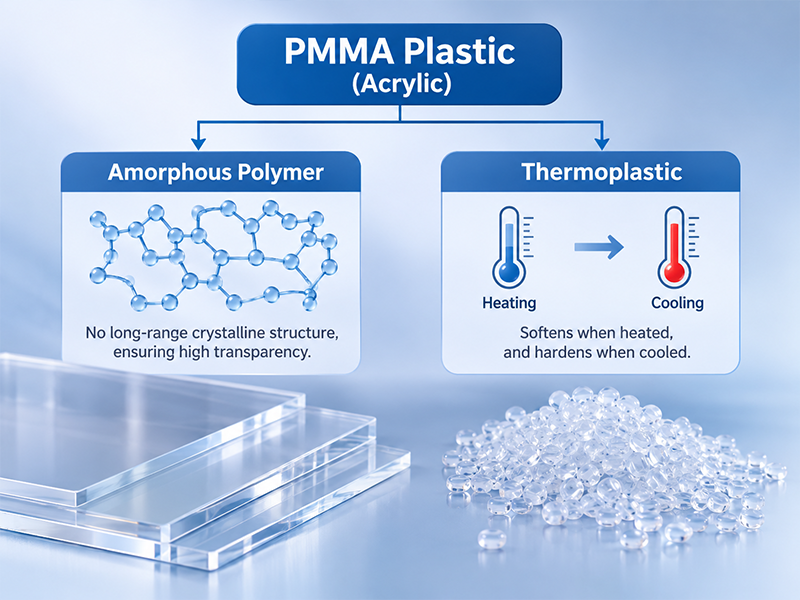
PMMA stands for polymethyl methacrylate and is also known as acrylic. It is an amorphous thermoplastic formed through the addition polymerization of methyl methacrylate (MMA) monomers. This places PMMA in two material categories:
Amorphous Polymer
An amorphous polymer has molecular chains that do not form a long-range, orderly crystalline structure. Because it lacks the distinct refractive-index differences between crystalline and amorphous regions found in semi-crystalline materials, light passes through it without significant scattering at crystal interfaces. This is one reason clear PMMA offers excellent transparency.
Thermoplastic
A thermoplastic is a polymer material that softens when heated and hardens again when cooled. At the molecular level, higher temperatures increase the mobility of polymer chain segments, allowing the material to soften. As it cools, chain mobility decreases and the material becomes rigid again. This allows PMMA to be heated, plasticized, and injection molding, then solidified by cooling to form the required part geometry.
PMMA also offers a naturally glossy surface and good UV stability. These properties help it retain its clarity and appearance outdoors, making it a lightweight alternative to glass in many applications.
Optical Properties
According to ASTM test methods, clear, colorless PMMA typically has a visible light transmittance of 92% and a refractive index of 1.49. These values demonstrate its excellent optical clarity and glossy surface. PMMA is suitable for applications that require clear light transmission and an attractive appearance, such as automotive lamp covers, LED lenses, and transparent display housings.
For parts with demanding optical requirements, however, mold polishing, flow marks, and internal bubbles also need to be carefully controlled.
Mechanical Properties
PMMA typically has a tensile strength of 60–75 MPa, a tensile modulus of approximately 2.4–3.3 GPa, and an elongation at break of around 2–5%. These values indicate that PMMA offers high stiffness and hardness, along with good resistance to compressive deformation. However, its impact toughness is relatively low. Notches can create stress concentrations and become starting points for cracks. PMMA is therefore suitable for applications such as automotive interior and exterior trim, household appliances, and lighting products.
For snap-fits, screw bosses, thin-wall corners, and areas exposed to impact, avoid sharp corners and excessive localized stress. Where necessary, increase the corner radii or consider an impact-modified grade.
Thermal Properties
Because PMMA has an amorphous structure, it does not have a distinct crystalline melting point like semi-crystalline plastics such as PE and PP. It does, however, have a defined glass transition temperature (Tg), typically 100–110°C, and a heat deflection temperature (HDT) of approximately 85–100°C at 1.8 MPa.
When designing a part, consider its actual operating temperature to prevent deformation or dimensional changes caused by prolonged heat exposure.
Electrical Properties
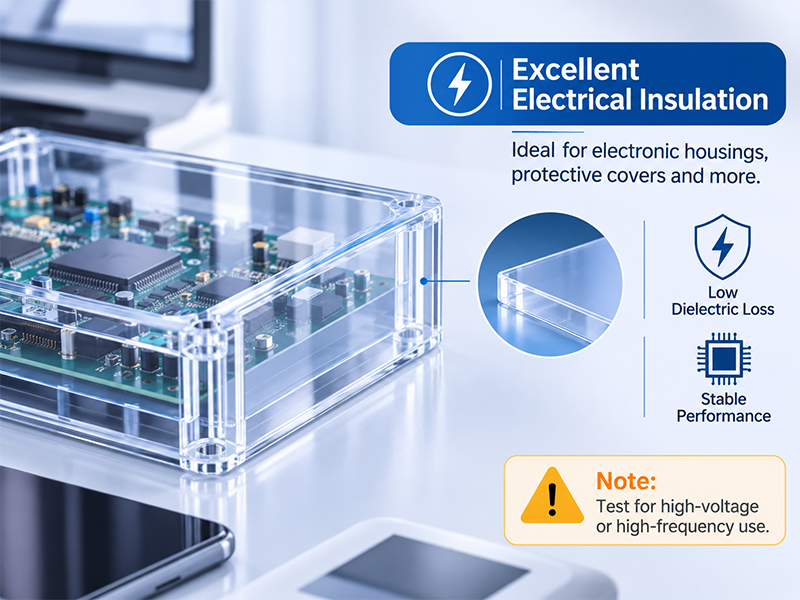
PMMA has good electrical insulating properties, with a typical relative dielectric constant of approximately 2.7–3.4. It is a poor electrical conductor and also has relatively low dielectric loss. These properties make it suitable for insulating housings in electronic devices, transparent protective covers, and non-conductive structural components in electrical assemblies.
For applications involving high voltage or high-frequency operation, appropriate insulation testing is still necessary to prevent electrical breakdown or insulation failure.
Weather and UV Resistance
For cast PMMA sheet, for example, the light transmittance at a wavelength of 420 nm is specified to remain at or above 88% after 1,000 hours of xenon-arc weathering. This demonstrates PMMA's good UV resistance and its ability to retain transparency and appearance during long-term outdoor use. It is therefore suitable for products exposed to sunlight over extended periods, including outdoor signs, architectural skylights, and automotive lamp covers.
Chemical Resistance
PMMA typically has a 24-hour water absorption rate of 0.2–0.5%. It offers good resistance to water, dilute acids, dilute alkalis, and many common environmental substances. This makes it suitable for use in humid environments or applications involving contact with diluted acidic or alkaline solutions, such as aquarium viewing panels and laboratory equipment guards.
However, PMMA has limited resistance to many organic solvents, including ketones and aromatic hydrocarbons. Under tensile stress, small flaws or locally damaged areas are more likely to develop and propagate cracks, potentially leading to part failure.
To meet the performance requirements of different products, PMMA can be modified, copolymerized, or blended with other polymers to further tailor its properties.
PMMA modification is generally used to adjust properties such as impact resistance, heat resistance, and processability while retaining as much of the PMMA material's optical performance as possible.
l General-Purpose PMMA
If appearance, transparency, and outdoor performance are your main priorities, general-purpose PMMA is usually a suitable choice. Typical applications include cosmetic display boxes, transparent viewing windows for household appliances, and clear storage containers.
Standard PMMA has limited resistance to crack initiation and propagation. Its brittleness should therefore be evaluated for parts that may be exposed to impact or high assembly stresses.
Increasing toughness can also reduce transparency, surface hardness, or stiffness. The extent of these trade-offs depends on the formulation and the proportion of the modifier. When selecting a grade, balance the product's transparency requirements against its actual impact conditions.
l Heat-Resistant PMMA
The molecular structure of PMMA is adjusted to increase its glass transition temperature and heat resistance, helping the material maintain better dimensional stability at elevated temperatures. This makes heat-resistant grades suitable for transparent components used in equipment operating in higher-temperature environments, including automotive lighting components, security equipment components, and optical lenses.
When greater heat resistance is required, compare the material's heat deflection temperature (HDT), Vicat softening temperature, and long-term service temperature with the actual operating environment. Trade-offs may also need to be considered in melt flow rate, processing conditions, and other material properties.
l Impact-Modified PMMA
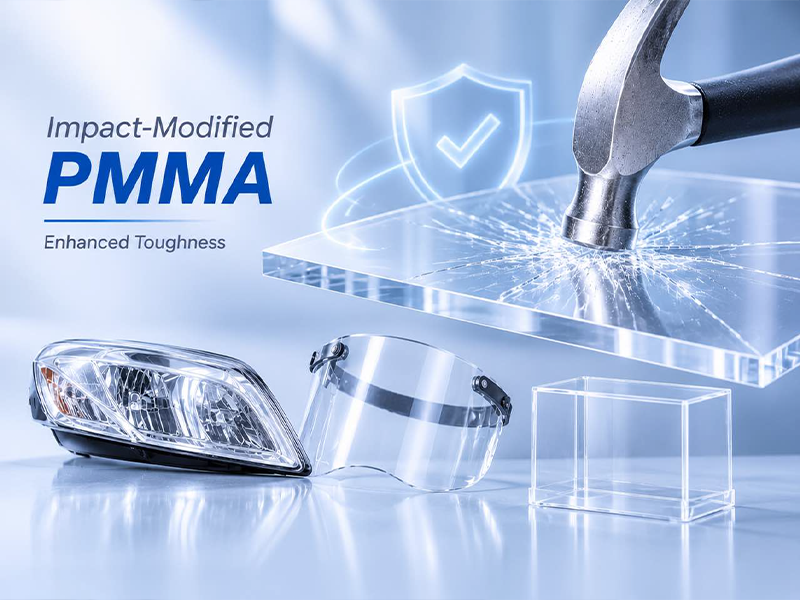
Impact resistance is improved by introducing a rubber toughening phase into the material. Impact-modified PMMA is suitable for transparent vending-machine panels, industrial equipment guards, machine viewing windows, and other components that need to balance transparency with impact resistance. It can reduce the risk of cracking when a product is struck or bumped.
l UV-Resistant PMMA
Standard PMMA already has good weatherability. UV stabilizers can be added to further slow photo-oxidative aging caused by prolonged outdoor exposure. Applications include advertising lightbox panels, architectural skylights, and protective covers for solar equipment. This helps reduce the risk of yellowing, fading, loss of gloss, and surface chalking.
l Optical-Grade PMMA
Optical-grade PMMA is produced by closely controlling material purity, haze, and optical uniformity. This helps light pass through the material more clearly and consistently, reducing optical distortion and meeting the visual-quality requirements of precision optical products. Typical applications include fiber-optic connectors, light guide plates, and optical instrument windows.
Mold polishing, molding defects, and residual stress can all affect the final optical performance. Grade selection should therefore be based on specific requirements for light transmittance, haze, refractive index, and optical uniformity.
l Colored PMMA
Colorants or color masterbatch can be added to achieve different colors and visual effects while retaining some of PMMA's transparency, gloss, or weather resistance. Applications include colored transparent components for taillights, bathroom accessories, and decorative housings for electronic products.
If the product needs to transmit light, confirm in advance that the selected pigment will not significantly affect its optical performance.
PMMA-based blends are made by physically combining PMMA with one or more other polymers. This can create a balance of properties that a single polymer may not be able to provide on its own. Two common examples are:
l PC/PMMA
PC contributes excellent impact resistance and heat resistance to PMMA. These blends can improve surface durability while maintaining good mechanical strength and optical performance. They are well suited to applications such as automotive interior panels, screen-protection components, and electronic housings, where both mechanical toughness and a high-quality surface finish are important.
l ABS/PMMA
This blend draws on ABS's toughness, impact resistance, and processing flexibility. The combination can help products retain their appearance and reduce surface scratching while maintaining mechanical performance. Typical applications include control panels and decorative housings.
Automotive Industry
PMMA's high transparency and excellent surface gloss help maintain the visual quality of automotive lighting and interior components.
It can provide uniform light output while offering a clear viewing area.
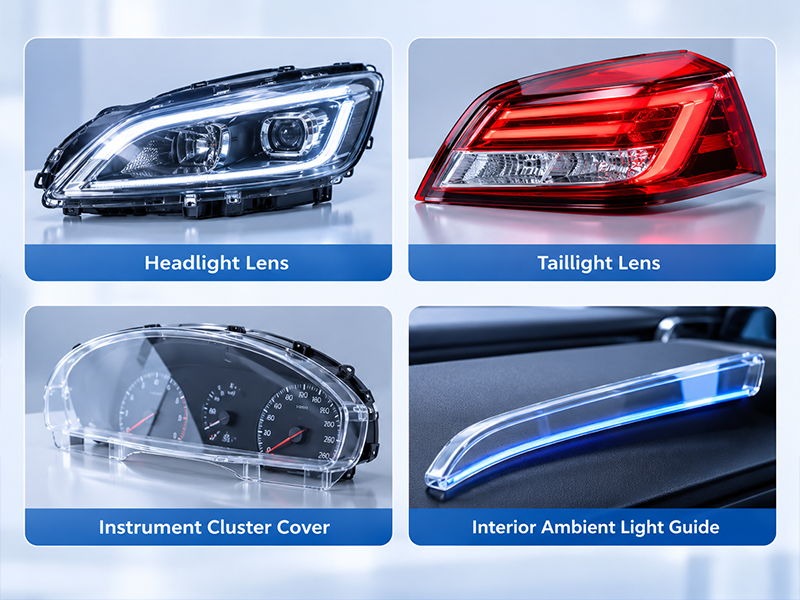
Common applications include automotive taillight lenses, transparent instrument-cluster covers, and interior ambient-light components. PMMA's weatherability also helps reduce yellowing caused by prolonged exposure to sunlight.
Consumer Electronics
Electronic components often have demanding appearance and light-transmission requirements. For example, control panels may need to allow LED indicators and display information to show through the panel.
PMMA is used in display cover lenses, smart-home device housings, and control panels. In addition to providing basic external protection, these components help shield display areas from dust and everyday contact.
Medical and Laboratory Equipment
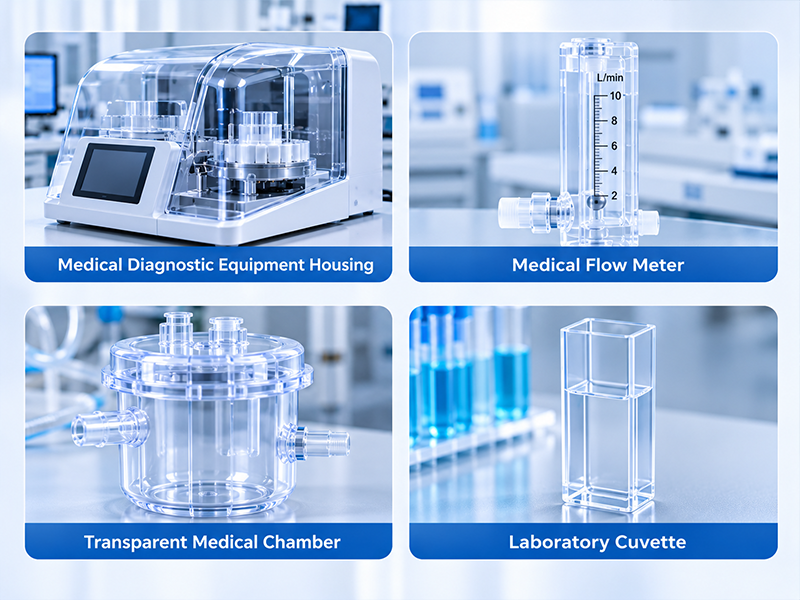
PMMA is used for transparent components in medical and laboratory equipment where users need to observe samples, liquids, or the operation of internal mechanisms. Its high transparency and dimensional stability help maintain a clear view while providing a physical barrier. Typical applications include equipment viewing windows, protective covers, and containers.
Architecture and Construction
In architecture and construction, PMMA is mainly used in the form of transparent or translucent sheets for daylighting and building separation structures. Examples include roof skylights, transparent noise barriers, and building façades. These applications provide a degree of physical protection while allowing natural light to enter the space.
Cosmetics
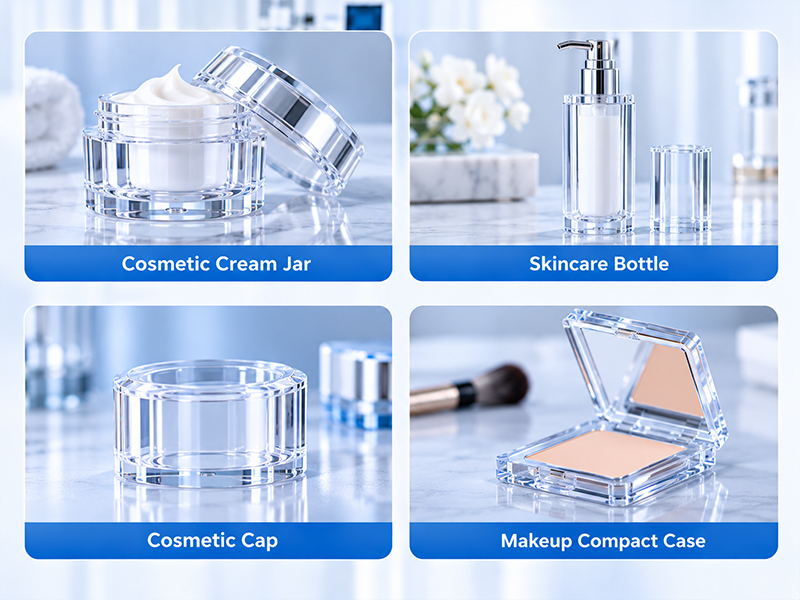
PMMA is also widely used in cosmetic packaging and containers. Its glass-like transparency showcases the contents, making it suitable for products where packaging appearance, clear product display, and surface quality are important. Common examples include cosmetic jars, perfume caps, and transparent lids for compact powder cases. These components can help enhance a brand's visual appeal.
Lighting and Optical Product
PMMA plays an important role in lighting and optical products because it does more than transmit light. With the right geometry, it can also guide and distribute light, helping create a more uniform brightness distribution and softer illumination.
PMMA performs particularly well in LED light guide plates and lighting diffusers. It is also used in optical components such as magnifying lenses and Fresnel lenses. Its optical clarity and molding capabilities make it well suited to manufacturing these precision components.
As an amorphous thermoplastic, PMMA can be softened by heating and then shaped. It can also be made into products of different shapes through polymer casting, machining, and other methods. The five main processing methods are outlined below.
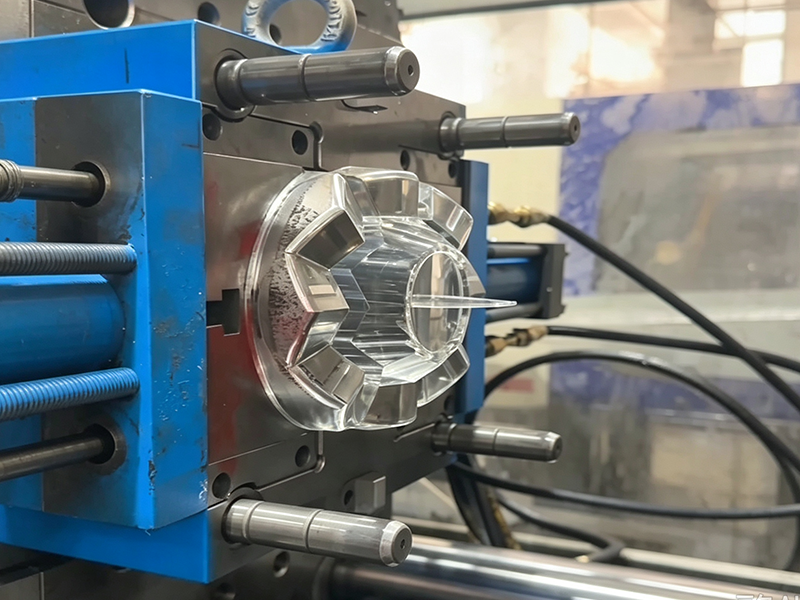
This process produces PMMA parts with complex geometries, precise dimensions, and smooth surfaces. It is suitable for mass production of cosmetic packaging components, automotive lamp covers, transparent panels for electronic devices, and optical components.
Process Overview
Injection molding involves heating PMMA pellets until they melt, then injecting the melt with a screw into a closed mold cavity. The material is packed and cooled in the mold until it solidifies, forming a plastic part that matches the cavity geometry.
Processing Parameters
PMMA is sensitive to moisture and processing temperature. Material drying, melt temperature, and mold temperature are therefore important factors affecting molding quality.
Parameter | Typical Reference Conditions | Purpose |
Drying Temperature | 80–90°C | Removes moisture from the pellets to reduce splay marks and bubbles |
Drying Time | 2–6 hours | Ensures that the material is sufficiently dry for processing |
Melt Temperature | 220–260°C | Ensures appropriate melt flow |
Mold Temperature | 50–85°C | Affects melt filling, surface gloss, and residual stress |
Injection Speed | Adjust according to part geometry | Controls filling and helps reduce flow marks and other appearance issues |
Design Considerations
l Maintain Uniform Wall Thickness: Avoid sudden changes in local wall thickness wherever possible. This helps reduce sink marks, warpage, and internal stress caused by differences in cooling rates.
l Use Rounded Corners: Add suitable radii to internal and external corners to prevent stress concentrations caused by sharp features and reduce the risk of cracking.
l Optimize Gate and Runner Design: Select gate locations and sizes according to the part geometry and melt-flow direction. This helps reduce excessively long flow paths and unnecessary weld lines.
l Provide Adequate Venting: Add appropriate vents in the last areas to fill so that air can escape from the cavity, reducing trapped gas and burn marks.
l Control Residual Stress: Adjust injection speed, packing pressure, mold temperature, and cooling time appropriately. For parts with demanding optical requirements, annealing may also be considered to reduce internal stress.
Extrusion is a continuous process for producing PMMA products with long lengths and consistent cross-sections. It offers high production efficiency and is suitable for transparent sheets, tubes, and architectural glazing profiles.
Process Overview
Dried PMMA pellets are fed into an extruder, where screw rotation, heating, and shear melt the material. The melt is then pushed through a die with the required cross-sectional profile. After cooling and solidification, the extruded product is cut to length to produce PMMA sheets, tubes, or profiles.
Processing Parameters
Use the PMMA extrusion conditions recommended by the material supplier as a reference. Temperature settings vary depending on the material formulation and equipment.
Parameter | Typical Reference Conditions | Purpose |
Barrel Temperature | 175–215°C, typically increasing gradually along the material flow direction | Gradually heats and melts PMMA pellets to form a uniform melt |
Melt Temperature | 205–240°C | Controls melt flow and viscosity |
Die Temperature | 235–245°C, depending on the grade and equipment | Maintains uniform melt flow through the die |
Screw Speed | Match to feed rate, melt temperature, and extrusion speed | Controls material throughput and shear |
Design Considerations
l Maintain Consistent Cross-Sections: Avoid sudden changes in the product cross-section wherever possible. This helps maintain stable melt flow and reduce dimensional variation.
l Optimize Die Design: Design the die flow channels appropriately so that the melt is distributed evenly and local differences in flow speed are minimized.
l Control Cooling Uniformity: Maintain consistent cooling conditions across all areas of the product to reduce warpage and dimensional deviations.
l Monitor Sheet Thickness: For sheet products, continuously monitor thickness and width to ensure that they meet dimensional requirements.
Cell casting can produce relatively thick PMMA sheets. Compared with extruded sheets, cast sheets generally have lower optical distortion, making them suitable for applications with demanding visual requirements, such as display panels, architectural glazing, and aquarium viewing panels.
Process Overview
MMA monomer or pre-polymerized syrup is used to form PMMA through a polymerization reaction. The liquid raw material is poured into a sealed mold cavity. The gap between glass plates determines the sheet thickness, after which the material is polymerized and cured. The PMMA sheet is removed once the reaction is complete.
Processing Parameters
There is no single temperature-and-time standard for PMMA cell casting that applies to every sheet thickness and formulation. The following values are reference polymerization conditions for sheet material at 60°C.
Parameter | Typical Reference Conditions | Purpose |
Polymerization Temperature | 50–60°C | Prevents the reaction from proceeding too quickly and generating excessive heat, which can cause bubbles or internal stress |
Polymerization Time | 8–12 hours (for 3–6 mm sheets) | Ensures sufficient polymerization of the monomer |
Post-Curing Temperature | 80–130°C | Reduces residual MMA monomer and improves material properties |
Cooling Conditions | Gradually cool to room temperature | Reduces internal temperature differences, lowering the risk of stress, warpage, and cracking |
Mold Gap | Set according to the target sheet thickness | Controls the final sheet thickness |
Design Considerations
l Specify Sheet Thickness: Determine sheet thickness according to the product's load-bearing requirements, transparency needs, and operating environment.
l Control Polymerization: Prevent uneven polymerization, which can cause bubbles, internal defects, and optical non-uniformity.
l Allow for Machining: If the sheet will be cut, drilled, or CNC machined, allow for machining stock and tolerances in advance.
l Avoid Sharp Internal Corners: Add appropriate radii to features that will be machined later to reduce the risk of cracking.
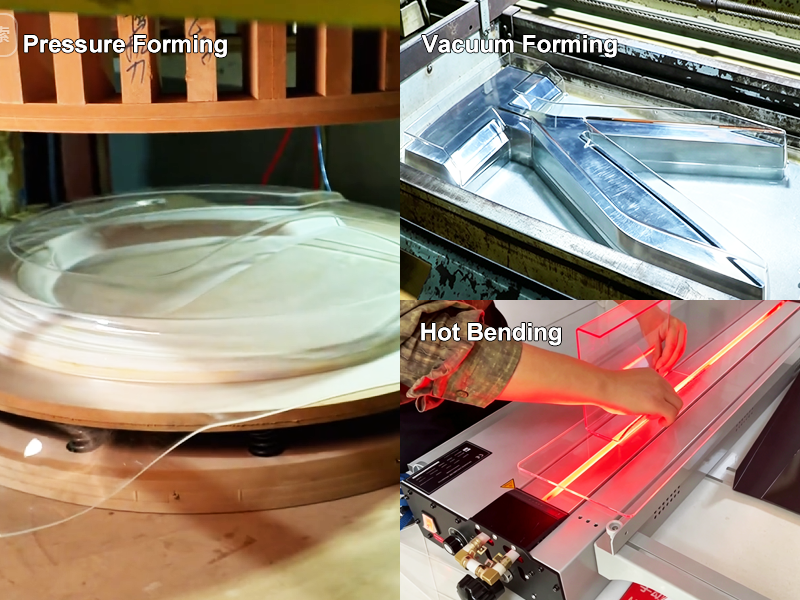
Thermoforming is suitable for manufacturing large PMMA components with curved surfaces or complex outer profiles.
Process Overview
A pre-manufactured acrylic sheet is heated until it softens. Vacuum, pressure, or mechanical stretching is then used to draw the sheet against the mold surface. After cooling and solidification, the formed part is removed, trimmed, and dimensionally finished.
Processing Parameters
PMMA thermoforming parameters depend on the sheet manufacturing method, thickness, part geometry, and equipment. The following values are provided as a reference based on acrylic sheet processing guidelines.
Parameter | Typical Reference Conditions | Purpose |
Forming Temperature | 145–160°C for extruded sheets; 170–195°C for cast sheets | Softens the sheet for forming |
Heating Time | 1 minute per 0.254 mm | Ensures uniform heating throughout the sheet |
Vacuum Level | 28 inHg | Removes trapped air and helps the sheet conform to the mold |
Forming Pressure | 50 psi | Forces the softened sheet against the mold surface |
Mold Temperature | 88°C | Prevents premature cooling and excessive forming stress |
Demolding Temperature | 85°C | Helps maintain dimensional stability during removal |
Cooling Conditions | Below 60–70°C | Reduces warpage and residual stress |
Design Considerations
l Avoid Excessive Draw Depth: Excessive draw depth can significantly reduce wall thickness in local areas. Design the part according to the sheet thickness and the forming capabilities of the process.
l Use Adequate Draft Angles: Provide sufficient draft on the mold sidewalls to reduce friction and damage when removing the formed part.
l Add Generous Corner Radii: Radii help the material stretch more evenly, reducing stress concentrations and excessive thinning at sharp corners.
l Ensure Uniform Heating: Uneven temperatures across the sheet surface or through its thickness can cause incomplete forming, localized thinning, or deformation.
l Plan for Trimming: Thermoformed parts usually require trimming after forming, so allow sufficient material for this operation in the design.
Machining provides precise dimensional control and allows complex local features to be produced. It is suitable for low-volume custom parts, transparent panels, optical components, and parts requiring accurately positioned holes and detailed contours.
Process Overview
Machining removes material from PMMA sheets, rods, or preformed plastic parts to achieve the required dimensions, contours, and hole locations. Common machining methods include:
l CNC Milling: Uses rotating cutting tools to remove material and create grooves, contours, and complex features.
l Drilling: Creates holes in PMMA parts for screw fastening, assembly, and connections.
l Sawing: Cuts PMMA sheets into specified sizes and shapes.
l Laser Cutting: Uses a laser beam to cut PMMA sheets and is suitable for producing complex two-dimensional profiles.
Processing Parameters
The following are reference parameters for CNC drilling PMMA. Actual settings should be adjusted according to drill diameter, sheet thickness, machine capability, and PMMA grade.
Parameter | Typical Reference Conditions | Purpose |
Spindle Speed | 500–1,500 RPM | Controls drill rotation speed and reduces overheating around the hole |
Feed Rate | 50–300 mm/min | Controls drilling load and reduces exit breakout and cracking |
Drill Point Angle | 60–90° | Reduces material damage as the drill enters and exits the workpiece |
Drill Geometry | Use sharp cutting edges, an appropriate helix angle, and well-designed flutes | Reduces cutting resistance and prevents chip blockage |
Peck Drilling | Use step-feed drilling and periodically retract the drill to clear chips | Prevents chip buildup and localized temperature rise |
Cooling and Chip Removal | Use compressed air for chip removal; apply a suitable water-based coolant when necessary | Reduces heat around the hole and prevents chip adhesion and material softening |
Design Considerations
l Avoid Sharp Internal Corners: Add suitable radii around slots and holes to reduce stress concentrations.
l Maintain Adequate Edge Distance: Keep sufficient distance between drilled holes and the part edge to reduce the risk of cracking during drilling.
l Control Machining Heat: Use sharp tools and appropriate cutting parameters to prevent localized overheating.
l Specify Surface Finish: For transparent parts, specify on the drawing whether cut edges require polishing and define the final transparency requirements.
Both PMMA and PC offer high transparency. However, PC has higher impact resistance and heat resistance, while PMMA performs better in surface hardness, scratch resistance, and outdoor weatherability.
Both materials can be used for transparent housings, display covers, and packaging components. PETG offers better toughness and thermoformability, making it particularly suitable for products with complex curves or substantial draw depths. PMMA's advantages include surface gloss, hardness, and weatherability.
PMMA and clear GPPS both offer good transparency, but they differ in performance and cost. GPPS is generally less expensive and is suitable for transparent products that have modest mechanical requirements and are not intended for demanding outdoor use. PMMA offers better weatherability, surface hardness, and impact performance.
PMMA and glass are both commonly used for transparent windows, protective covers, and architectural daylighting products. Compared with glass, PMMA is significantly lighter and easier to process into different shapes through injection molding, extrusion, and thermoforming. Glass offers very high surface hardness and good heat resistance, but it is heavier and can be more prone to breakage under impact.
Material | Recommended Applications | Considerations |
PMMA | Automotive lamp covers, transparent display covers, cosmetic packaging, and optical components | Choose when high transparency, good surface gloss, scratch resistance, and outdoor weatherability are required |
PC | Safety guards, machinery viewing windows, and high-impact transparent housings | Choose when the product must withstand significant impact or higher operating temperatures |
PETG | Transparent display covers, complex curved housings, and thermoformed packaging | Choose when good toughness and thermoformability are required |
PS | General transparent packaging and low-cost consumer products | Suitable when cost is a priority and environmental and impact requirements are relatively modest |
Glass | Building windows, glass curtain walls, and highly scratch-resistant viewing windows | Choose when high hardness, scratch resistance, and heat resistance are required and weight is not a major constraint |
PMMA material is not the highest-performing option in every category among transparent materials. Its broad use in products with demanding appearance and optical requirements comes from the balance it offers between transparency, weatherability, and processability.
At Alpine Mold, we use PMMA to manufacture transparent and appearance-critical components for automotive lighting, medical equipment, and cosmetic packaging. If you are looking for a reliable manufacturing partner for your PMMA parts, we provide a one-stop solution from mold development to plastic part production. With dependable quality and stable manufacturing processes, we help you meet your product requirements.
Contact Alpine Mold to discuss your project and find a manufacturing solution that fits your needs.
At normal room temperatures, PMMA platic is not prone to releasing harmful substances. When it meets the applicable standards, PMMA can also be suitable for medical and food-contact products. However, overheating or thermal decomposition may produce irritating vapors, so proper ventilation and temperature control are important.
PMMA (polymethyl methacrylate) is the chemical name of the material, while Plexiglass is a commercial brand name for acrylic. The name has also become widely used informally to refer to acrylic sheet. Other well-known acrylic brands include Acrylite and Perspex.
After molding, PMMA parts can undergo various secondary finishing processes to improve appearance, dimensional accuracy, and assembly performance. Common methods include screen printing, laser engraving, and painting. Each process can affect PMMA's transparency and surface quality differently, so the choice should be based on the part design and final appearance requirements.
Not every PMMA part requires a mirror-polished mold. However, high-quality mold polishing helps achieve optical clarity and a high-gloss surface while reducing surface imperfections.
PMMA has limited resistance to many organic solvents. Chemicals such as ketones, aromatic hydrocarbons, and esters may cause PMMA to swell, lose transparency, or crack. The extent of the damage depends on the chemical concentration, exposure time, and residual stress within the PMMA part.


