WhatsApp: +86 18126157548 Email: kerry@alpinemold.com

Views: 0 Author: Site Editor Publish Time: 2026-03-31 Origin: Site


When developing a new product, one of the first decisions is choosing the right manufacturing process.3D printing and injection molding are two of the most common options—but they serve very different purposes.
Many engineers and buyers struggle with questions like: Should I prioritize lower upfront cost or lower unit cost? Is this project better suited for prototyping or mass production? Can I achieve the required precision and surface quality?
In this article, we’ll break down the key differences between 3D printing and injection molding to help you choose the most suitable solution for your project.
3. Key Differences Between 3D Printing and Injection Molding |
3D printing, also known as additive manufacturing, is a process that builds parts layer by layer directly from a digital 3D model. Unlike traditional manufacturing methods, it does not require molds or tooling, making it highly flexible for product development.
The process starts with a 3D CAD file, which is sliced into thin layers. The printer then deposits or solidifies material layer by layer until the final part is formed. This allows for rapid iteration and easy design modifications.
FDM (Fused Deposition Modeling): Uses thermoplastic filaments; cost-effective and widely used for basic prototypes
SLA (Stereolithography): Uses liquid resin cured by a laser; offers high precision and smooth surface finish
SLS (Selective Laser Sintering): Uses powdered materials; suitable for functional parts with good strength
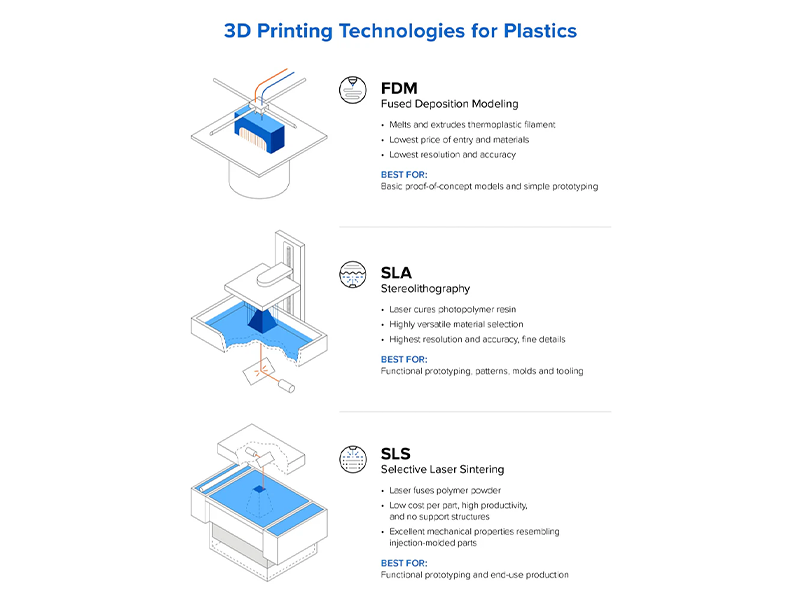
3D printing offers significant advantages in product development, especially for prototyping and low-volume production. It does not require molds or tooling, which greatly reduces initial costs and lead time. This makes it ideal for rapid prototyping and fast design iteration.
3D printing enables high design flexibility, allowing complex geometries and customized parts that are difficult or impossible to achieve with traditional manufacturing methods. It is also suitable for small batch production with no minimum order quantity, making it a cost-effective solution during early-stage development.
Despite its flexibility, 3D printing has limitations when it comes to large-scale production. The cost per part remains relatively high since each part is built individually, making it less economical for mass production. Surface finish and dimensional consistency may also require additional post-processing.
Furthermore, depending on the technology and material used, the mechanical properties of 3D printed parts may be lower than those produced by injection molding. Production speed is another constraint, as it is not efficient for high-volume manufacturing.
Injection molding is a manufacturing process where molten plastic is injected into a custom-designed mold, cooled, and solidified into a final part. It is widely used for producing high-volume plastic components with consistent quality.
The process begins with heating plastic material until it melts. The molten plastic is then injected into a precisely machined mold cavity under high pressure. After cooling and solidification, the mold opens and the part is ejected. This cycle repeats, enabling efficient mass production.
Injection molding is highly efficient for mass production of plastic parts with consistent quality. Once the mold is developed, the cost per unit becomes very low, making it ideal for large production volumes. It offers excellent precision, repeatability, and surface finish, with the ability to produce complex parts with tight tolerances. Injection molding also supports a wide range of engineering plastics, including high-strength and flame-retardant materials, ensuring strong mechanical performance and durability in final products.
The main drawback of injection molding is the high initial investment required for mold design and manufacturing, which can be costly and time-consuming. Lead times are typically longer compared to 3D printing, as tooling must be completed before production begins.
Design changes after mold fabrication can be difficult and expensive, as they may require mold modifications. This makes injection molding less suitable for low-volume production or projects that require frequent design adjustments.
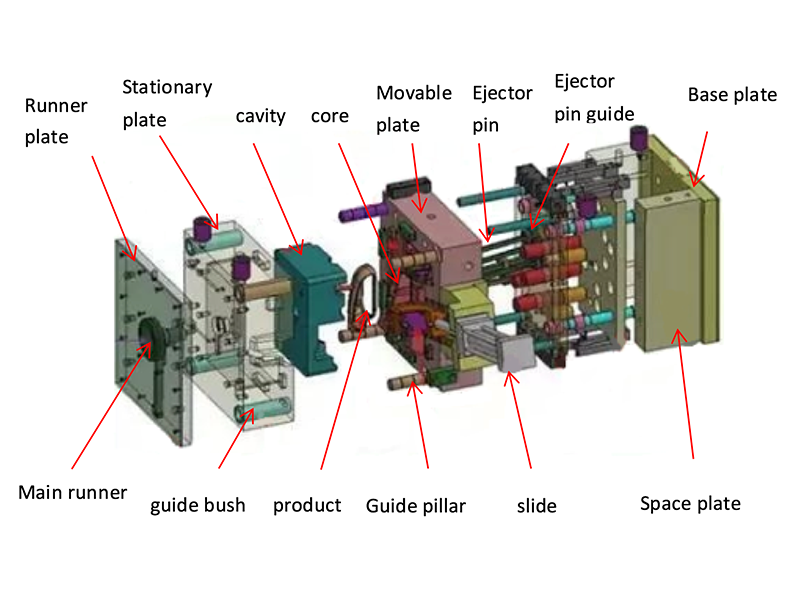
When comparing 3D printing vs injection molding, it’s important to look beyond just cost. The right manufacturing method depends on multiple factors such as production volume, lead time, material selection, and part performance.
Below is a quick comparison overview, followed by a detailed explanation of each factor to help you decide which process is more suitable for your project.
Factor | 3D Printing | Injection Molding |
Production Volume | Low-volume / prototyping | Medium to high-volume production |
Cost | No tooling, high cost per part | High tooling cost, low unit cost |
Lead Time | Fast (hours to days) | Longer initial lead time (3–6 weeks) |
Materials | Limited printable materials | Wide range of engineering plastics |
Strength | Moderate (depends on process) | High strength and durability |
Surface Finish | May require post-processing | Excellent surface finish directly |
Design Complexity | Very high flexibility | Needs design for manufacturability |
File Type | CAD/STL files | 3D CAD + tooling design required |
Applications | Prototyping, customization | Mass production, functional parts |
Production volume is often the first factor to consider when choosing between 3D printing and injection molding.
3D printing is ideal for prototypes, one-off parts, or small batch production, where flexibility and speed are more important than cost per unit.
Injection molding, on the other hand, is designed for medium to high-volume manufacturing. Once the mold is built, it allows for fast cycle times and consistent output, making it the preferred solution for large-scale production.
The cost structure of 3D printing vs injection molding is fundamentally different.
3D printing has no tooling cost, making it highly cost-effective for early-stage development. However, the cost per part remains relatively high.
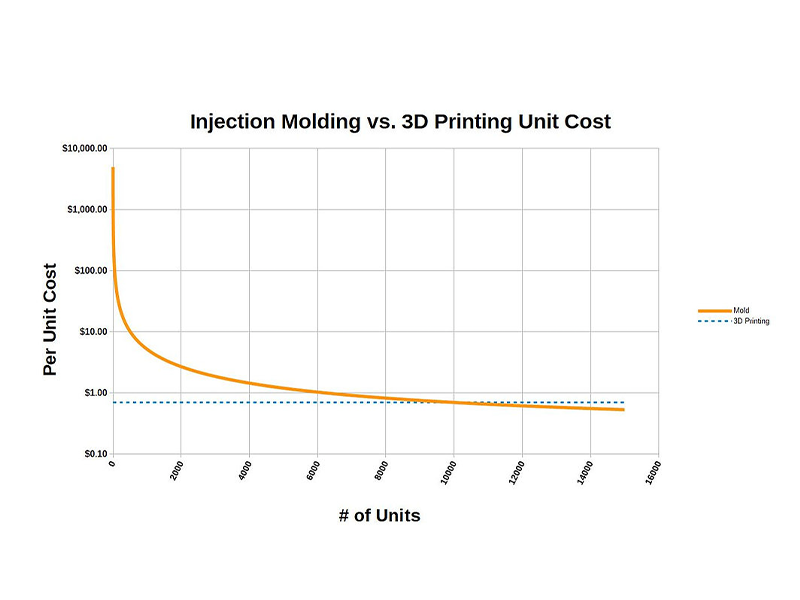
Injection molding requires a significant upfront mold investment, but as production volume increases, the cost per part drops dramatically. For mass production, it becomes the more economical choice.
Lead time depends on whether tooling is required.
3D printing offers very fast turnaround, often delivering parts within hours or a few days, which is ideal for rapid prototyping.
Injection molding requires additional time for mold design and manufacturing, typically 3–6 weeks. However, once production starts, parts can be produced at a much faster rate.
Material selection is another key difference in plastic manufacturing processes.
3D printing supports a range of plastics, resins, and powders, but the options are still relatively limited compared to injection molding.
Injection molding offers a wide range of engineering-grade materials, including ABS, PC, PA (Nylon), PP, and flame-retardant plastics, making it suitable for functional and industrial applications.
The mechanical properties of parts vary significantly between the two processes.
3D printed parts may have layer-based structures, which can result in weaker strength depending on the printing method and orientation.
Injection molded parts are typically stronger, more uniform, and more reliable, making them suitable for load-bearing or long-term use applications.
Surface quality is especially important for visible or consumer-facing products.
3D printing often produces parts with visible layer lines, requiring additional post-processing such as sanding or coating.
Injection molding can achieve high-quality surface finishes directly from the mold, including glossy, matte, or textured surfaces (SPI/VDI standards).
3D printing allows for extremely complex geometries, including internal channels and organic shapes, without additional cost.
Injection molding also supports complex designs, but it requires design for manufacturability (DFM), such as draft angles, uniform wall thickness, and proper gate placement.
3D printing typically uses STL or simplified CAD files, making it easier to start production quickly.
Injection molding requires more detailed engineering data, including 3D CAD files (STEP/IGES), mold design, and DFM analysis, to ensure manufacturability and production stability.
The application scenario often determines the best manufacturing method.
3D printing is widely used for rapid prototyping, product development, and customized parts.
Injection molding is best suited for mass production of plastic parts, especially when high precision, durability, and consistent quality are required.
When comparing 3D printing vs injection molding cost, it’s important to understand that these two processes follow completely different cost models. The right choice depends not only on price, but also on your production stage and volume.
3D Printing: There is no tooling cost, which makes it highly attractive for early-stage development. However, the cost per part remains relatively high, as each part is produced individually. This means total cost increases steadily as quantity grows.
Injection Molding: Injection molding requires a significant upfront mold investment, but once the mold is built, the unit cost becomes very low. This makes it one of the most cost-effective manufacturing methods for large-scale production.
Production volume is the key factor when deciding between these two processes.
Low-volume production (1–1000 parts): 3D printing is typically more economical because you avoid mold costs and can produce parts on demand. It is ideal for prototyping, testing, and small batch production.
Medium to high-volume production (1000+ parts): Injection molding becomes more cost-effective as the mold cost is spread across a larger number of parts. The cost per unit decreases significantly, making it suitable for mass production.
In real-world product development, companies rarely choose only one process—they often use both.
A typical workflow looks like this:
3D printing for rapid prototyping
Validate design quickly
Test fit, function, and structure
Make fast design iterations without tooling cost
Injection molding for mass production
Once the design is finalized
Achieve consistent quality and tight tolerances
Reduce cost per part for large orders
For example, in electronic housing projects, many companies start with 3D printing to test assembly and performance. After design validation, they switch to injection molding, where the unit cost can drop dramatically, especially at scale.This combined approach is often the most efficient way to balance speed, cost, and production stability.
Understanding the difference between 3D printing and injection molding becomes clearer when looking at real-world applications. Different industries choose different processes based on volume, precision, and performance requirements.
In the electronics industry, such as sensor housings, router enclosures, and smart device casings, both processes are often used at different stages.
3D Printing:
Used for early prototyping to verify internal structure, assembly fit, and design appearance
Injection Molding:
Used for mass production to achieve tight tolerances, consistent quality, and high surface finish
For example, in a radar sensor housing project, initial prototypes were developed using 3D printing. Once validated, injection molding was applied to ensure stable production with reinforced materials like PC + GF, meeting both strength and precision requirements.
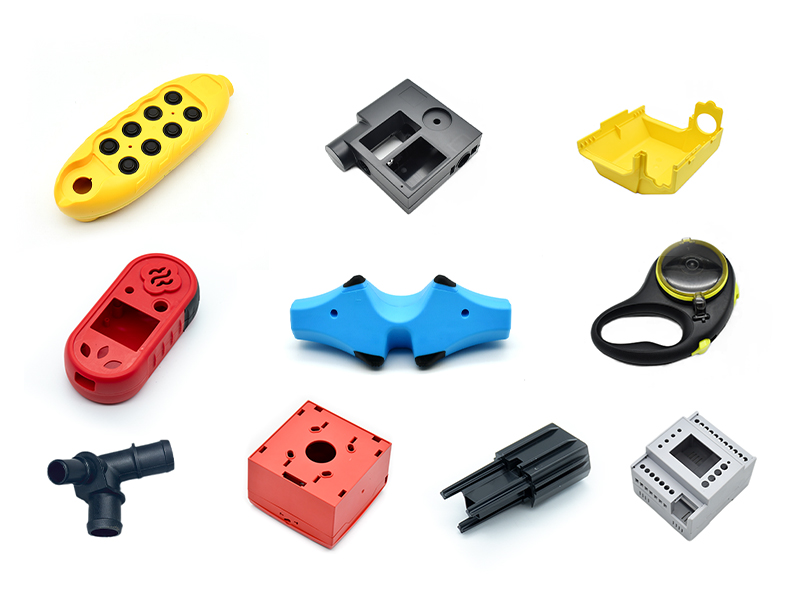
Medical parts, such as disposable surgical accessories, catheter components, and device housings, require strict quality and precision standards.
3D Printing:
Suitable for concept validation and functional testing
Injection Molding:
Essential for high-volume production, dimensional consistency, and clean surface quality
In one case, a disposable laparoscopic accessory required tight tolerances and zero-defect surface quality. After prototype validation, injection molding enabled stable mass production with high yield and consistent performance.
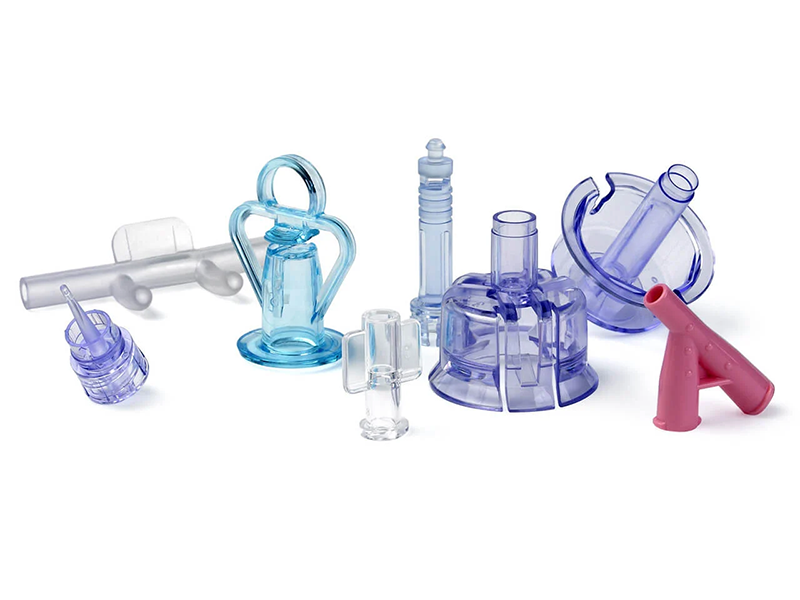
Choosing between 3D printing and injection molding ultimately depends on your project stage, production volume, and performance requirements. Rather than treating them as competing processes, the most effective approach is often to use 3D printing for rapid prototyping and injection molding for mass production.
At Alpine Mold, we provide a complete solution covering both processes. From early-stage 3D printing for design validation to full-scale injection mold manufacturing and mass production, our engineering team supports you throughout the entire product development cycle. We also offer DFM analysis, Moldflow optimization, and material selection guidance to help reduce risk and improve efficiency.
Not sure which solution is right for your project?
Send us your 3D drawings, and we’ll help you evaluate the most cost-effective approach—with professional feedback and a fast quotation.
3D printing is cheaper for low-volume production because it requires no tooling.
However, for large quantities, injection molding becomes more cost-effective due to its low unit cost.
No, 3D printing cannot fully replace injection molding.
It is ideal for prototyping and small batches, while injection molding is better suited for mass production and consistent quality.
Injection molding provides superior surface finish and is suitable for visible parts, while 3D printed parts often require post-processing.
Yes, 3D printing is faster for initial parts since it requires no tooling. Injection molding has a longer setup time but becomes faster in high-volume production cycles.
Yes, many companies use 3D printing for prototyping and testing, then transition to injection molding for mass production, combining the strengths of both processes.


