WhatsApp: +86 18126157548 Email: inquiry@alpinemold.com

Views: 0 Author: Site Editor Publish Time: 2026-07-31 Origin: Site


Choosing the right overmolding materials is essential for achieving strong adhesion, a comfortable grip, reliable sealing, good wear resistance, and stable long-term performance. Since not all soft materials can bond effectively with substrates such as ABS, PC, PP, nylon, or metal, the wrong combination may lead to peeling, deformation, or higher production costs. This guide introduces common overmold materials and substrate materials, provides an overmold material compatibility chart, and explains how to select the right material combination for different products and applications.
Table of Contents
| 1. What Are Overmolding Materials? |
| 2. Common Overmolding Materials and Their Properties |
| 3. Common Substrate Materials for Overmolding |
| 4. Overmold Material Compatibility Chart |
| 5. How to Choose the Right Overmolding Material |
| 6. Conclusion |
| 7. FAQ |
Overmolding materials are the two materials used to create a single molded component. The first material forms the main structure of the part and is called the substrate material. It is usually a rigid plastic such as ABS, PC, PP, nylon, or PBT, but it can also be metal. The second material, known as the overmold material, is molded directly onto the substrate to add functions such as a soft-touch surface, non-slip grip, impact protection, sealing, insulation, or improved appearance.
The overmold layer is commonly made from TPE, TPU, TPV, silicone, or soft PVC. In some applications, a rigid plastic may also be molded over another rigid material. The success of the final part depends on whether the two materials can bond properly and withstand the required temperature, chemicals, wear, and working conditions. Therefore, material compatibility must be confirmed before mold manufacturing begins.
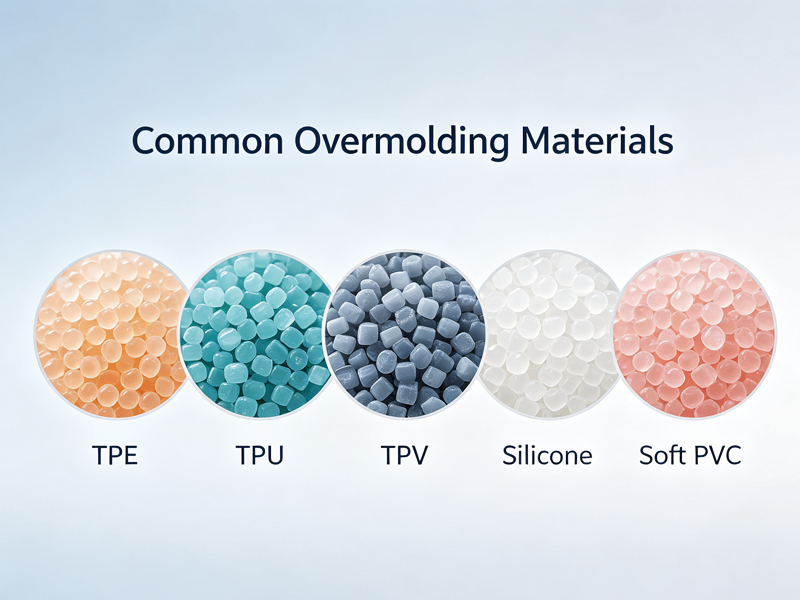
The most common overmolding materials are elastomers that add softness, grip, sealing, cushioning, or impact resistance to a rigid substrate. The correct choice depends on the required hardness, bonding performance, wear resistance, operating temperature, chemical exposure, and product application.
Thermoplastic elastomer, or TPE, is one of the most widely used materials for overmolding. It offers a soft rubber-like feel while remaining suitable for standard injection molding. TPE is commonly used for tool handles, toothbrushes, buttons, electronic housings, and other products that require a non-slip or comfortable surface. Different TPE grades are developed to bond with specific substrates such as ABS, PC, PP, or nylon, so the exact material grade must be confirmed before production.
Thermoplastic polyurethane, or TPU, provides better abrasion resistance, tear strength, and mechanical durability than many general-purpose TPE materials. It is often selected for power tools, protective housings, cables, sports products, and industrial parts. TPU is suitable for applications that require flexibility together with high wear resistance, but it normally requires careful drying and higher processing temperatures.
Thermoplastic vulcanizate, or TPV, combines the processing advantages of thermoplastics with the flexibility and weather resistance of rubber. It is commonly used for automotive seals, outdoor components, grips, and industrial products exposed to heat, moisture, or UV radiation. TPV is especially suitable for applications requiring long-term elasticity and environmental resistance.
Silicone and liquid silicone rubber, or LSR, provide excellent flexibility, temperature resistance, sealing performance, and chemical stability. They are frequently used in medical devices, food-contact products, baby products, seals, and components exposed to high or low temperatures. However, silicone overmolding usually requires specialized molds, equipment, and processing methods that differ from conventional thermoplastic overmolding.
Soft PVC is a flexible and cost-effective overmold material commonly used for cable jackets, protective covers, handles, and general consumer products. Its hardness and flexibility can be adjusted through formulation. However, environmental regulations, plasticizer migration, odor, and product safety requirements should be reviewed before selecting soft PVC.
Overmolding is not limited to soft materials over rigid plastics. In some products, one rigid thermoplastic is molded over another to add color, create transparent areas, improve structural performance, or combine different functional properties. These combinations are commonly seen in electronic housings, automotive components, and multi-material molded parts.
The substrate is the first molded material that provides the main structure, strength, and dimensional stability of the final part. Common substrate materials for overmolding include ABS, PC, PC/ABS, PP, nylon, PBT, POM, and metal. Each material has different bonding characteristics, processing temperatures, and design requirements, so the correct overmold material must be selected according to the exact substrate grade.
ABS is widely used as a substrate because it offers good dimensional stability, surface quality, impact resistance, and processability. It is commonly found in electronic housings, household products, tool handles, and consumer goods. Many specially formulated TPE and TPU grades can bond well with ABS, provided that the surface is clean and the molding temperature is properly controlled.
Polycarbonate and PC/ABS are popular substrate materials for products requiring impact strength, heat resistance, and good appearance. Typical applications include automotive interiors, electronic devices, controllers, and protective housings. Compatible TPE or TPU grades can create reliable adhesion, but excessive overmolding temperature or pressure may cause deformation, stress cracking, or surface defects.
Polypropylene is lightweight, cost-effective, and resistant to moisture and many chemicals. It is commonly used in household products, containers, tools, and automotive parts. However, PP has low surface energy, which makes bonding difficult with many standard elastomers. PP-compatible TPE or TPV grades are usually required, and mechanical locking features may be added to improve bonding strength.
PA6 and PA66 provide high strength, wear resistance, and heat resistance, making them suitable for power tools, automotive parts, industrial components, and structural housings. Glass fiber can also be added for higher rigidity. Since nylon absorbs moisture, it must be properly dried before molding. Excess moisture may reduce adhesion, affect dimensions, and create surface defects.
PBT offers good dimensional stability, electrical insulation, chemical resistance, and heat resistance. It is commonly used for connectors, switches, sensor housings, and automotive electrical components. Overmolding PBT normally requires a specially formulated TPE or TPU grade, as bonding performance can vary significantly between different material grades.
POM is known for its low friction, high wear resistance, and excellent dimensional stability. It is often used in gears, clips, moving components, and precision mechanical parts. However, its low surface energy makes chemical bonding difficult. Mechanical interlocking structures, surface treatment, or specialty overmolding grades may be required to prevent separation.
Metal substrates are commonly used in tool handles, medical instruments, threaded inserts, electrical components, and industrial parts. Unlike plastic-to-plastic overmolding, bonding to metal often relies on mechanical features such as holes, grooves, knurling, undercuts, or surface textures. Surface cleanliness and proper insert positioning are also important for stable production and reliable bonding.
Material compatibility is one of the most important factors in overmolding. Even when two materials belong to the same plastic family, their bonding performance may vary depending on the exact resin grade, additives, surface condition, processing temperature, and part design. The following overmold material compatibility chart provides a general reference for common substrate and overmold combinations.
Substrate Material | Common Overmold Materials | Typical Applications | Key Considerations |
ABS | TPE, TPU, soft PVC | Tool handles, electronic housings, household products | Keep the surface clean and select a grade designed for ABS |
PC | TPE, TPU | Protective housings, medical devices, electronics | Control melt temperature to reduce stress cracking or deformation |
PC/ABS | TPE, TPU | Automotive interiors, controllers, handheld products | Confirm compatibility with the exact PC/ABS grade |
PP | PP-bonding TPE, TPV | Household products, containers, automotive parts | Standard TPE may not bond well because PP has low surface energy |
PA6/PA66 | Nylon-bonding TPE, TPU | Power tools, industrial parts, automotive components | Dry the nylon properly before molding |
PBT | Specialty TPE, TPU | Connectors, sensors, electrical housings | Processing temperature and resin grade strongly affect adhesion |
POM | Specialty elastomer grades | Precision components, clips, wear-resistant parts | Mechanical locking or surface treatment is often required |
PMMA | Specialty TPE | Transparent covers, decorative parts | Avoid excessive temperature and stress cracking |
Metal | TPE, TPU, thermoplastics | Tool handles, inserts, medical instruments | Use holes, grooves, knurling, or undercuts for mechanical retention |
This chart should only be used as an initial guide. Final material selection should be confirmed with the material supplier, followed by mold trials and adhesion testing. For difficult combinations such as PP, POM, or metal, mechanical interlocking structures can significantly improve bonding reliability.
Choosing the right overmolding material requires more than comparing softness or price. The material must bond reliably with the substrate, meet the product’s functional requirements, and remain stable under the expected operating conditions. The following factors should be reviewed before mold manufacturing and material confirmation.
Start by identifying what the overmold layer needs to achieve. Common functions include:
Soft-touch feel
Non-slip grip
Waterproof sealing
Impact protection
Vibration reduction
Electrical insulation
Wear resistance
Chemical resistance
For example, a soft TPE may be suitable for a comfortable handle, while TPU may be a better choice for a part exposed to abrasion or repeated impact.
The overmold material must be compatible with the exact substrate grade. Two materials may appear suitable in theory but still produce weak adhesion because of additives, fillers, flame retardants, or different resin formulations. Material supplier data should be reviewed to confirm whether the selected grade is designed to bond with ABS, PC, PP, nylon, or another substrate.
Hardness affects grip, flexibility, sealing performance, and wear resistance. Softer materials usually provide better comfort and cushioning, while harder materials offer greater durability and dimensional stability.
As a general reference:
Shore A 30–50: soft and flexible
Shore A 50–70: commonly used for grips and handles
Shore A 70–90: firmer and more wear-resistant
The final hardness should be selected according to the wall thickness, product structure, and user experience requirements.
The material must withstand the actual working conditions of the product. Important factors include:
High or low temperatures
UV exposure
Water and humidity
Oil and grease
Alcohol and cleaning agents
Sweat and skin contact
Outdoor weathering
Sterilization
Food-contact requirements
Flame-retardant requirements
A material suitable for an indoor household product may not perform well in automotive, medical, or outdoor applications.
The overmold material must be processed at a temperature high enough to create proper bonding, but not so high that it damages the substrate. Excessive temperature may cause warpage, stress cracking, discoloration, or dimensional changes. The molding temperature ranges of both materials should therefore be compared before production.
Some applications require certified material grades. Depending on the product, the selected material may need to comply with:
FDA food-contact requirements
Medical-grade or biocompatibility standards
UL flame ratings
RoHS
REACH
Automotive material standards
These requirements should be confirmed before ordering material or starting mold trials.
Material performance must also be balanced with project cost. Standard TPE is often more economical than high-performance TPU or silicone, but it may not provide the same wear, chemical, or temperature resistance. For high-volume production, material price, cycle time, scrap rate, and long-term process stability can significantly affect the total manufacturing cost.
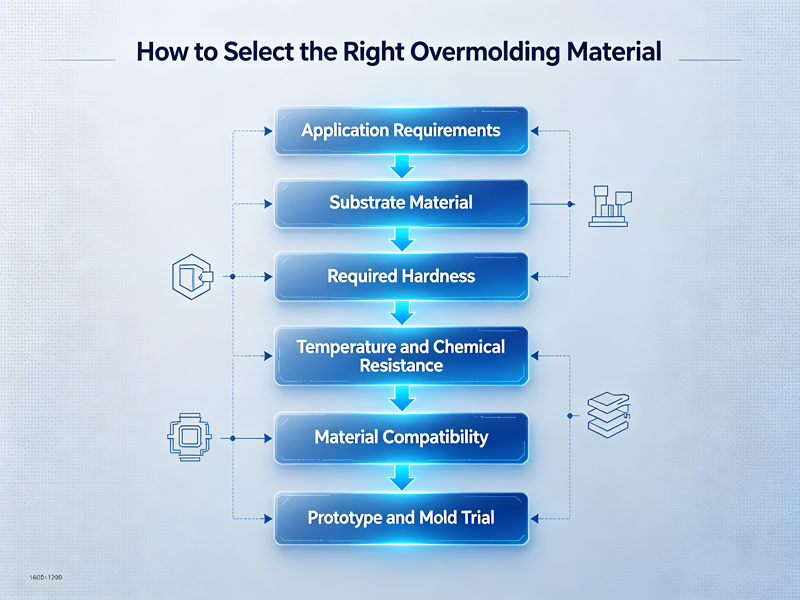
Selecting the right overmolding materials requires careful consideration of substrate compatibility, bonding performance, hardness, operating environment, processing temperature, and regulatory requirements. Even when two materials appear compatible, the exact resin grade, product structure, and molding conditions can significantly affect the final result. Confirming the material combination early can help prevent peeling, deformation, unstable production, and unnecessary tooling changes.
At Alpine Mold, we support overmolding projects from DFM analysis and material evaluation to mold manufacturing, trial molding, and mass production. Send us your 3D CAD files, material requirements, and estimated production volume, and our engineering team will review the feasibility of your project and provide a suitable molding solution.
The molding cycle for an overmolded part usually takes from several seconds to a few minutes, depending on the part size, material, wall thickness, cooling time, and molding method. For a complete project, including DFM analysis, mold design, mold manufacturing, trials, and adjustments, the lead time is commonly several weeks.
The strength of an overmolded part depends on the substrate, overmold material, bonding area, part design, and molding conditions. Materials such as TPU offer good abrasion and tear resistance, while TPE is often selected for flexibility, grip, and cushioning. Mechanical locking features can further improve bonding strength and reduce the risk of separation.
There is no universal minimum thickness for every product. In many designs, the overmold layer can be approximately 0.5–1.0 mm in localized areas, but a thickness of 1.0–2.5 mm is generally easier to fill and provides a more noticeable soft-touch effect. The final thickness depends on material flow, part geometry, and performance requirements.
Overmolded parts can last for many years when the materials are properly selected and processed. Their service life depends on temperature, UV exposure, abrasion, chemicals, moisture, repeated deformation, and bonding quality. Accelerated aging, wear, chemical-resistance, and environmental tests can be used to evaluate durability before mass production.
Overmolding usually has higher initial tooling and development costs than single-material injection molding because it requires additional mold structures, material testing, and processing steps. However, it can reduce separate assembly, adhesives, fasteners, and labor costs. For medium- and high-volume production, overmolding can provide a cost-effective way to combine multiple functions in one part.
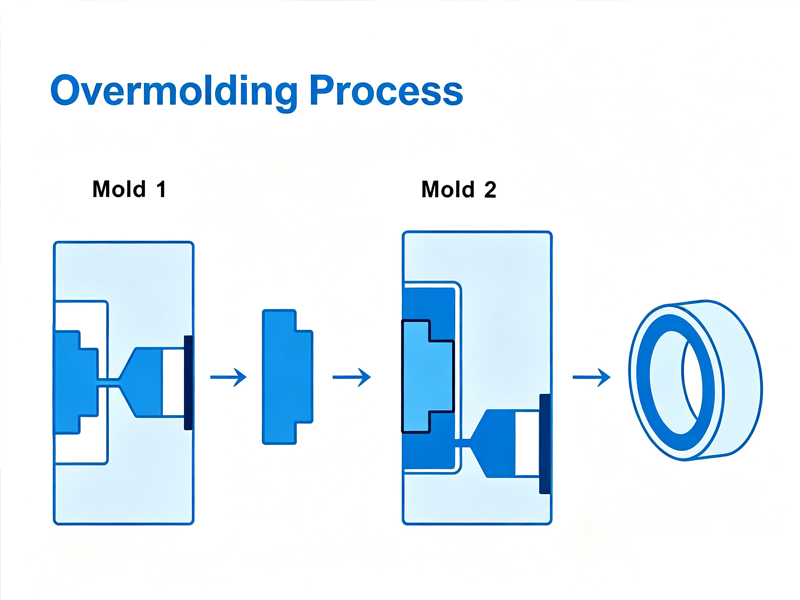
Overmolding is a manufacturing process in which a second material is molded over a previously molded plastic part or a metal insert. It can be completed through two-shot molding or by transferring the substrate into another mold. The process is commonly used to add grip, sealing, cushioning, insulation, protection, or decorative features to a product.


